The RAG Learning Curve: Beyond Buzzwords
Retrieval-Augmented Generation (RAG) promises to enhance LLM responses by grounding them in specific external data. The concept is straightforward: ingest documents, retrieve relevant snippets based on a user’s query, and then use those snippets to prompt an LLM for a more informed answer. This approach aims to mitigate LLM hallucinations and provide answers rooted in a defined knowledge base. However, the path to understanding RAG, as many developers discover, is often paved with unexpected costs.
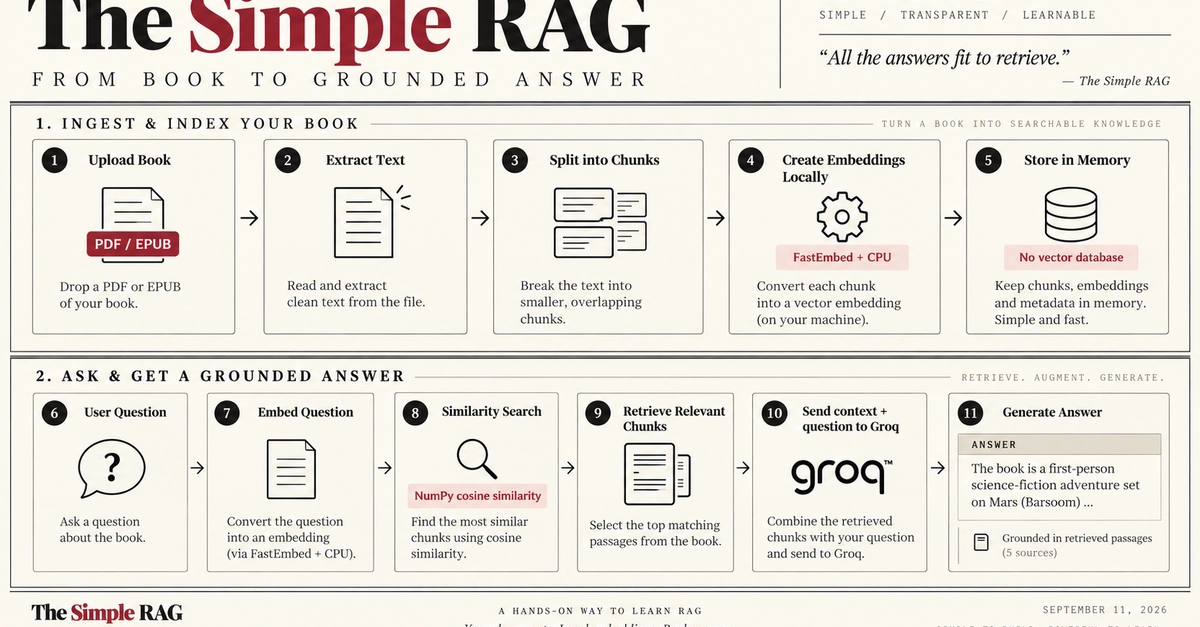
My own journey began with an effort to demystify RAG by building a project called simple_rag. The goal was to move beyond the hype and grasp the mechanics. The initial setup involved uploading a PDF, posing questions, and receiving LLM-generated answers that leveraged the document’s content. While the core functionality was achievable, a significant hurdle emerged: efficiently managing the embedding model.
The Unexpected Cost of Embeddings
Early implementations of simple_rag utilized cloud-based LLM services for both embedding and generation. Initially, this meant relying on models like Gemini, and later, exploring Mistral. Both offered functional results, but the architecture’s core became a point of friction. The primary challenge was the cost associated with generating embeddings. Embedding models, which convert text into numerical vectors for similarity searches, are computationally intensive. When these models are accessed via APIs, each embedding request incurs a fee. For a project intended for learning and experimentation, these API calls quickly became prohibitively expensive, especially when iterating or processing large documents.
The problem is that generating embeddings, even for moderately sized documents, can result in thousands of API calls. If a document has 10,000 chunks, and each chunk requires an embedding, that’s 10,000 API calls. With pricing models that charge per token or per request, this can escalate rapidly. For instance, a $5 per million tokens pricing for embeddings could easily run into tens or hundreds of dollars for a single document, making continuous development and testing financially untenable for individuals or small teams learning the ropes.
Leveraging Local CPU Power for Embeddings
The breakthrough came with a shift in perspective: what if the most expensive part of RAG—embedding generation—could be handled locally, using readily available hardware? The realization was that while large-scale LLM inference for generation might still benefit from powerful GPUs or cloud services, the embedding process itself is often amenable to CPU execution. This is particularly true for smaller, more specialized embedding models designed for efficiency.
The key was identifying and integrating a local embedding model. Projects like Sentence-Transformers provide a vast library of pre-trained embedding models that can be downloaded and run directly on a developer’s machine. These models, such as variations of BERT, RoBERTa, or specialized sentence embedding architectures, can be surprisingly effective when run on a modern CPU. While GPU acceleration is always faster, the performance gap on a CPU is often less dramatic for embedding tasks compared to large language model generation. The cost, however, drops to zero after the initial hardware investment.
The implementation involves a few steps. First, select an appropriate embedding model from libraries like Sentence-Transformers. Second, download the model weights. Third, write Python code to load the model and process document chunks, generating vectors locally. These local vectors can then be stored in a vector database (which can also be run locally or self-hosted) or even a simple in-memory index for smaller projects. The generation part of the RAG pipeline can still use an API-based LLM, but by offloading the embedding workload, the overall API expenditure is drastically reduced.
Redefining RAG Development Costs
This local-first approach to embeddings fundamentally changes the economics of learning and developing RAG applications. It democratizes the process, making it accessible to anyone with a standard laptop or desktop computer. Instead of worrying about a rapidly ticking API bill for every iteration, developers can focus on the core logic of retrieval and generation. The expensive part—turning text into vectors—becomes a one-time computation per document chunk, executed on hardware they already own.
The implications extend beyond individual learning. For startups and smaller companies entering the RAG space, this offers a viable path to build and iterate without massive upfront cloud costs. It allows for more rapid experimentation with different embedding models, chunking strategies, and retrieval algorithms. While large-scale production deployments might eventually require optimized GPU clusters or managed services for both embedding and generation, the local CPU approach provides an invaluable on-ramp.
The surprising detail here is not the existence of local embedding models, but how overlooked their cost-saving potential is in the broader RAG conversation, which often defaults to API-centric architectures. By embracing local computation for embeddings, developers can effectively sidestep the most significant financial barrier to entry.
What’s Next for Local RAG?
The success of running embeddings locally raises further questions. How do these CPU-based embeddings compare in quality and performance to their cloud-hosted counterparts on larger datasets? What are the optimal CPU configurations and batching strategies for maximizing embedding throughput on consumer hardware? Furthermore, as LLMs themselves become more efficient and capable of running locally, will the entire RAG pipeline become feasible without any external API calls?
For now, the immediate takeaway is clear: if you’re learning RAG and hitting API cost walls, look to your CPU. It’s likely capable of handling the heavy lifting of embeddings, turning an expensive experiment into an affordable learning exercise.