Qwen3.8-Flash-Next: A Sparse MoE Architecture Preview
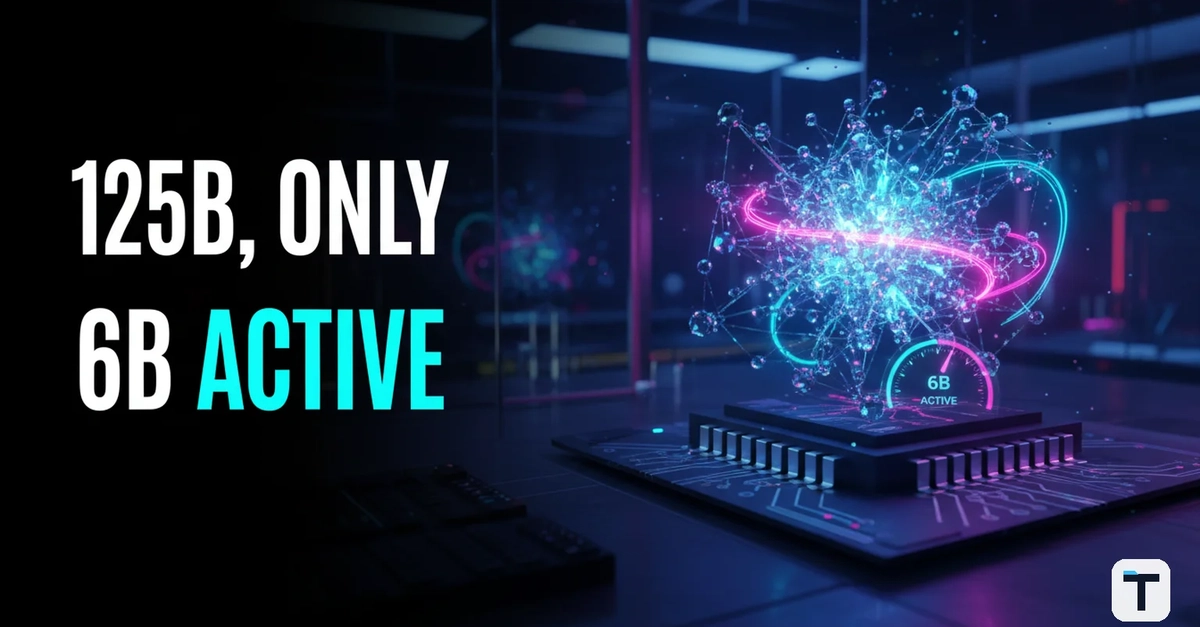
Alibaba has unveiled Qwen3.8-Flash-Next, a public preview model that offers a significant architectural shift toward sparse Mixture-of-Experts (MoE) for its upcoming Qwen4 generation. Released on August 26, 2026, this model presents a compelling alternative to traditional dense architectures, particularly for workloads involving extended contexts and agentic operations. The core innovation lies in its ultra-sparse design: a substantial 125 billion total parameters are managed, but critically, only 6 billion parameters are activated per token. This is complemented by a 51 billion parameter N-gram embedding table, further differentiating its approach to knowledge representation and retrieval.
The implications of this sparse MoE design are profound. Unlike dense models where every parameter is engaged for every computation, MoE architectures employ a routing mechanism that selects a subset of specialized expert networks to process input. This drastically reduces the computational cost per token, making it more efficient for tasks that do not require the full breadth of the model's knowledge at every step. For Qwen3.8-Flash-Next, this translates to superior performance in long-context throughput, meaning it can process and understand much larger amounts of text or data without the typical degradation seen in dense models.
Performance Benchmarks: Sparse vs. Dense
When directly compared against the dense Qwen3.8-27B model, Qwen3.8-Flash-Next demonstrates a clear advantage in specific scenarios. Its sparse nature allows for more efficient handling of long documents and complex, multi-step reasoning tasks characteristic of agentic workloads. This efficiency means faster processing and potentially lower inference costs for applications that require agents to interact with vast information landscapes, such as advanced research assistants, sophisticated customer support bots, or complex data analysis tools.
However, the dense Qwen3.8-27B model retains its own set of strengths. For users prioritizing ease of deployment and single-GPU operation, particularly on consumer-grade hardware, the dense architecture remains the more practical choice. Deploying and running a dense model like the 27B variant typically involves less complex infrastructure and fewer configuration hurdles compared to managing the routing and expert selection mechanisms inherent in MoE models. This makes it ideal for local coding assistants, simpler chatbot applications, or scenarios where computational resources are strictly limited.
Architectural Innovations Beyond Sparsity
Beyond its sparse MoE design, Qwen3.8-Flash-Next incorporates other advanced architectural elements. It features a hybrid Gated DeltaNet alongside Qwen's Sparse Attention mechanism. The Gated DeltaNet is an innovative approach to integrating new knowledge or adapting to changing data distributions without requiring a full model retraining. This is crucial for maintaining model relevance and performance in dynamic environments. The Sparse Attention, when combined with the MoE structure, further refines how the model attends to different parts of the input sequence, optimizing computational resources and improving focus on relevant information.
The inclusion of a 51B-parameter N-gram embedding table is another noteworthy aspect. Traditional language models often rely on token embeddings, which can struggle with capturing the nuances of multi-word expressions or idiomatic phrases. An N-gram embedding table, however, explicitly encodes sequences of words, providing a richer semantic representation and potentially improving the model's understanding of complex linguistic structures and factual recall. This could be particularly beneficial for tasks requiring high precision in factual accuracy or understanding of domain-specific jargon.
The Road to Qwen4
Qwen3.8-Flash-Next is not merely an incremental update; it is a strategic preview of the architectural direction Qwen4 will take. The adoption of sparse MoE, coupled with innovations in attention mechanisms and embedding strategies, signals Alibaba's commitment to pushing the boundaries of LLM efficiency and capability. The preview allows developers and researchers to experiment with this new paradigm, providing valuable feedback that will shape the final Qwen4 release.
For developers building agentic systems or applications that thrive on processing extensive datasets, integrating Qwen3.8-Flash-Next offers a tangible benefit today. The performance gains in long-context throughput and agentic workload economics suggest a future where complex AI agents can operate more efficiently and effectively. Conversely, those focused on straightforward, resource-constrained deployments will likely find existing dense models, like the 27B variant, to be more suitable for their immediate needs. The choice between sparse and dense architectures will increasingly depend on the specific application's demands, computational budget, and desired performance characteristics.
Future Considerations and Unanswered Questions
While Qwen3.8-Flash-Next presents a compelling vision for efficient LLMs, several questions remain. The long-term maintenance and fine-tuning strategies for such large, sparse models are still being explored. How will these models adapt to new data over time without the computational overhead of retraining dense counterparts? Furthermore, the exact nature of the routing mechanisms and their potential biases or failure modes in complex, real-world scenarios warrant further investigation. The surprising detail here is not just the parameter count but how Alibaba is orchestrating active parameters to achieve efficiency. What remains to be seen is how the developer community will adapt their tooling and workflows to fully leverage the unique capabilities of these sparse MoE architectures, and whether the economic benefits will materialize as anticipated across a wider range of applications beyond the current preview's focus.