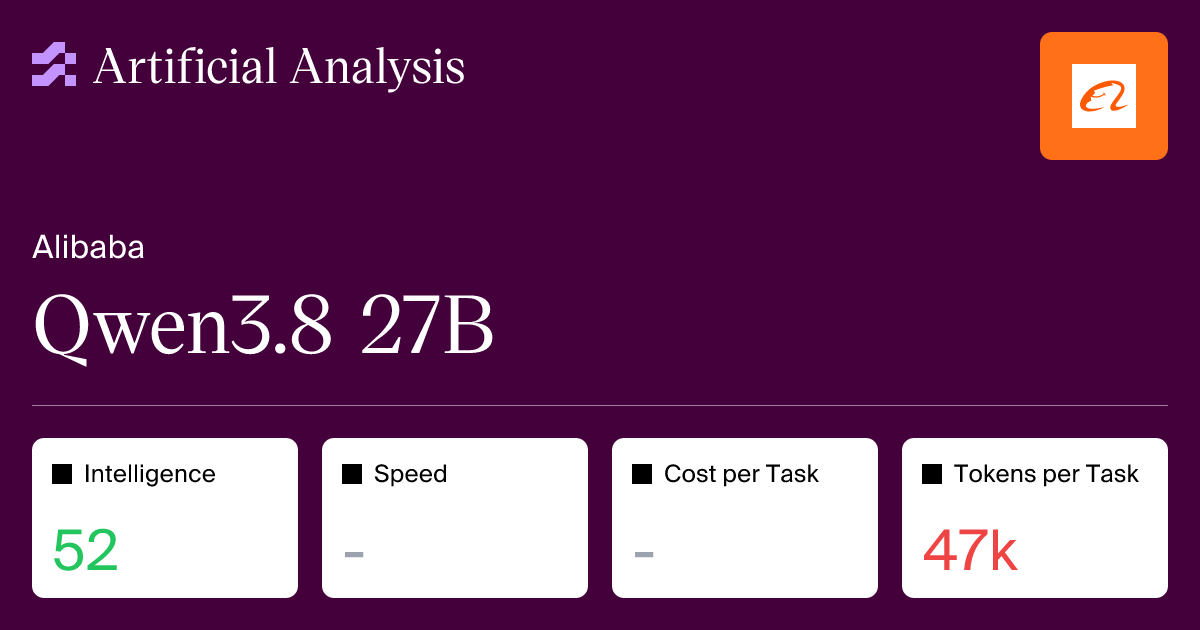
Qwen3.8 27B Performance Overview
Qwen3.8 27B, a significant large language model developed by Alibaba, has demonstrated robust capabilities, scoring a 52 on the Artificial Analysis benchmark. This score places it among the leading models evaluated on the platform, particularly highlighting its strengths in areas requiring complex reasoning and advanced coding proficiency.
Artificial Analysis is a comprehensive benchmark suite designed to evaluate the performance of large language models across a wide spectrum of tasks. It emphasizes real-world applicability, testing models on their ability to understand context, generate coherent and relevant text, solve intricate problems, and execute code accurately. A score of 52 indicates that Qwen3.8 27B is performing at a level that can handle demanding computational and logical challenges, often surpassing general-purpose models in specialized domains.
The benchmark comprises several sub-categories, each probing different facets of a model's intelligence. While specific breakdowns for Qwen3.8 27B's performance across these individual sub-categories are not detailed in the initial report, the overall score suggests a balanced proficiency. This implies the model is not merely excelling in one narrow area but exhibits a broad competence that is crucial for a wide range of applications, from sophisticated AI assistants to complex data analysis tools.
The development of models like Qwen3.8 27B by major technology players like Alibaba underscores the intense competition and rapid advancement in the field of artificial intelligence. These models are the backbone of next-generation AI products and services, and their performance on standardized benchmarks like Artificial Analysis provides a critical yardstick for progress and comparison.
Implications of the Benchmark Score
A score of 52 on Artificial Analysis is a notable achievement. It suggests that Qwen3.8 27B can effectively tackle tasks that require deep understanding and multi-step problem-solving. This is particularly relevant for developers and researchers who rely on AI models for tasks such as:
- Complex Code Generation: Writing intricate algorithms, debugging existing code, and translating between programming languages.
- Advanced Reasoning: Solving logic puzzles, performing mathematical calculations, and drawing logical inferences from given information.
- Scientific and Technical Understanding: Comprehending and generating text related to specialized fields like physics, biology, and computer science.
- Creative Content Generation: Producing nuanced and contextually appropriate text for various applications, though this benchmark focuses more on analytical capabilities.
The Artificial Analysis benchmark is known for its rigor. It moves beyond simple metrics like perplexity or BLEU scores, which measure text fluency but not necessarily accuracy or reasoning ability. Instead, it employs a more human-like evaluation process, assessing the model's capacity to perform tasks that mirror human cognitive processes.
For the AI research community, Qwen3.8 27B's performance provides valuable data points. It helps in understanding the current state-of-the-art and identifies areas where further research and development are needed. The model's success could influence future architectural choices and training methodologies for other LLM developers.
The competitive landscape for large language models is fierce. Companies are investing heavily in developing models that not only perform well but are also efficient and deployable. Qwen3.8 27B's strong showing suggests that Alibaba is a key player in this arena, capable of producing models that compete at the highest levels.
The specific architecture and training data used for Qwen3.8 27B are proprietary, but its performance indicates a sophisticated approach to model design. It is likely trained on a massive and diverse dataset, incorporating techniques that enhance its reasoning and coding abilities. The 27 billion parameter count suggests a balance between model size, computational cost, and performance, making it potentially more accessible for deployment than models with hundreds of billions or trillions of parameters.
What remains to be seen is how Qwen3.8 27B's performance translates to specific applications and industries. While benchmark scores are crucial indicators, real-world deployment often reveals nuances and challenges not captured by standardized tests. The ability to fine-tune the model for specific tasks, its inference speed, and its cost-effectiveness will all play a role in its adoption.
The Artificial Analysis benchmark serves as a critical tool for measuring progress in AI. Qwen3.8 27B's score of 52 is a testament to its advanced capabilities and positions it as a strong contender in the rapidly evolving LLM market.