Qwen2.5 7B vs. Qwen3 4B: Performance Parity, Speed Difference
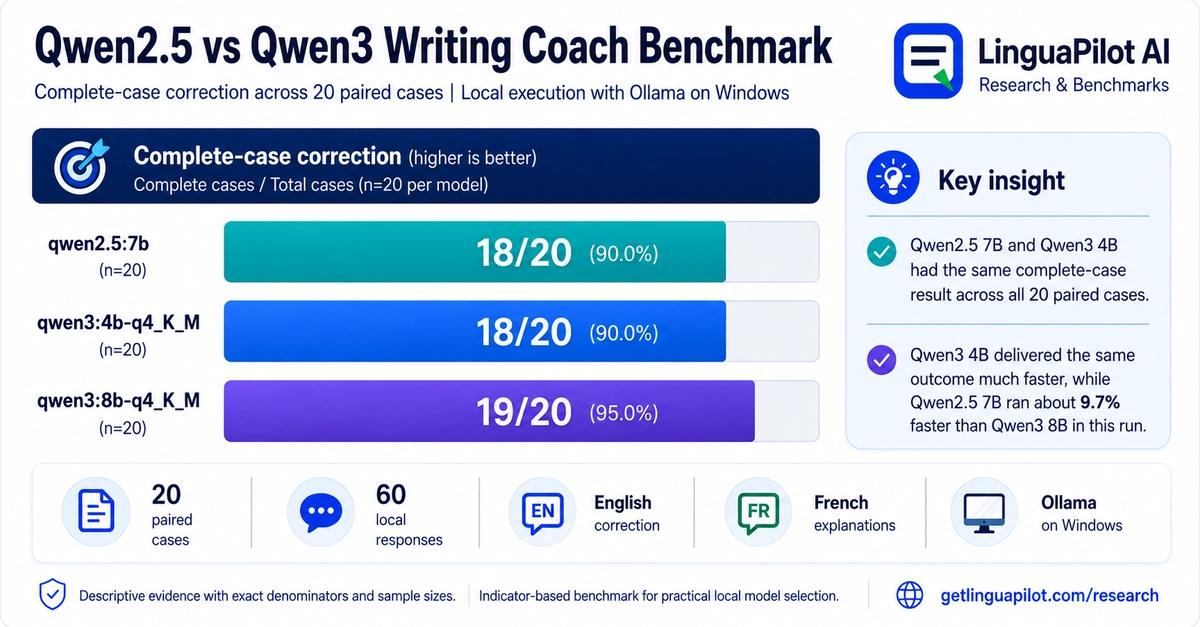
The prevailing expectation was that Qwen2.5 7B would demonstrably outperform the smaller Qwen3 4B model in writing correction tasks. However, an experiment involving 60 local Ollama responses on Windows revealed a surprising outcome: the two models performed identically on the tested cases. Across 20 paired writing scenarios, both Qwen2.5 7B and Qwen3 4B succeeded on 18 cases and failed on the same 2.
This parity in correction accuracy shifts the focus to execution speed. In a cold-start setup, Qwen3 4B averaged a brisk 23.99 seconds per task. In stark contrast, Qwen2.5 7B required an average of 54.37 seconds to complete the same tasks. This substantial difference in local execution time suggests that the newer generation's smaller model offers a compelling efficiency advantage.
The core question arising from this observation is practical: can a smaller model from a newer generation replicate the real-world writing correction capabilities of a larger model from the previous generation? The initial findings suggest a strong 'yes'. This benchmark is a follow-up to earlier comparisons of Qwen3 4B, 8B, and 14B models.
Qwen3 8B Performance
While the primary comparison focused on Qwen2.5 7B and Qwen3 4B, the performance of Qwen3 8B also provides valuable context. The Qwen3 8B model achieved an accuracy rate of 19 out of 20 cases, with 18 successes and 1 failure. This is a marginal improvement over the 4B and 7B models, which both had 18 successes and 2 failures. However, the execution time for Qwen3 8B was significantly longer than the Qwen3 4B, averaging 48.42 seconds. This indicates a trade-off between the marginal accuracy gain and a substantial increase in processing time when moving from the 4B to the 8B version of Qwen3.
Methodology and Setup
The experiment was conducted locally on a Windows machine using Ollama for model deployment. The test suite comprised 20 distinct writing cases, each presented to the models in a paired format. This ensured that each model was evaluated on the identical set of prompts and correction tasks. The 'cold-start' setup implies that each response was generated after a period of inactivity, simulating a typical user interaction where the model is loaded fresh for each query. This methodology is crucial for accurately measuring the raw inference speed without the influence of caching or pre-loaded states.
The evaluation metric focused on the complete-case outcome, meaning whether the model successfully corrected the writing error as intended. Failures were logged when the correction was inaccurate, incomplete, or introduced new errors. Execution time was measured from the moment the prompt was sent to Ollama until the response was fully received.
Implications for Local LLM Users
For users running large language models locally, particularly on Windows via Ollama, these findings have direct implications. The data suggests that for writing correction tasks, one does not necessarily need the largest or most recent model to achieve optimal results. Qwen3 4B, a smaller and presumably more efficient model from the Qwen3 series, delivers performance on par with the larger Qwen2.5 7B. Crucially, it does so in less than half the time.
This efficiency gain is significant for users with limited hardware resources or those who prioritize speed in their workflows. The ability to achieve comparable accuracy with a faster model means more interactions can be processed in a given time, or that less powerful hardware can be utilized effectively. The Qwen3 8B model, while offering a slight edge in accuracy, comes with a considerable performance penalty, making the 4B version a more practical choice for speed-sensitive applications.
The experiment highlights the rapid advancements in LLM development, where newer architectures and optimizations can allow smaller models to compete with or even surpass their predecessors in specific tasks. This trend is vital for the democratization of AI, making powerful tools more accessible and performant on consumer-grade hardware.
The Unanswered Question: Broader Task Applicability
While this specific benchmark provides clear insights into writing correction, a significant question remains: does this performance parity and efficiency advantage extend to other natural language processing tasks? If Qwen3 4B can match Qwen2.5 7B on correction, can it do the same for summarization, question answering, or creative writing? Understanding the generalizability of this finding will be key to advising users on model selection for diverse applications beyond simple text editing.