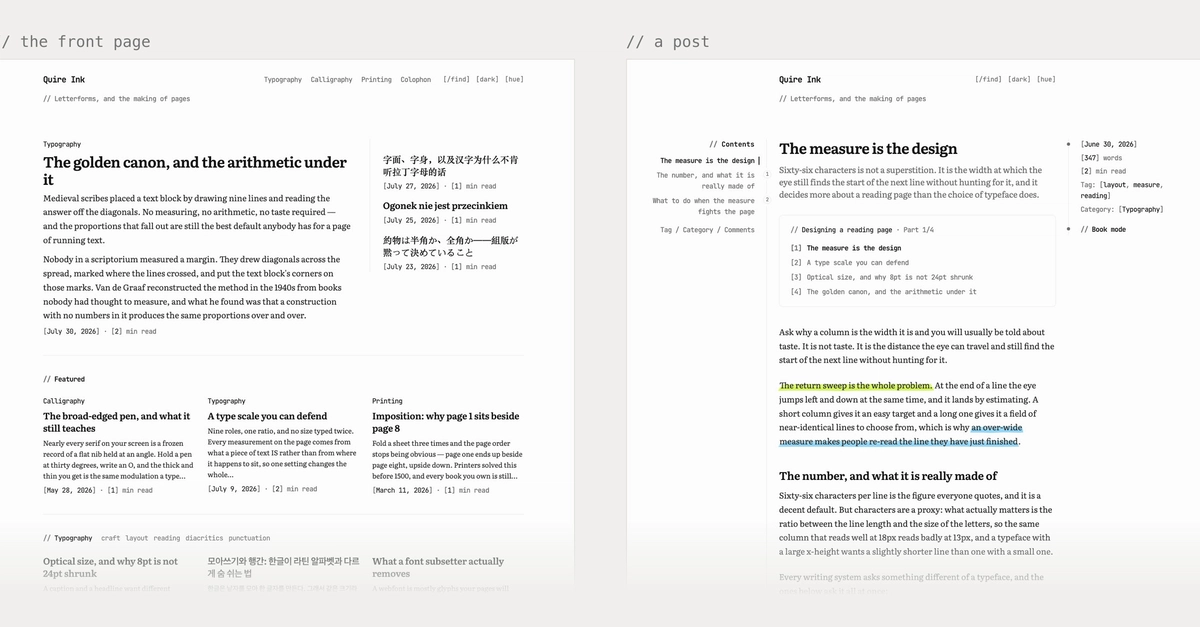
Quire Ink: The Minimalist Blog Engine
Developer Steven Joi has released Quire Ink, an open-source blog engine designed for extreme simplicity and speed. Unlike traditional platforms that rely on complex databases, build pipelines, and cloud infrastructure, Quire Ink operates with a single process and two SQLite files. The entire deployment can be managed with a single command: bun src/index.ts. This approach eliminates the need for database servers, build tooling, and any external cloud accounts, making it an attractive option for developers seeking full control and minimal overhead.
The engine's design prioritizes performance. Page loads for posts are remarkably small, around 114 KB on the first visit without caching. This includes self-hosted fonts and hand-written JavaScript that ranges from 3.6 KB to 7.8 KB. Crucially, Quire Ink achieves zero third-party requests, meaning no CDNs, no external font hosts, and no trackers. This strict limitation is enforced by the build process itself, which includes size caps for bundles, causing the build to fail if any feature exceeds the defined limit.
AI Agent for Content Management
Beyond its lean architecture, Quire Ink integrates an AI agent designed to manage blog content. This agent can reportedly write posts, summarize content, and potentially handle other editorial tasks, freeing the creator from routine content generation. The specifics of the AI integration are not fully detailed in the initial announcement, but the concept suggests a future where AI agents can autonomously maintain and update a personal blog or content platform. This moves beyond simple AI-assisted writing tools to a more integrated, operational role.
Technical Architecture: SQLite and Bun
The core of Quire Ink's architecture lies in its use of SQLite. Instead of a full-fledged relational database server like PostgreSQL or MySQL, Quire Ink leverages SQLite, a file-based database engine. This means the entire database resides within one or more flat files on the server. The engine utilizes two such files, likely one for content and another for metadata or configuration, simplifying data management and deployment. This file-based approach dramatically reduces the complexity of setup and maintenance.
The choice of Bun as the runtime environment is also significant. Bun is a modern, all-in-one JavaScript toolkit that includes a bundler, transpiler, task runner, and package manager, all designed for speed. By using Bun, Quire Ink benefits from fast execution and efficient bundling, contributing to its overall performance claims. The single-process nature means the entire application, including the web server, the AI agent, and the database interaction, runs within a single Bun process.
Self-Hosting and Control
Quire Ink champions the self-hosting paradigm. By moving away from managed platforms and cloud services, users gain complete control over their data, infrastructure, and application. This is particularly appealing for developers and content creators who are wary of vendor lock-in, platform policy changes, or data privacy concerns associated with larger services. The engine's minimal dependencies and straightforward deployment make it accessible even to those with limited server administration experience. The instruction to point Nginx at the port underscores the ease of integration with standard web server setups.
Implications for Content Creators and Developers
For developers, Quire Ink offers a blueprint for building highly performant, minimalist web applications. The combination of Bun, SQLite, and a strict build process demonstrates an effective strategy for optimizing for speed and reducing operational complexity. The integration of an AI agent for content management points towards future workflows where AI plays a more active role in content creation and maintenance, not just as an editing assistant but as a functional component of a publishing system.
For content creators, Quire Ink represents a return to direct ownership and control. It provides a fast, private, and customizable blogging experience without the bloat of many modern web applications. The ability to host it on a simple rented server and manage it with a single command lowers the barrier to entry for sophisticated self-hosting. The stringent performance targets also ensure a good user experience, even on slower connections or less powerful devices, by minimizing asset sizes and eliminating external dependencies.
The surprising detail here is not just the technical elegance of using two SQLite files and a single process, but the explicit integration of an AI agent that can actively run the blog. This suggests a shift from AI as a tool for writers to AI as a co-pilot or even an autonomous operator of content platforms. What remains to be seen is how robust this AI agent is and the breadth of its capabilities beyond basic content generation.