
Local AI Evaluation for Developers
Evaluating AI models, particularly in the context of development and coding agents, has historically been a complex, fragmented process. Developers often find themselves juggling disparate scripts, notebooks, and logs to manage datasets, model APIs, scoring logic, and result storage. This makes reproducing evaluations and diagnosing issues a significant challenge. The core question – 'did the system improve?' – becomes difficult to answer definitively when the entire evaluation pipeline is not standardized and easily auditable.
Quantiles emerges as a solution to this problem. It's an open-source AI evaluation platform designed to streamline this workflow. Licensed under Apache 2.0, Quantiles allows developers and coding agents to run, analyze, and compare AI evaluations directly on their local machines. This approach eliminates the need for complex cloud setups and offers greater control and transparency over the evaluation process.
The platform aims to consolidate the various components of an AI evaluation into a cohesive, reproducible system. By providing a Command Line Interface (CLI), Quantiles simplifies the execution of these evaluations. Developers can point it to their models, datasets, and scoring functions, and the tool handles the orchestration. The goal is to make the process of determining model performance gains or regressions straightforward and efficient.
Simplifying the Evaluation Pipeline
The typical AI evaluation involves several key stages. First, a dataset must be prepared or selected. This dataset could be a collection of prompts and expected outputs, or more complex structures for coding agents. Second, one or more AI models need to be configured. This involves setting up API connections or local model endpoints, along with any necessary parameters like temperature or system prompts.
Next comes the scoring mechanism. How do you objectively measure the quality of an AI's output? This could range from simple string matching to sophisticated semantic similarity scores, or even human evaluation. Finally, the results from running the model against the dataset using the scorer need to be stored and analyzed. Crucially, for effective development, the ability to compare the results of different runs – perhaps with a modified prompt, a new model version, or a different dataset – is essential.
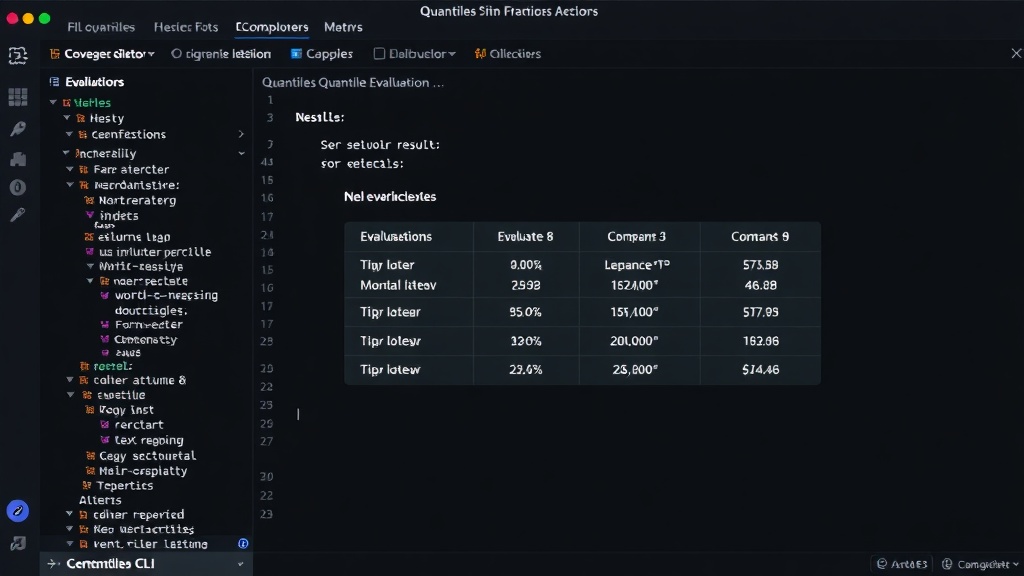
Quantiles addresses these stages by providing a unified interface. Developers can use the CLI to define their evaluation runs. For example, the platform can be configured to use the SimpleQA Verified benchmark, a common test suite for question-answering systems. By following specific commands, users can execute these evaluations locally. The results are then stored in a structured format, making them easy to inspect and compare.
Local Control and Transparency with Quantiles
A significant advantage of Quantiles is its local execution model. This contrasts with cloud-based AI development tools that often require API keys, involve subscription fees, and necessitate uploading source code to external servers. For developers concerned about data privacy, intellectual property, or simply the cost of cloud services, a local solution is highly desirable.
Quantiles, being open-source and run locally, offers a high degree of control. Your prompts, datasets, and evaluation logic remain on your machine. This also means that when you run an evaluation, you know exactly what is being tested and how. If a score changes, you can be confident that the change is due to the model or configuration you intended to test, rather than an external factor in a cloud service.
The platform’s design emphasizes reproducibility. By defining evaluations through configuration files or CLI arguments, developers can easily re-run the exact same tests at any time. This is critical for tracking progress, debugging regressions, and ensuring that model updates lead to genuine improvements.
Comparing Models and Configurations
Beyond simply running an evaluation, the ability to compare results is paramount. Quantiles allows users to compare different evaluation runs side-by-side. This could mean comparing two different versions of a language model, testing the impact of a prompt change, or assessing the performance difference on various subsets of a dataset.
The CLI provides commands to facilitate these comparisons. Users can analyze metrics, view specific examples where performance differed, and understand the characteristics of successful or unsuccessful generations. This comparative analysis is what drives iterative improvement in AI development. Without it, developers are essentially working in the dark, unable to confidently identify what works and what doesn't.
For coding agents specifically, this evaluation capability is even more critical. Agents often perform multi-step tasks involving shell commands, web searches, and code generation. Evaluating their reliability, safety, and efficiency requires a robust framework that can track success across these diverse actions. Quantiles provides the foundation for such rigorous testing.
FLASH CLI: An Alternative for Local AI Agents
While Quantiles focuses on the evaluation aspect, other tools are emerging to support local AI development more broadly. FLASH CLI (Fast Local Agent SHell) is one such tool. It positions itself as a free, local AI agent that runs entirely on the user's machine, connecting to local or self-hosted Ollama models.
FLASH CLI’s core differentiator is its commitment to local execution. This means no API keys, no subscriptions, and crucially, no uploading of source code to third-party servers. Your prompts and data stay private. This privacy-first approach is a significant draw for developers and organizations handling sensitive information.
Unlike traditional chatbots, FLASH CLI is designed to be truly agentic. It doesn't just engage in conversation; it can execute shell commands, inspect system states, perform web searches, and articulate its reasoning process. This makes it a powerful assistant for developers who need help with tasks directly within their terminal environment.
The freedom to choose models is another key feature. FLASH CLI can connect to various Ollama-compatible models, including popular ones like Llama 3.1, Qwen 2.5, and Mistral. This flexibility allows users to experiment with different models to find the best fit for their specific needs without being locked into a single vendor’s ecosystem.
Synergy and Future Directions
While Quantiles and FLASH CLI address different, albeit related, aspects of local AI development, they represent a growing trend towards more accessible, transparent, and developer-centric AI tooling. Quantiles provides the rigorous testing infrastructure, while tools like FLASH CLI offer the local AI execution environment.
One can envision a future where these tools integrate. A developer might use FLASH CLI to quickly prototype an AI agent's capabilities, and then use Quantiles to systematically evaluate its performance against a defined benchmark. This combination allows for rapid iteration and robust validation, all within a developer's control.
The open-source nature of both Quantiles and the underlying Ollama models is crucial. It fosters community contribution, allows for deep customization, and prevents vendor lock-in. As AI development continues to mature, the demand for such tools that empower developers with local control and transparent evaluation will only increase.
The question remains: how will the broader AI ecosystem adapt to the proliferation of powerful, locally-run agents and evaluation frameworks? Will cloud providers offer competitive local solutions, or will the trend toward decentralized, on-premise AI accelerate, fundamentally changing how AI products are built and deployed?