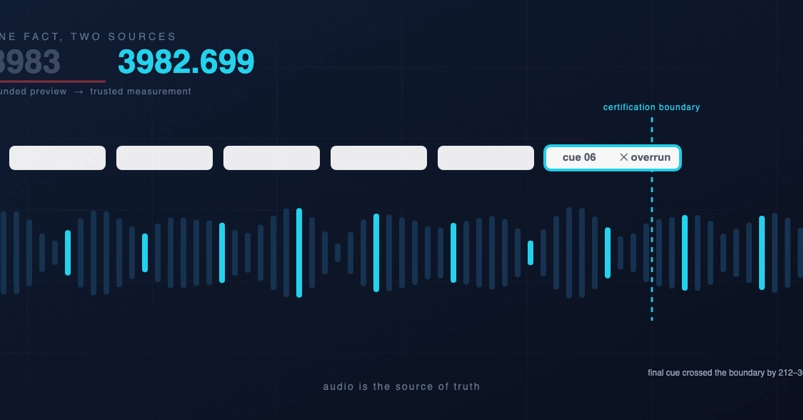
The 0.3-Second Failure Loop
A seemingly minuscule 0.3-second discrepancy between two sources of truth within a system led to the repeated failure of a first paying customer. The issue, a rounding error in how project duration was stored and measured, caused a cascade of failures that went undetected until manual investigation. This incident underscores a critical point: quality assurance cannot be a mere final check; it must be integrated throughout the development and operational lifecycle.
The browser preview of a project stored its duration rounded to the nearest whole second, a value of 3983s. However, the backend worker processing the audio data measured the actual media duration with higher precision, ranging from 3982.699s to 3982.788s. This slight difference, less than a second, became the fulcrum upon which the customer's experience pivoted.
The subsequent processes – cue generation and delivery certification – operated on conflicting data. Cue generation relied on the rounded, less precise figure from the browser preview. In contrast, delivery certification used the accurate, trusted measurement from the audio worker. Because the rounded number exceeded the certified boundary by a deterministic margin of 212–301ms, any candidate generated based on the rounded duration was guaranteed to fail the certification. This created a closed loop of failure: the system repeatedly rejected the output because of a foundational data inconsistency.

A Cycle of Identical Failures
The consequence for the customer was not a single failure, but a repeating cycle of identical issues. They ended up with four completed projects, yet critically, three distinct audio files, each failing at the same quality gate. The system provided no explanation, no error message that pointed to the root cause, and no clear path forward. The customer was left with unusable assets and no clear understanding of why.
What makes this scenario particularly concerning is that the failure was entirely silent from the system's perspective. No alerts were triggered, and no complaints were lodged by the customer directly. The problem was only uncovered because the developer, the author of the system, was actively investigating. This highlights a dangerous gap: the absence of proactive error detection and reporting for critical customer-facing processes.
The quality gate itself, in this instance, performed precisely as designed. Its purpose was to reject any output that did not meet the defined certification standards. It successfully identified the unsafe results and prevented them from reaching the customer. However, its design flaw lay in its reactive nature and its reliance on potentially inconsistent upstream data. The gate acted as a final arbiter, but it lacked the intelligence to diagnose the source of the inconsistency it was enforcing.
Quality: Beyond the Final Check
This experience forces a re-evaluation of how quality is implemented in software systems, especially those dealing with precise measurements and customer-facing outputs. Quality assurance is often conceptualized as a final hurdle – a series of tests run just before deployment or delivery. This incident proves that quality must be a continuous thread woven into the fabric of development and operation.
The core of the problem was a lack of data integrity and synchronization. The browser's UI layer and the backend processing layer operated under different assumptions about data precision. This isn't a failure of the testing framework itself, but a failure of system design to ensure consistency across different components. The quality gate was enforcing a rule based on incomplete or inaccurate information, a common pitfall when data pipelines are not robustly designed.
Consider this scenario: a chef meticulously seasons a dish, but the measuring spoon used for salt is slightly warped. The chef follows the recipe precisely, tasting and adjusting until it matches the expected flavor profile based on the warped spoon. The final dish might be perfectly seasoned *for that spoon*, but it will be off for anyone using a standard spoon. The quality check (tasting) happened, but it was based on faulty input. The problem wasn't the chef's skill, but the tool's inaccuracy and the lack of cross-verification with a standard measure.
For developers and product managers, this means several things:
- Data Consistency Across Services: Ensure that all components of your system agree on the fundamental data points, especially those that drive critical processes. Implement robust validation and reconciliation mechanisms between different services or layers.
- Precision Management: Be acutely aware of the precision requirements for different parts of your system. Rounding should be a deliberate, documented decision, not an accidental byproduct of data transfer.
- Proactive Monitoring and Alerting: Implement monitoring that doesn't just check if a process completed, but if it completed *correctly* and without data inconsistencies. Alerts should be triggered by deviations in data, not just outright process failures.
- Integrated Quality: Shift quality assurance from a final gate to an integrated practice. This includes unit tests, integration tests, end-to-end tests, but also continuous data validation and anomaly detection in production.
The Unanswered Question: Scalability of Silent Failures
While this incident involved a single paying customer and a specific technical flaw, it raises a broader, unanswered question: how many other such silent, deterministic failures are occurring in systems where data inconsistencies are not as easily traced or where the impact is less immediately obvious? The fact that the system produced four identical failures without any internal flags suggests a potential for widespread issues that could go unnoticed until they reach a critical mass, impacting multiple customers or leading to significant data corruption.
The quality gate did its job by preventing a bad output from reaching the customer. But the real failure was in the system's design, which allowed such a discrepancy to exist and go undetected. It’s a stark reminder that robust quality is not about building perfect final checks, but about building a system where inconsistencies are identified and rectified long before they trigger a gate, or worse, escape it entirely.