
The PyTorch Ecosystem: A Unified Map
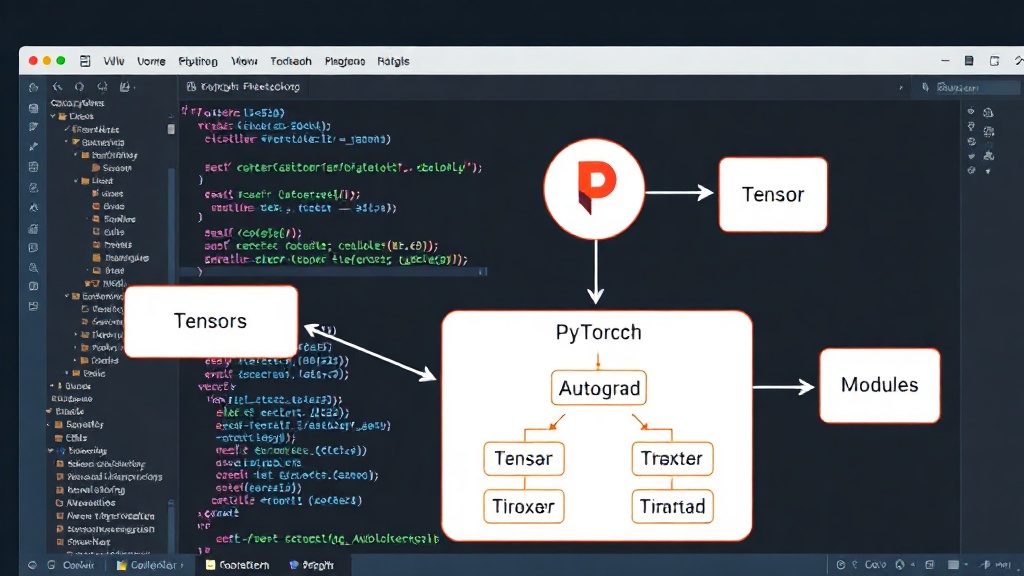
Navigating the vast landscape of a deep learning framework like PyTorch can feel daunting. From fundamental tensor operations to advanced distributed training strategies, understanding how each component fits together is crucial for efficient development and research. This article presents a unified map of the PyTorch ecosystem, designed to provide a clear, high-level overview of its architecture and key modules. This isn't just a list of features; it's an attempt to visualize the interconnectedness of PyTorch's components, akin to a city map where each district represents a core functionality and the roads show how data and control flow between them.
At its core, PyTorch is built upon a foundation of Tensors. These are multidimensional arrays, analogous to NumPy arrays but with the critical addition of GPU acceleration. This tensor layer is the bedrock upon which all other PyTorch functionalities are built. Operations on these tensors, whether mathematical, logical, or indexing, are efficiently handled by the underlying C++ backend, leveraging highly optimized libraries like cuDNN for NVIDIA GPUs and MKL for Intel CPUs.
Building on tensors, PyTorch introduces the concept of Autograd. This is PyTorch's automatic differentiation engine, responsible for computing gradients needed for training neural networks. Autograd tracks operations performed on tensors and builds a dynamic computation graph. When `backward()` is called on a tensor (typically the loss), it traverses this graph to compute gradients with respect to model parameters. This dynamic graph is a key differentiator, allowing for more flexible model architectures compared to static graph systems.
Neural Network Building Blocks: nn.Module
The torch.nn module is where most developers spend their time when building neural networks. It provides a rich set of pre-built layers (like Linear, Conv2d, ReLU) and loss functions (like CrossEntropyLoss). The central abstraction here is nn.Module, a base class for all neural network modules. A custom network is typically created by subclassing nn.Module, defining its layers in the constructor (`__init__`), and specifying the forward pass logic in the `forward` method.
This module system is designed for composability. You can nest modules within other modules, creating complex architectures from simpler building blocks. Each nn.Module automatically handles parameter registration, moving parameters to the correct device (CPU/GPU), and provides methods for saving and loading model states. This abstraction significantly simplifies the process of defining and managing model parameters.
Data Handling and Preprocessing: torch.utils.data
Efficiently feeding data into a neural network is as critical as the network architecture itself. The torch.utils.data module offers utilities for data loading and preprocessing. Key components include:
Dataset: An abstract class representing a dataset. You typically subclass this, implementing `__len__` to return the dataset size and `__getitem__` to fetch a single data sample.DataLoader: This class wraps aDatasetand provides an iterable over the data. It handles batching, shuffling, and parallel data loading (using multiple worker processes) to keep the GPU busy.
This separation of concerns allows for flexible data pipelines. You can implement custom data transformations, augmentations, and sampling strategies without altering the core model or training loop. The DataLoader is particularly powerful, enabling asynchronous data fetching that prevents bottlenecks during training.
Optimization and Training Loops
Once you have your model defined and your data loaded, you need optimizers to update model weights and a training loop to manage the process. PyTorch's torch.optim module provides various optimization algorithms, including popular ones like Adam, SGD, and RMSprop. These optimizers take the model's parameters and update them based on the gradients computed by Autograd.
The training loop itself is typically implemented manually. It involves iterating over the DataLoader, performing a forward pass, calculating the loss, performing a backward pass to get gradients, and then calling `optimizer.step()` to update weights. This manual control is a hallmark of PyTorch, offering maximum flexibility. However, higher-level libraries like PyTorch Lightning or fastai abstract this loop for faster development.
Advanced PyTorch Features
Beyond the core components, PyTorch offers advanced capabilities for scaling and deployment:
- Distributed Training: For training models on multiple GPUs or multiple machines, PyTorch provides
torch.distributed. This module supports various backends (like NCCL, Gloo) and communication strategies (e.g., All-reduce) to synchronize gradients and model states across workers. DataParallel and DistributedDataParallel are high-level wrappers that simplify distributed training setup. - TorchScript: To bridge the gap between research and production, PyTorch offers TorchScript. It's a way to serialize and optimize PyTorch models into a statically typed graph representation that can be run independently of Python, in environments like C++ or on mobile devices. This is crucial for deployment scenarios where Python's overhead is undesirable.
- TorchServe: A flexible and easy-to-use tool for serving PyTorch models in production. It handles model versioning, batching, and scaling, making it straightforward to deploy trained models.
Understanding this entire map—from the fundamental tensor operations and automatic differentiation to the modular network definition, data loading utilities, optimization algorithms, and advanced distributed training and deployment tools—provides a holistic view of the PyTorch ecosystem. Each component is designed to be flexible and composable, empowering developers to build, train, and deploy complex deep learning models efficiently.