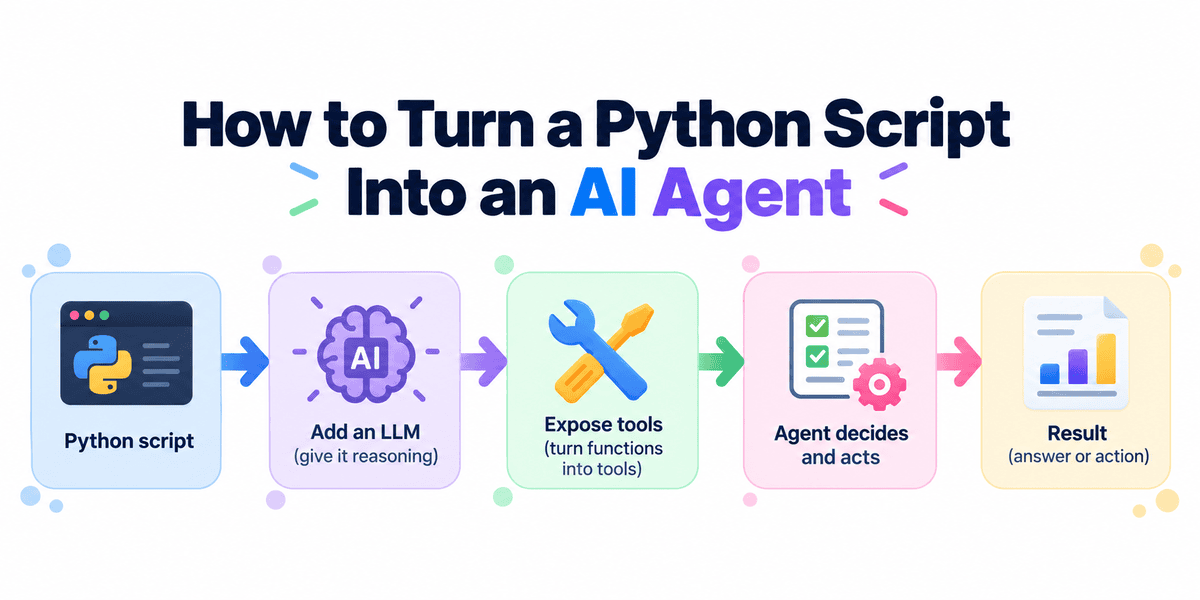
From Static Script to Dynamic Agent
Python scripts have long been the workhorses of automation, handling everything from data processing to system administration. However, their capabilities are typically confined to predefined logic. Now, with the advent of OpenAI's Agents SDK, these scripts can transcend their static nature and become intelligent agents capable of multi-step reasoning and tool utilization. This evolution allows developers to imbue their existing Python code with AI-driven decision-making, enabling them to tackle more complex, dynamic workflows.
The core idea behind transforming a Python script into an AI agent is to provide it with an 'understanding' of its environment and the ability to interact with it intelligently. This is achieved by integrating large language models (LLMs) with specific tools, allowing the LLM to decide which tool to use, when to use it, and how to interpret its output. The OpenAI Agents SDK simplifies this process, offering a structured way to connect LLMs with functions and external APIs.
Leveraging Tool Calling for Enhanced Functionality
At the heart of an AI agent's ability to perform complex tasks is its access to 'tools.' In the context of the OpenAI Agents SDK, these tools are essentially functions or APIs that the agent can call upon. This is akin to giving a brilliant but disembodied intellect a set of hands and senses to interact with the real world. For a Python script, this means exposing its existing functionalities as callable tools.
The SDK facilitates this through a mechanism often referred to as 'tool calling' or 'function calling.' When presented with a task, the LLM, powered by the SDK, can analyze the request and determine if any of its available tools are relevant. If a tool is deemed appropriate, the LLM will generate the necessary arguments to invoke that tool. The Python environment then executes the function with these arguments, and the result is fed back to the LLM. This iterative process allows for complex problem-solving, where the LLM can chain multiple tool calls together to achieve a desired outcome.
Consider a scenario where a Python script is responsible for managing customer support tickets. Without AI capabilities, it might only be able to categorize tickets based on keywords. With the Agents SDK, you could equip it with tools to:
- Query a CRM for customer history.
- Access a knowledge base to find relevant solutions.
- Draft an email response to the customer.
- Update the ticket status in a project management tool.
The LLM could then orchestrate these tools. For instance, upon receiving a new ticket, it might first query the CRM to understand the customer's past interactions. Based on that context, it could search the knowledge base for relevant articles. Finally, it could draft a personalized response and update the ticket, all without explicit human intervention for each step.
Structuring Your Agent with the SDK
The OpenAI Agents SDK provides a framework for defining these agents. Developers typically start by defining the agent's persona, its capabilities (the tools it has access to), and its goals. The SDK then handles the orchestration between the LLM and the tools.
A common pattern involves using a primary LLM to act as the agent's 'brain.' This LLM is configured with a system message that defines its role and instructions. When a user or another system provides an input, the LLM processes it, decides on an action, and if that action requires a tool, it outputs a structured request for the tool's execution. The Python code then intercepts this request, calls the appropriate function, and returns the result to the LLM. This loop continues until the LLM determines the task is complete.
The beauty of this approach lies in its extensibility. You can start with a simple script that performs one basic automation and gradually add more sophisticated tools, transforming it into a highly capable AI agent. The SDK abstracts away much of the complexity of prompt engineering and state management, allowing developers to focus on defining the agent's core logic and the tools it needs.
Beyond Simple Automation: Multi-Step Workflows
The true power of turning a Python script into an AI agent emerges when dealing with multi-step workflows. These are tasks that cannot be accomplished with a single function call and require a sequence of actions, conditional logic, and intermediate data processing. Traditional scripts struggle with this, often requiring complex conditional statements and manual state tracking.
An AI agent, however, can manage this complexity naturally. The LLM's reasoning capabilities allow it to break down a high-level goal into a series of sub-goals, each of which can be addressed by a tool call. For example, an agent tasked with 'researching the latest trends in renewable energy and summarizing them for a marketing report' would involve several steps:
- Identify relevant search queries for news articles and research papers.
- Execute web searches using a search API tool.
- Scrape content from the returned URLs using a web scraping tool.
- Process and filter the extracted text for relevance.
- Summarize the key findings using the LLM's summarization capabilities.
- Format the summary into a report structure.
The AI agent, orchestrated by the SDK, can manage this entire sequence. It can adapt its approach based on the results of each step. If a search yields too many irrelevant results, it might refine its search queries. If a webpage is difficult to scrape, it might try an alternative method. This adaptability is what separates an AI agent from a simple script.
The Future of Scripting: Intelligent Automation
The ability to transform Python scripts into AI agents signifies a major leap in automation. It democratizes the creation of intelligent systems, allowing developers to leverage the power of LLMs without needing to be AI research experts. By providing a clear pathway to integrate existing codebases with advanced reasoning capabilities, the OpenAI Agents SDK empowers developers to build more sophisticated, autonomous, and adaptable applications. As this technology matures, we can expect to see a proliferation of AI agents that automate increasingly complex tasks across various domains, from software development to scientific research.