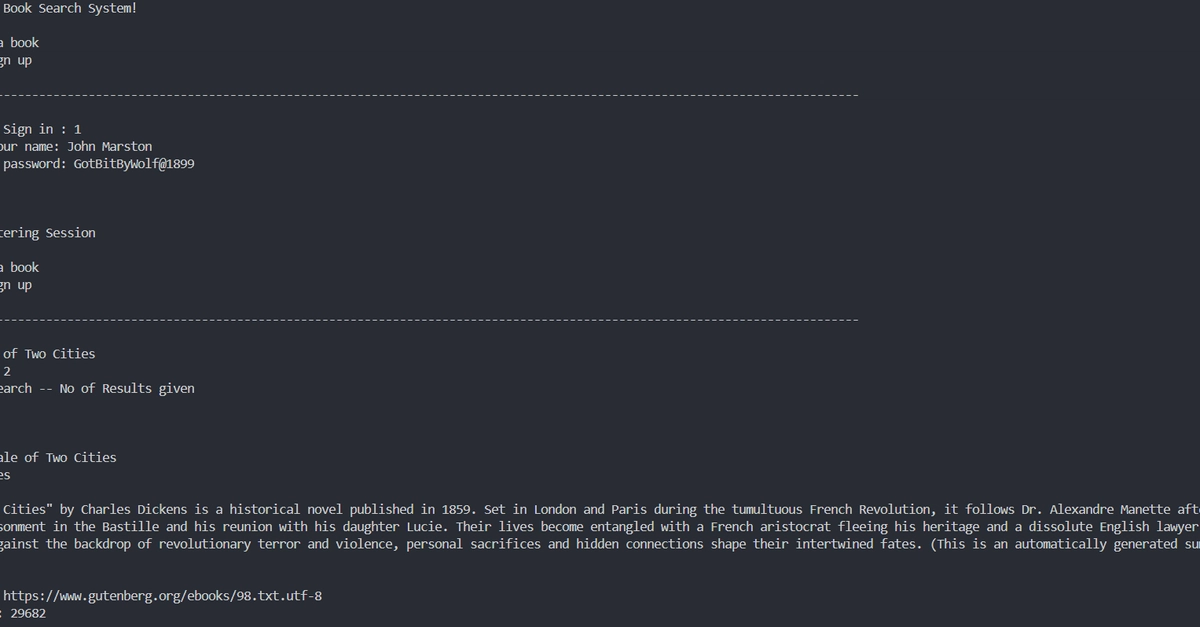
Py Book Search: A Command-Line Tool for Developers
A newly released Python project, dubbed Py Book Search, offers a practical example for developers looking to build command-line applications. Developed over two weeks with minimal AI assistance, this application leverages the Gutendex API to search for books, display relevant information, and facilitate book downloads directly from the terminal. The creator highlights the project's success in clarifying Python syntax, improving file input/output operations, and reinforcing core data structure concepts like dictionaries and lists.
The core functionality of Py Book Search revolves around interacting with the Gutendex API, a free, open-source API providing access to over 60,000 free eBooks. Developers can query the API to find books based on various criteria, though the current implementation focuses on basic search capabilities. Upon receiving search results, the application parses the JSON response from Gutendex, extracting key details such as the book title, author(s), language, and available formats.
Technical Implementation Details
The project's architecture is straightforward, prioritizing clarity and learnability for aspiring Python developers. The primary library used for making HTTP requests to the Gutendex API is the popular requests library. This choice simplifies the process of sending GET requests and handling the subsequent JSON responses. Error handling for network issues or invalid API responses is a crucial component, ensuring the application remains robust even when encountering external service disruptions.
File I/O operations are central to the book download feature. Once a user selects a book and a desired format (e.g., plain text, EPUB, PDF), the application constructs a download URL. It then fetches the file content and saves it to the local file system. This process requires careful management of file paths, writing binary data, and providing user feedback on download progress or completion. The project's documentation and examples were instrumental in guiding the developer through these file handling nuances.
Data structures, particularly Python dictionaries and lists, are extensively used. API responses, typically in JSON format, are directly converted into Python dictionaries, allowing for easy access to nested data. Lists are employed to manage collections of search results, authors, or available book formats. Understanding how to navigate and manipulate these structures efficiently is key to processing the data retrieved from the API and presenting it to the user in a digestible format.
Learning Outcomes and Future Potential
The developer emphasizes that Py Book Search served as a significant learning experience. It provided hands-on practice with fundamental Python concepts that are essential for building more complex applications. The project moved beyond simple script execution to encompass interactive command-line interfaces, external service integration, and local file management – skills highly valued in software development.
While the current version is a starter-level project, its modular design suggests avenues for expansion. Potential enhancements could include more sophisticated search filters (by genre, publication date, etc.), user account management for tracking downloaded books, integration with other book metadata APIs, or even a graphical user interface (GUI) built with libraries like Tkinter or PyQt. The project's GitHub repository serves as a public showcase of its capabilities and a reference point for others embarking on similar learning journeys.
The Gutendex API Advantage
Gutendex is a vital component of this project. It acts as a bridge to Project Gutenberg's vast collection of public domain books. Unlike proprietary APIs, Gutendex is open and accessible, making it an ideal resource for educational projects and independent developers. Its JSON-based responses are predictable and easy to parse, reducing the barrier to entry for integrating book data into applications. The API's structure allows for straightforward queries, enabling developers to quickly retrieve book metadata and download links.
The simplicity of querying Gutendex is a key reason this project is suitable for beginners. A typical request might involve a base URL followed by query parameters for searching by title, author, or subject. The API returns a structured JSON object, which the Python script then decodes. This direct mapping from API response to usable data structures is a fundamental pattern in modern web development and data processing.
Beyond Syntax: Practical Python Skills
Py Book Search moves beyond rote memorization of Python syntax. It challenges developers to think about application flow, user interaction, and external data handling. The decision to build a command-line interface (CLI) specifically forces an understanding of how programs interact with the operating system's shell, how to capture user input, and how to present output clearly. This is a different skill set than developing web applications or desktop GUIs, but it is critical for many backend services, automation scripts, and developer tools.
The project's success in reinforcing concepts like dictionaries and lists is notable. In Python, these are not just abstract data types; they are fundamental building blocks for managing collections of data. When retrieving book information, a dictionary might hold details like 'title', 'authors', and 'download_links'. A list could contain multiple authors or multiple available download formats. Manipulating these structures—accessing values by key, iterating over items, appending new elements—is a daily task for any Python developer. This project provides a concrete context for practicing these essential operations.
File I/O, often a source of subtle bugs, is another area where Py Book Search offers practical experience. Writing downloaded book content to disk requires understanding file modes (e.g., 'wb' for binary write), managing file handles, and ensuring files are closed properly to prevent data corruption or resource leaks. The project demonstrates how to handle potentially large files, a common concern in real-world applications that deal with media or large datasets.
What's Next for Py Book Search?
The current iteration of Py Book Search stands as a solid foundation. The developer's commitment to using documentation and examples over heavy AI reliance underscores a desire for genuine learning. This approach ensures a deeper understanding of the underlying technologies. For other developers inspired by this project, it serves as a clear roadmap for building their own CLI tools. The project is available on GitHub, inviting contributions and further development.