
Introduction
Python's data model is the engine that drives its dynamic behavior. At its heart is the concept of an object. Everything in Python – numbers, strings, lists, functions, classes – is an object. Understanding how Python represents, identifies, and compares these objects is fundamental to mastering the language. This knowledge isn't just academic; it's crucial for preventing subtle bugs related to aliasing, incorrect comparisons, and unexpected side effects, especially when dealing with mutable containers.
This article lays the groundwork for understanding this powerful model. We will explore what constitutes an object in Python, the critical distinction between an object's identity and its equality, the nuances of mutability, and the lifecycle of an object from creation to destruction. Finally, we'll see how these concepts interrelate when objects are stored within containers.
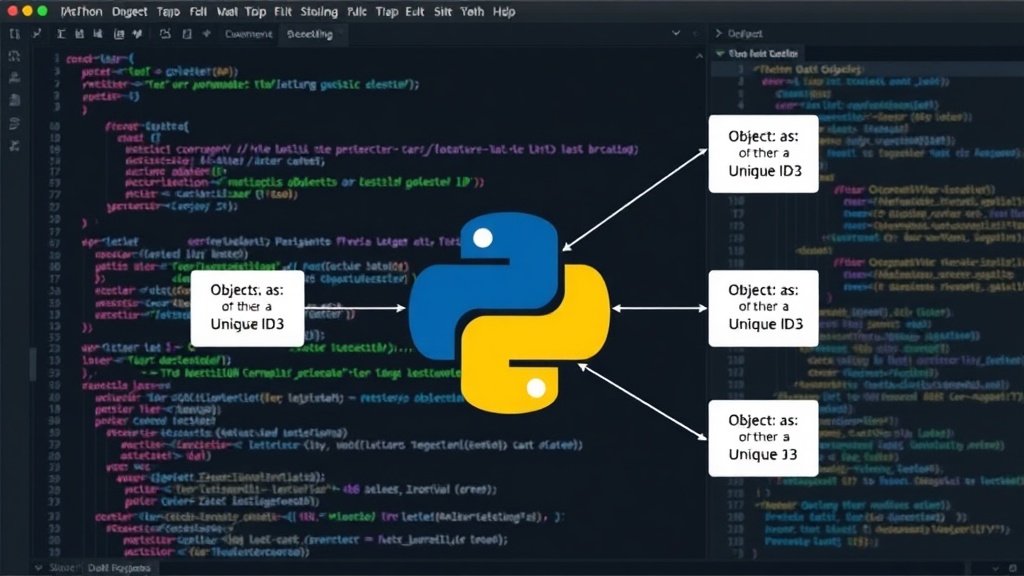
What is an Object in Python?
In Python, an object is an instance of a class. It encapsulates data (attributes) and behavior (methods). When you write x = 10, you're not just assigning a value to a variable; you're creating an integer object with the value 10 and making the name x refer to this object. Similarly, my_list = [1, 2, 3] creates a list object, and my_list becomes a name pointing to it.
Every object in Python has three key characteristics:
- Type: Defines the kind of object it is (e.g.,
int,str,list). This determines what operations can be performed on the object. - Value: The actual data the object holds. For example, the value of the integer object
10is 10. - Identity: A unique identifier for the object. This identity is guaranteed to be unique and constant for the object's lifetime. In CPython, this is typically the memory address of the object.
The identity of an object can be retrieved using the built-in id() function. The equality of objects is determined by their value, and the type is inherent to the object itself.
Identity vs. Equality
This is where many newcomers to Python stumble. Identity refers to whether two names point to the exact same object in memory. Equality refers to whether two objects have the same value, regardless of whether they are the same object.
Python's is operator checks for identity. If a is b evaluates to True, it means both names a and b refer to the identical object.
The == operator, on the other hand, checks for equality. If a == b evaluates to True, it means the objects referred to by a and b have the same value. This comparison is defined by the object's class (e.g., two lists are equal if they contain the same elements in the same order).
Consider this:
a = [1, 2, 3]
b = [1, 2, 3]
c = a

print(a == b)  # Output: True (values are the same)
print(a is b)   # Output: False (different list objects in memory)
print(a is c)   # Output: True (a and c refer to the same object)
The surprising detail here is how Python handles small integers and short strings. Due to performance optimizations (interning), multiple names might point to the same immutable object if their values are identical and within a certain range. For example, x = 5 and y = 5 might result in x is y being True. However, relying on this behavior for mutable objects or larger values is a common source of bugs.
Mutability and Immutability
Mutability refers to whether an object's state (its value) can be changed after it has been created. Python categorizes objects into two broad types:
- Mutable Objects: Objects whose state can be modified after creation. Examples include lists, dictionaries, and sets.
- Immutable Objects: Objects whose state cannot be changed after creation. Examples include integers, floats, strings, tuples, and frozensets.
When you