Transforming Web Content into Focused QA Systems
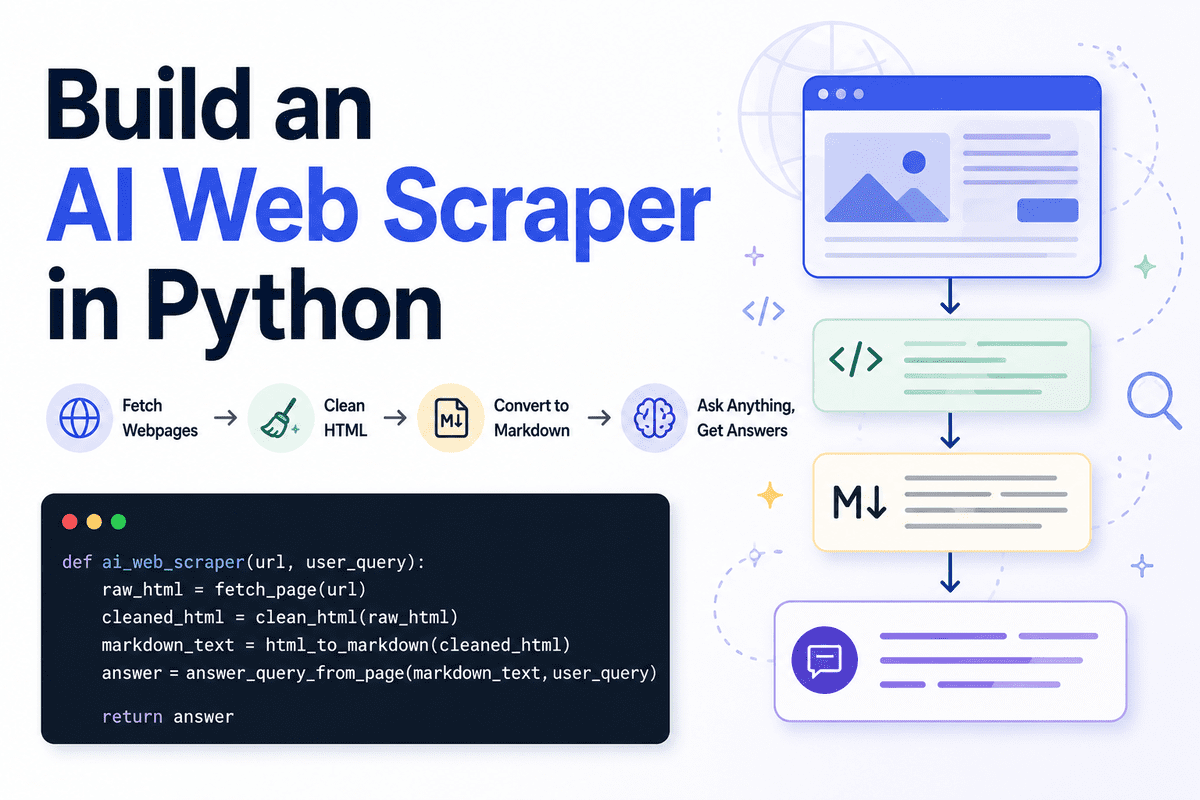
Extracting specific information from web pages often involves sifting through irrelevant content. This new approach leverages Large Language Models (LLMs) to create a lightweight Question Answering (QA) engine directly from any webpage. The process involves cleaning HTML, converting content to a usable format like Markdown, and then employing an LLM to return precise answers to user queries. This method significantly reduces token usage compared to feeding entire webpages into an LLM, making it more efficient and cost-effective.
The core challenge in building such a system lies in effectively preparing the raw HTML data. Webpages are notoriously messy, containing navigation menus, advertisements, scripts, and other elements that are not part of the core content. Simply scraping the raw HTML and passing it to an LLM would lead to noisy input, increased processing time, and higher costs due to excessive token consumption. Therefore, a robust cleaning and content extraction pipeline is essential.
HTML Cleaning and Content Extraction
The first step involves fetching the HTML content of a target webpage. Libraries like requests in Python are commonly used for this purpose. Once the HTML is retrieved, it needs to be parsed to identify and extract the main textual content. Libraries such as Beautiful Soup are invaluable here. They allow developers to navigate the HTML structure, select specific tags, and filter out unwanted elements like scripts, styles, and navigation bars.
A common strategy is to identify the primary content container, often a <div> with a specific ID or class, or by looking for semantic HTML tags like <article> or <main>. After isolating the relevant content blocks, any remaining extraneous HTML tags, attributes, and excessive whitespace must be removed. The goal is to obtain a clean string of text that represents the core information of the webpage.
Content Conversion to Markdown
While clean text is a good start, converting it to Markdown offers several advantages. Markdown is a lightweight markup language that preserves basic formatting (headings, lists, bold, italics) while being easy to read and process. This conversion makes the content more structured and semantically richer, which can aid LLMs in understanding the context and relationships between different pieces of information. Libraries like html2text can automate this conversion process effectively, transforming HTML tags into their Markdown equivalents.
For example, an HTML heading like <h2>Introduction</h2> would be converted to ## Introduction in Markdown. Similarly, lists and paragraphs are handled gracefully. This structured Markdown output can then be further processed or directly fed into an LLM for the QA task.
Leveraging LLMs for Question Answering
With the content cleaned and converted to Markdown, the next stage is to deploy an LLM to act as the QA engine. The LLM is provided with the structured content and a user's question. The prompt engineering is critical here. The prompt should instruct the LLM to act as a QA system, to answer the question based *only* on the provided text, and to be concise. It should also explicitly state the goal of minimizing token usage.
An example prompt might look like this: "You are an AI assistant that answers questions based on the provided text. Answer the following question using only the information in the text below. Be as concise as possible and avoid unnecessary details. If the answer is not found in the text, state that you cannot find the answer. Text: [Insert Markdown Content Here] Question: [User's Question Here] Answer:"
The LLM then processes this prompt and generates an answer. The key benefit is that the LLM is not processing the entire, often massive, raw HTML of the webpage. Instead, it's working with a pre-processed, semantically relevant subset of the content, drastically reducing the number of tokens required for the inference. This makes the system significantly faster and cheaper to operate, especially for applications that might involve querying many different web pages or handling a high volume of user questions.
Reducing Token Usage and Improving Efficiency
The efficiency gains are substantial. Traditional web scraping for LLM input might involve sending hundreds of thousands of tokens for a single page. By cleaning HTML and converting to Markdown, the token count can be reduced by orders of magnitude. For instance, a complex webpage might yield only a few thousand tokens of clean, relevant content in Markdown format. This reduction not only lowers API costs for LLM inference but also speeds up response times, leading to a better user experience.
This technique is particularly useful for building internal knowledge bases from company documentation, creating summarization tools for articles, or developing chatbots that can answer questions about specific websites. The ability to turn any webpage into a targeted information retrieval system without incurring massive computational costs opens up numerous possibilities for developers and businesses looking to harness the power of LLMs more effectively.
Potential Applications and Future Directions
The immediate applications are clear: developers can build custom search engines for specific websites, automate the extraction of key data points for market research, or create educational tools that simplify complex online information. For founders, this offers a way to build AI-powered features on top of existing web content without the prohibitive costs associated with processing raw, uncleaned data.
Future work could involve more sophisticated content extraction techniques, perhaps using AI to identify not just main content but also related articles or key entities within the text. Further optimization of the LLM prompting could also yield even greater efficiency or more nuanced answers. The surprising detail here is how a relatively simple pipeline of cleaning and formatting can unlock such powerful LLM applications, making advanced AI accessible for common web data tasks.