The Genesis of Pulse: Beyond Tutorial Projects
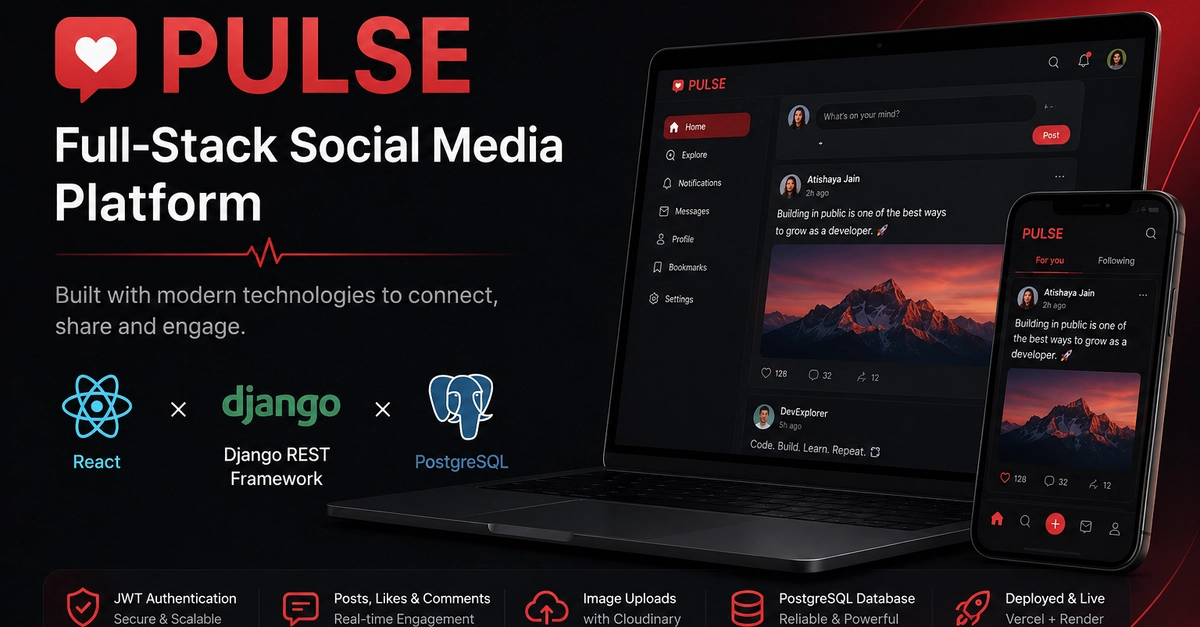
Building projects from tutorials offers a valuable starting point, but true mastery of full-stack development emerges when disparate systems are integrated into a cohesive application. This principle guided the creation of Pulse, a comprehensive social media platform developed using React for the frontend, Django REST Framework for the backend API, and PostgreSQL as the database. The ambition behind Pulse extended beyond mere frontend aesthetics; it aimed to demystify the intricate workings beneath the user interface, including robust authentication mechanisms, thoughtful API design, seamless database interactions, secure media storage, efficient token management, and the complexities of deployment.
Core Functionality: Mimicking Modern Social Platforms
Pulse was designed to encapsulate the essential features expected from contemporary social networking applications. This involved implementing a secure user registration and login system, underpinned by JSON Web Token (JWT) based authentication for stateless, efficient session management. The platform supports detailed user profiles, enabling users to express their identity and connect with others. Content creation is central, with functionality for users to craft and share posts. To enrich the user experience, features for liking and commenting on posts were integrated, fostering interaction and engagement. Furthermore, a search capability was included, allowing users to discover other profiles and content within the platform.
Technical Architecture: Bridging Frontend and Backend
The technical foundation of Pulse is a deliberate choice of technologies optimized for scalability, performance, and developer productivity. React, a popular JavaScript library, drives the frontend, offering a component-based architecture that facilitates the creation of dynamic and responsive user interfaces. Its virtual DOM implementation ensures efficient rendering and a smooth user experience, even with complex data visualizations and real-time updates. On the backend, Django REST Framework (DRF) provides a powerful and flexible toolkit for building RESTful APIs. DRF leverages Django's robust ORM and its built-in security features, simplifying the process of creating secure, production-ready APIs. It handles request parsing, response serialization, and view logic, allowing developers to focus on business logic rather than boilerplate code.
PostgreSQL serves as the relational database management system, chosen for its reliability, advanced features, and strong support for complex queries and data integrity. Its ability to handle large datasets and support concurrent transactions makes it an ideal choice for a social media platform that anticipates significant user growth and data volume. The integration of JWT for authentication addresses the need for secure, token-based communication between the React frontend and the Django backend. Upon successful login, the backend issues a JWT, which the frontend then uses to authenticate subsequent requests, eliminating the need for traditional session cookies and improving scalability.
Key Development Challenges and Solutions
Developing a platform like Pulse involves navigating several common but critical challenges. One significant area is media storage. For image uploads, integrating a cloud storage solution like Amazon S3 or a similar service is paramount. This offloads the burden of storing and serving large files from the application server, enhancing performance and scalability. Django's `django-storages` library simplifies this integration. Another challenge lies in API design. A well-structured API is crucial for maintainability and extensibility. This involves defining clear endpoints, using consistent naming conventions, and implementing proper versioning. DRF's class-based views and serializers facilitate the creation of organized and efficient API endpoints.
Managing user authentication and authorization requires careful implementation. JWT provides a stateless authentication mechanism, but ensuring token security is vital. This includes setting appropriate expiration times, using strong secret keys, and potentially implementing refresh token mechanisms to allow users to maintain sessions without frequent re-logins. Furthermore, handling real-time features like notifications or live comment updates often necessitates the integration of WebSockets, which allow for bidirectional communication between the client and server. While not explicitly detailed in the initial scope, this is a common next step for social platforms seeking to enhance user engagement.
Deployment Strategy
Deploying a full-stack application involves orchestrating multiple services. For Pulse, a typical deployment would involve running the Django backend, potentially using a WSGI server like Gunicorn behind a reverse proxy such as Nginx. The React frontend, typically built into static assets, would be served by Nginx or a dedicated static file hosting service. PostgreSQL would run as a separate database instance, accessible by the Django application. Containerization using Docker can significantly simplify the deployment process, ensuring consistency across development, testing, and production environments. Cloud platforms like AWS, Google Cloud, or Heroku offer managed services for databases, application hosting, and static file storage, streamlining the operational aspects of running the platform.
Learning and Iteration
The development of Pulse is an iterative process. Each feature implemented, from basic user authentication to more complex interactions like likes and comments, provides opportunities for learning and refinement. Understanding the trade-offs between different technologies and architectural decisions is key. For instance, choosing between a monolithic Django application and a microservices architecture depends on the expected scale and complexity of future features. Similarly, the choice of database and its schema design will profoundly impact the platform's performance and ability to scale. Pulse serves as a tangible demonstration of how these core components can be assembled to create a functional and engaging social media experience, offering invaluable insights for developers embarking on similar full-stack projects.