The Challenge of AI Context Portability
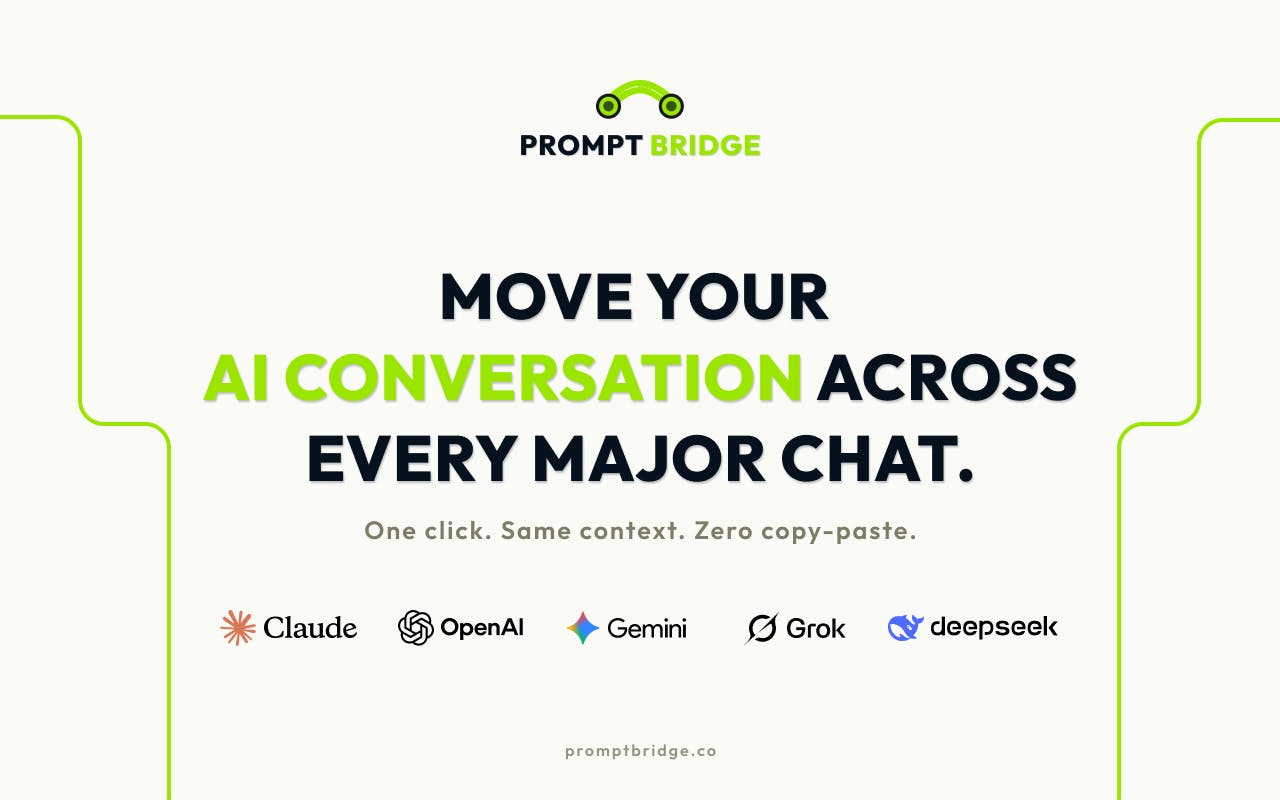
Large language models (LLMs) are increasingly powerful, but their ability to retain and transfer context across different sessions, platforms, or even models remains a significant hurdle. Users often find themselves re-explaining previous interactions or re-uploading data when switching between AI tools or engaging with different AI agents. This fragmentation leads to inefficiencies and a disjointed user experience. Prompt Bridge emerges as a solution designed to address this core problem by enabling the seamless portability of AI context.
The core idea behind Prompt Bridge is simple: to decouple the context of an AI interaction from the specific application or model it originated from. Think of it less like a database and more like a highly organized digital assistant who remembers everything you told them and can relay that information accurately to any new colleague you introduce them to, regardless of the company they work for. This allows users to maintain continuity in their AI-driven workflows without starting from scratch each time.
How Prompt Bridge Works
While the technical specifics are not fully detailed in the initial announcement, Prompt Bridge appears to function by capturing and serializing the essential elements of an AI conversation or task. This typically includes not just the user's prompts but also the AI's responses, any associated metadata, and potentially user-defined parameters or system instructions. This serialized context can then be stored and later re-loaded into another instance of Prompt Bridge, or theoretically, into a compatible AI application or model.
The primary benefit is that it allows users to pick up where they left off. If you were iterating on a piece of code with an AI assistant in one environment, you could theoretically save that context and load it into another, perhaps a more specialized coding AI or a different development platform, without needing to provide the entire history of your requests and the AI's outputs. This is particularly valuable for complex tasks that involve many turns of conversation or require a deep understanding of previous steps.
Potential Use Cases and Impact
The implications of portable AI context are far-reaching. For developers working with multiple AI models for tasks like code generation, debugging, or documentation, Prompt Bridge could significantly speed up workflows. Instead of copying and pasting snippets or re-explaining requirements, they could simply load the relevant context. Creators using AI for writing, image generation, or content ideation could maintain consistent stylistic elements or narrative threads across different tools.
For businesses integrating AI into their operations, this could mean more cohesive and efficient AI-powered customer service agents, internal knowledge bases, or data analysis tools. The ability to transfer context means that an AI agent could, for example, remember a customer's previous support interactions even if the customer is routed to a different agent or a different channel. This level of continuity has been a long-standing goal in the development of more intelligent and user-friendly AI systems.
The Broader Ecosystem Challenge
The success of Prompt Bridge, and indeed any similar solution, hinges on broader adoption and standardization. For context to be truly portable, there needs to be a common format or an agreed-upon mechanism for how AI models and applications expose and consume this context. Without this, Prompt Bridge might become another silo, albeit one that bridges *within* its own ecosystem, rather than universally across the AI landscape.
What remains to be seen is how Prompt Bridge will handle the nuances of different AI architectures. A context that works perfectly for a transformer-based LLM might need significant adaptation for a diffusion model used in image generation. The developers at Prompt Bridge face the challenge of creating a flexible enough system that can account for these differences, or they will need to rely on integrations and APIs from specific AI providers to translate their generic context format into something each model understands.
The current focus appears to be on making AI context portable, a goal that, if achieved effectively, could significantly reduce friction in the rapidly expanding world of AI tools and applications. The challenge is akin to building a universal translator, not just for human languages, but for the complex, evolving languages of artificial intelligence. Prompt Bridge is an early step in that direction, aiming to make AI interactions more fluid and less repetitive.