The Core Distinction: Ownership and Decision-Making
The lines between job titles in technology can blur, but understanding the fundamental difference between a product engineer and a programmer is crucial, especially for founders hiring their first technical talent. At its heart, the distinction lies in ownership and decision-making authority. A programmer, in the most common understanding of the term, receives a clearly defined task and executes it with proficiency. They are skilled at translating requirements into functional code.
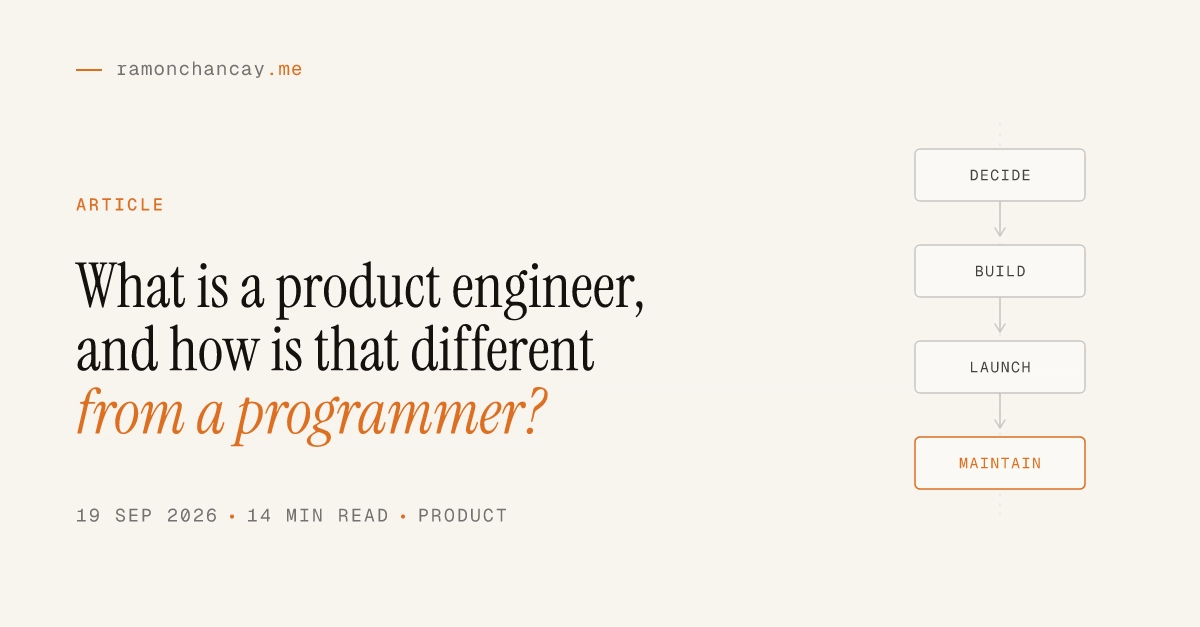
A product engineer, however, operates with a broader scope of responsibility. They are accountable for ensuring a digital product not only functions correctly but also effectively solves the business needs it was designed for. This involves making critical decisions about what features constitute the Minimum Viable Product (MVP) for the first version and what can be deferred. They are involved in the entire lifecycle: defining the scope, building the solution, launching it to users, and crucially, maintaining and iterating on it post-launch. The product engineer answers for the final outcome; their success is tied to the product's success, not just the quality of the code they write.
This difference is significant. Founders often ask about this distinction because hiring the wrong profile can lead to more costly mistakes than choosing an incorrect technology stack. A team filled with only task-executing programmers might struggle with strategic product direction, while a team of product engineers might be overkill for simple execution tasks. Both roles are legitimate and valuable, but their impact and responsibilities diverge significantly.
Beyond the Code: The Product Engineer's Mandate
Consider a scenario where a business needs a new feature. A programmer might be given specifications: 'Build a user authentication system that accepts email and password, with a 'forgot password' functionality.' The programmer's job is to deliver this system, likely with a focus on writing clean, efficient, and secure code for those specific requirements. If the business later realizes that social logins would have been a more strategic initial offering, the programmer can point to the completed task.
The product engineer, on the other hand, would be involved earlier. They might ask: 'What is the primary goal of this authentication system? Is it speed of user onboarding, security, or integration with existing systems?' Based on the business objectives, they might propose that the initial version should focus on email/password for simplicity and speed, while flagging social logins as a high-priority item for version 2. They would then build the email/password system, but they would also be thinking about how to architect it for future social login integration. Post-launch, if user adoption is low, the product engineer would investigate why – was the user experience poor? Was the feature not discoverable? Did it not solve the core problem effectively? They own the problem, not just the solution code.
The Programmer's Value: Execution Excellence
This is not to diminish the critical role of a programmer. In many contexts, a programmer's focused execution is exactly what is needed. For established products with clear roadmaps, or for specific, well-defined components within a larger system, a programmer's ability to efficiently translate requirements into working software is invaluable. They are masters of implementation, ensuring that the technical details are handled with precision. Many successful tech companies rely on teams of highly skilled programmers working under the guidance of product managers and engineering leads who define the 'what' and 'why'.
The key differentiator remains the locus of decision-making and accountability. A programmer typically operates within a framework defined by others. A product engineer helps define that framework. If a company lacks someone to define what the first version should do, what should be prioritized, and who is ultimately responsible for the product's success in the market, that responsibility often falls to the product engineer. Without this role, critical decisions about product direction may be made by default, or not made at all, leading to scope creep, delayed launches, and products that miss the mark.
When to Hire Which Role
For early-stage startups, particularly those with limited funding and a need to iterate quickly based on market feedback, hiring product engineers is often more strategic. These individuals can wear multiple hats: they can contribute to product strategy, take ownership of feature development from ideation to deployment, and remain accountable for the product's performance. They are often described as having a 'full-stack' mentality, not just in terms of technical layers, but in terms of product responsibility.
As a company matures and its product suite grows, the need for specialized roles like programmers becomes more apparent. Larger engineering teams might have product managers defining the roadmap, system architects designing complex systems, and then programmers executing specific feature development or component implementation. In such structures, product engineers might still exist, potentially leading smaller feature teams or focusing on critical product areas requiring end-to-end ownership.
Ultimately, the choice depends on the company's stage, its product strategy, and its organizational structure. However, recognizing that a product engineer is defined by their ownership and decision-making power, while a programmer is defined by their execution of defined tasks, is fundamental to building an effective technology team.