The Core Innovation: Learning by Doing
Traditional Large Language Models (LLMs) are trained on vast, static datasets. They ingest information and then generate outputs based on that learned knowledge. Prime Agent, developed by Prime Intellect, takes a fundamentally different approach. It operates more like a sentient being, learning and evolving through direct experience and self-reflection.
At its heart, Prime Agent is a Reinforcement Learning from Human Feedback (RLHF) agent, but with a critical augmentation: it continuously learns from its own interactions. Instead of relying solely on human-provided feedback or pre-existing datasets to update its parameters, Prime Agent actively engages with its environment. This could be a simulated world, a set of tools, or even a human user. Through these interactions, it generates actions, observes the outcomes, and then critically evaluates those outcomes. This evaluation process, much like human learning from mistakes and successes, allows it to refine its strategies and improve its performance over time without requiring constant human retraining.
Think of it less like a student who memorizes textbooks and more like an apprentice who learns a craft by practicing, observing, and adjusting. The agent doesn't just process information; it *acts* on it and learns from the consequences. This self-improving loop is the key differentiator.
How Prime Agent Achieves Self-Improvement
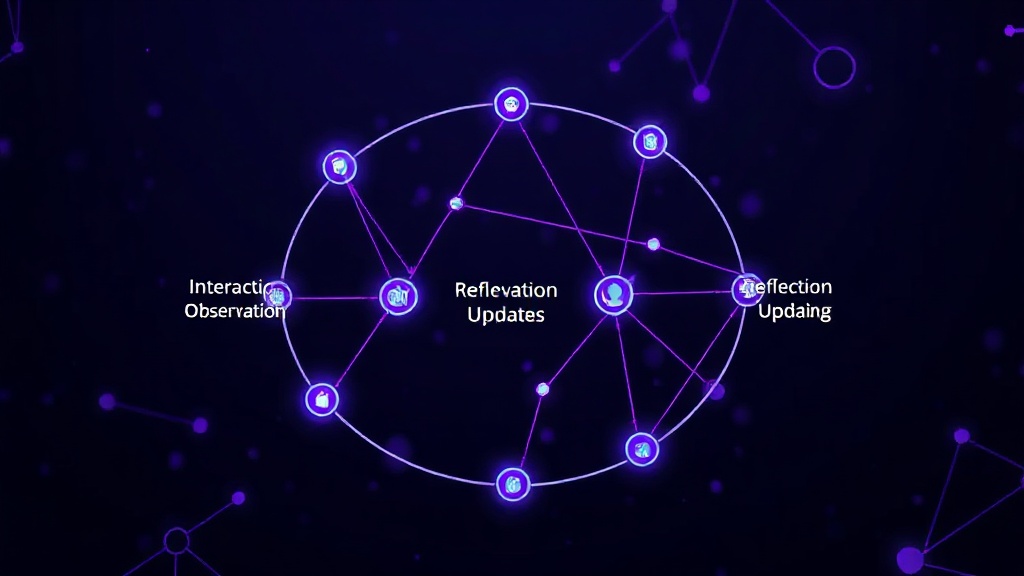
The mechanism behind Prime Agent's continuous learning involves several key components:
- Environment Interaction: The agent is placed in an environment where it can perform actions. This environment could be a simulated coding sandbox, a text-based adventure game, or an interface to real-world tools.
- Action Generation: Based on its current state and objectives, the agent generates a sequence of actions. This is where its underlying LLM capabilities come into play, predicting the most effective actions.
- Outcome Observation: After executing an action, the agent observes the resulting state of the environment. This observation is crucial for understanding the impact of its actions.
- Self-Reflection and Evaluation: This is the most critical step. The agent doesn't just passively observe; it actively reflects on the outcomes. It compares the observed results against its goals and its internal model of how the world works. This reflection can involve identifying errors, successes, or unexpected consequences.
- Parameter Update: Based on the self-evaluation, the agent updates its internal parameters. This is not a full retraining process but an incremental adjustment, similar to how humans refine skills through practice. It learns which actions led to positive outcomes and which led to negative ones, adjusting its future decision-making accordingly.
This cycle allows Prime Agent to adapt to new situations, overcome novel challenges, and become more proficient in its tasks without explicit human intervention for every learning step. The human role shifts from constant supervision and data labeling to setting higher-level goals and providing occasional guidance or correction when the agent deviates significantly from desired behavior.
Implications for AI Development and Deployment
The implications of a self-improving agent are profound. For developers, it means the potential for AI systems that require less ongoing maintenance and can adapt to evolving operational contexts. Imagine an AI assistant that not only performs tasks but also learns to perform them more efficiently or safely over time, based on its actual usage patterns.
For founders, this technology could lead to more robust and autonomous AI solutions. Companies could deploy agents that continuously optimize their own performance, reducing operational costs and improving service quality. The ability for an AI to learn from its own operational data, rather than waiting for periodic, costly retraining cycles, represents a significant leap in efficiency.
The surprise here is not just the self-improvement, but the potential for agents to develop emergent capabilities. By exploring their environments and learning from their experiences, these agents might discover novel strategies or solutions that human designers did not anticipate. This moves AI closer to genuine problem-solving rather than just pattern replication.
The Future of Autonomous Agents
Prime Agent represents a significant step towards more autonomous and adaptable AI. While current LLMs are powerful tools, they are largely static once deployed. A self-improving agent, on the other hand, is a dynamic entity that grows in capability with every interaction. This could unlock new applications in areas requiring continuous adaptation, such as complex robotics, dynamic system control, and personalized learning platforms.
The challenge ahead lies in ensuring the safety and alignment of these self-improving systems. As agents learn and evolve, guaranteeing that their objectives remain aligned with human values becomes paramount. However, the potential for AI that truly learns from its own existence, much like biological organisms, is a tantalizing prospect for the future of artificial intelligence.