The Silent Threat of Stale Data After Database Failover
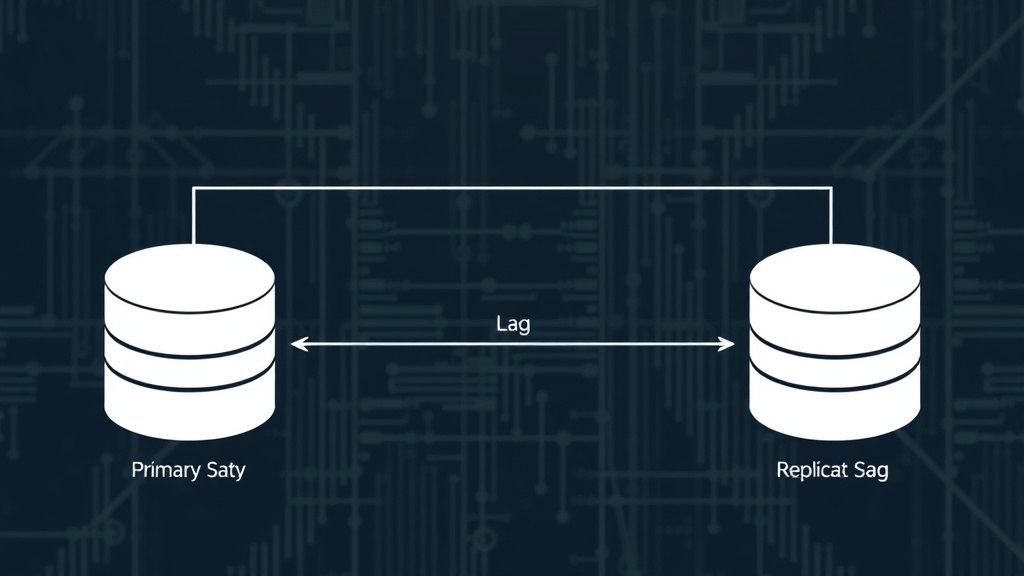
In the quest for continuous availability, database failover mechanisms are essential. When a primary database server fails, a replica steps in to take its place, ensuring applications remain accessible. This process, however, can harbor a subtle yet critical flaw: the replica may be lagging behind the primary, serving stale data. This lag can lead to applications returning incorrect answers, even though every query appears to succeed.
Consider a scenario where a user interacts with an application. Before a failover, they perform an action that updates a record in the primary database. Immediately after, a failover occurs. The application, now connected to a replica, might serve the user a subsequent query that reads this *same* record. Because the replica is behind, it may not yet have received the update from the primary. The application, unaware of the data staleness, proceeds with its logic, potentially combining a pre-failover result with a post-failover follow-up. Every individual query succeeds, giving the illusion of a complete and correct operation, but the final answer is fundamentally broken.
This problem is not unique to PostgreSQL, but the excerpt highlights a common manifestation. The core issue is that a successful connection retry against a replica, which is not yet fully synchronized, can inject inconsistent states into application logic. This is particularly insidious in conversational interfaces or complex workflows where multiple queries build upon each other. The application sees a consistent stream of successful responses, but the underlying data has diverged.
Defining Consistency Contracts for Workflows
To combat this, developers must move beyond simply ensuring uptime and implement robust consistency contracts for their application workflows before deploying to production. These contracts define acceptable levels of data freshness and consistency for different types of operations. Here are several key types:
- Eventual Consistency with a Disclosed Lag Budget: This is the most common state after a failover to a replica. The contract here is to acknowledge the potential lag and define an acceptable window (e.g., 5 seconds, 1 minute) within which data is expected to be consistent. Applications relying on this must be designed to tolerate or account for this delay.
- Monotonic Consistency within One Conversation: For a single user session or conversation, data should only ever move forward in time. If a read occurs, subsequent reads within that same session should not see older data. This is crucial for maintaining user context and preventing rollbacks within a flow.
- Read-Your-Writes: A user performing an write operation should immediately see their own write reflected in subsequent reads, even if other users do not. This is a stronger guarantee than eventual consistency and often requires directing reads back to the primary or using more sophisticated replication strategies.
- Point-in-Time Consistency Across Multiple Queries: This is a very strong guarantee, requiring that a set of queries executed within a short timeframe all see the database state as it was at a single, consistent point in time. Achieving this typically involves snapshotting or using transaction-level consistency guarantees, which can impact performance.
- Primary-Only Reads: For the most critical operations where absolute data freshness is paramount, all reads must be directed exclusively to the primary database. This sacrifices availability during failover events but guarantees data consistency.
Beyond Promotion: Comprehensive Failover Testing
Testing failover solely by verifying that the replica can be promoted to primary and serve basic queries is insufficient. A comprehensive testing strategy must simulate the real-world conditions that can expose data staleness issues. This includes testing:
- Idle Pooled Connections: How do existing, idle connections behave when they are suddenly directed to a replica that might be out of sync?
- Active Transactions: What happens to transactions that were in-flight on the primary when the failover occurs? Are they rolled back, committed to a stale replica, or lost?
- Prepared Statements and DNS Caches: These components can hold stale network information or query plans, further complicating the transition to a replica.
- Interrupted Multi-Query Answers: Test scenarios where a sequence of queries is interrupted by a failover. Does the application correctly handle partial results or data inconsistencies?
- Bounded Retries: Ensure that retry logic is not simply re-executing queries against a stale replica indefinitely, but has mechanisms to detect and report stale data or escalate.
- Conversation Continuity: For stateful applications, verify that the application can maintain user context and data integrity across a failover, especially if the replica holds older information.
- Schema and Policy Versions: In environments with frequent schema changes or evolving data policies, ensure that the replica is not only caught up on data but also on the correct schema and policy versions.
By implementing rigorous consistency contracts and performing thorough, multi-faceted testing that simulates real-world failover conditions, developers can mitigate the risk of serving incorrect answers and ensure their applications remain both available and accurate.