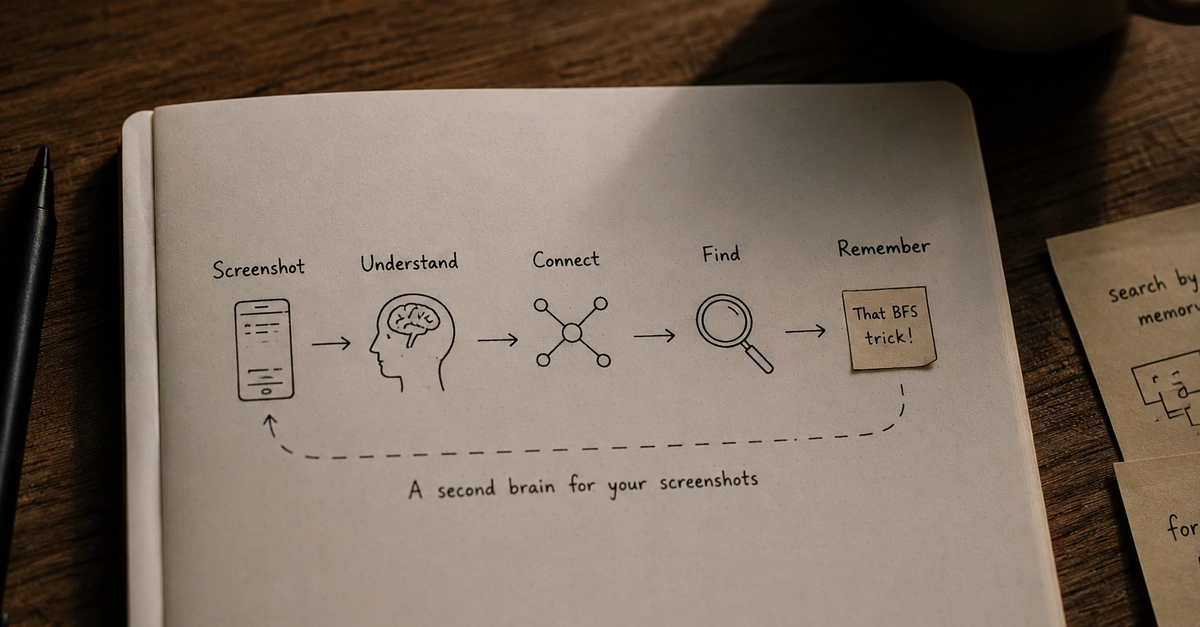
The Problem: Screenshots as Digital Black Holes
We all take screenshots. They serve as quick visual notes, reminders, or evidence. Yet, these digital artifacts often become lost in the vastness of our file systems. The original project, Breadcrumb, identified this common pain point: saving screenshots with the intent of future reference, only to find them inaccessible and useless when needed. The core problem isn't the act of capturing information visually, but the subsequent retrieval and contextualization of that information.
The challenge Pomniter aims to solve is not merely better organization, but a fundamental shift in how we interact with visual memories. It moves beyond the limitations of a standard gallery or a basic search bar. Instead, Pomniter seeks to imbue screenshots with a level of understandability that allows them to be searched not just by filename or date, but by their actual content. This requires a more sophisticated approach to image analysis and data indexing, transforming static images into dynamic, queryable data points.
From Breadcrumb to Pomniter: A Name Change Reflects a Deeper Purpose
The project has undergone a significant rebranding, shifting its name from Breadcrumb to Pomniter. This change is more than cosmetic; it directly reflects the project's evolving mission. The new name, inspired by the Russian word помнить (pomnit), meaning "to remember," encapsulates the central theme of transforming fleeting visual captures into lasting, retrievable memories. This linguistic shift signals a commitment to building a system that actively aids users in recalling and accessing information they've previously deemed important enough to screenshot.
The decision to rename highlights a strategic pivot. While "Breadcrumb" might suggest a trail of digital breadcrumbs, "Pomniter" directly addresses the user's need for recall. It positions the tool not just as a passive storage solution, but as an active memory assistant. This implies a deeper integration with user workflows and a more intelligent approach to indexing and searching visual data, moving beyond simple file management into the realm of cognitive support.
Designing for Searchable Memories: Beyond Basic Galleries
The design philosophy behind Pomniter is to avoid becoming just another screenshot gallery with a marginally improved search function. The aspiration is to make screenshots so understandable that they become inherently searchable. This necessitates a technical approach that can parse the visual information within a screenshot and make it accessible through natural language queries. Imagine being able to search for "that article about AI ethics I screenshotted last Tuesday" and having Pomniter surface the exact image, not just based on metadata, but on the actual text and objects depicted within it.
This ambitious goal requires a multi-faceted technical strategy. It likely involves leveraging optical character recognition (OCR) to extract text from images, and potentially object recognition or image analysis techniques to identify key visual elements. The challenge lies in creating a robust system that can handle the variety and messiness of real-world screenshots – from UI elements and code snippets to diagrams and webpages. The metadata generated by these analysis processes would then be indexed, creating a powerful search index that allows users to query their visual history with unprecedented accuracy and ease.
The Technical Hurdles and Future Potential
Building a system that can meaningfully search screenshots presents significant technical hurdles. High-quality OCR is essential, but it's only one piece of the puzzle. Understanding context – what the screenshot is *of*, what information it conveys beyond raw text – is crucial for effective searching. This could involve analyzing surrounding UI elements, identifying document types, or even inferring user intent based on the content. Furthermore, the scalability of such a system is a major consideration. As users accumulate thousands, or even millions, of screenshots, the indexing and search processes must remain performant.
The potential applications, however, are vast. Developers could search for code snippets or error messages they encountered weeks ago. Designers could find UI elements or inspiration images. Students could retrieve lecture notes or diagrams. For anyone who relies on visual information capture, Pomniter promises to transform a chaotic collection of images into a structured, accessible knowledge base. It represents a significant step towards bridging the gap between our visual perception and our digital information retrieval capabilities.