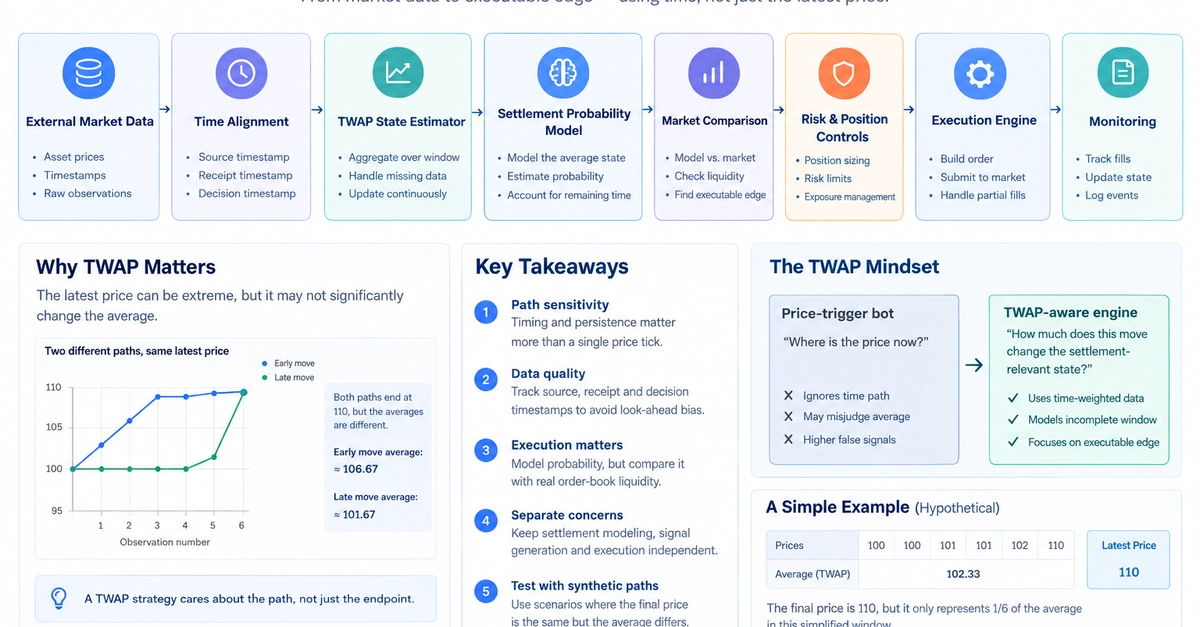
Building a Polymarket TWAP-Aware Trading Engine
A trading engine can correctly predict the underlying asset and still lose the trade. This sounds obvious in traditional markets. It is less obvious in short-duration prediction markets, where traders often treat the latest external price as if it were the same thing as the market's settlement value. It isn't—when the settlement mechanism depends on a time-based average.
The engineering problem is therefore not simply "Did the price go up?" The harder question is:
The Core Question
How should a Polymarket TWAP trading bot transform a live price signal into a decision when the economically relevant quantity may depend on a time path rather than a single observation? The answer requires changing the architecture itself.
Why Traditional Approaches Fail
Many trading bots operate on a simple principle: observe the current price, compare it to a target, and execute a trade if the difference exceeds a threshold. This works for markets where settlement is based on a single, instantaneous price point. However, Polymarket, like many prediction markets, often uses a Time-Weighted Average Price (TWAP) for settlement. This means the final settlement price is not determined by the price at the exact moment of market closure, but by the average price over a specified period leading up to closure.
A bot that only reacts to the live price feed, without considering the time-weighted average, will fundamentally misunderstand the market's objective. Imagine a market that settles on the average price between 1:00 PM and 1:15 PM. If a bot sees the price surge at 1:14 PM and buys based on that single data point, it might be making a losing trade if the price was significantly lower for the preceding 14 minutes, dragging the TWAP down.
This disconnect between a single price observation and the time-averaged settlement value creates a critical flaw in naive bot designs. The bot's decision-making logic must evolve beyond simple price directionality to encompass the temporal dynamics of the settlement mechanism.
Rethinking the Architecture: Time-Aware Decision Making
To build a truly effective TWAP-aware trading engine, the architecture must fundamentally change. Instead of a reactive system, it needs to be a predictive one that accounts for the future path of prices.
The core challenge is to predict not just the direction of the price, but the trajectory of the price over the settlement window. This involves several key components:
1. Data Ingestion and Historical Context
The engine must ingest not only the latest price but also a rich history of price data within the relevant settlement window. This includes timestamps and price points to calculate historical TWAP. The longer the historical data available, the better the model can understand recent trends and volatility.
2. TWAP Prediction Models
This is where the core innovation lies. Instead of a simple "is price up or down?" model, the engine needs to employ predictive models that forecast the TWAP itself. This could involve techniques such as:
- Time Series Forecasting: Using models like ARIMA, Prophet, or more advanced deep learning models (e.g., LSTMs) to predict future price points based on historical patterns.
- Volatility Analysis: Understanding and predicting price volatility is crucial. High volatility means a single price point has less impact on the TWAP, while low volatility means each point is more significant.
- Market Impact Modeling: For more sophisticated engines, understanding how the bot's own trades might influence the TWAP is important, though this adds significant complexity.
The output of these models should be a predicted TWAP value for the remainder of the settlement period, along with confidence intervals.
3. Trade Execution Strategy
Once the TWAP prediction is made, the bot can devise an execution strategy. This strategy would aim to buy or sell such that the bot's effective entry or exit price, when averaged over time, aligns with its prediction of the settlement TWAP. This is not about hitting the market at the right time based on a single price, but about executing trades consistently over the settlement window to achieve a desired average price.
For example, if the bot predicts the settlement TWAP will be 0.80 and the current price is 0.75, it might decide to buy. However, it won't dump its entire order at once. It will spread its buys over the remaining time, adjusting its pace based on real-time price movements and its updated TWAP predictions. If the price starts to rise rapidly, it might accelerate its buying to secure a lower average price before the TWAP increases too much. Conversely, if the price is falling, it might slow down its buying or even pause, waiting for a better entry point.
4. Risk Management
As with any trading system, robust risk management is paramount. This includes setting stop-losses, position sizing rules, and monitoring for unexpected market conditions or model failures. The temporal nature of TWAP settlement means that risk management must also consider the time dimension – for instance, ensuring trades are not concentrated too close to the settlement deadline, where market impact can be amplified and predictions become less reliable.
The Author's Contribution
The author, Soulcrancerdev, specializing in engineering, highlights this critical distinction. The problem isn't about predicting price direction; it's about understanding how price movements contribute to a time-averaged settlement. This requires a shift from a reactive, single-point-in-time decision model to a proactive, time-series forecasting model integrated into the trading strategy.
Building such an engine involves significant engineering effort, moving beyond simple API calls for price data to developing sophisticated forecasting models and adaptive execution algorithms. The value proposition is clear: a TWAP-aware engine can navigate the nuances of prediction market settlement, turning potential losses into profitable opportunities by respecting the market's underlying economic mechanism.
What's Next?
The development of TWAP-aware trading engines is a natural progression for sophisticated participants in prediction markets. As these markets mature, strategies that exploit the temporal settlement mechanisms will become increasingly important. Future work might involve exploring more advanced machine learning techniques for TWAP prediction, incorporating real-time order book data, or even developing multi-agent simulations to understand how such bots interact within the broader market ecosystem.