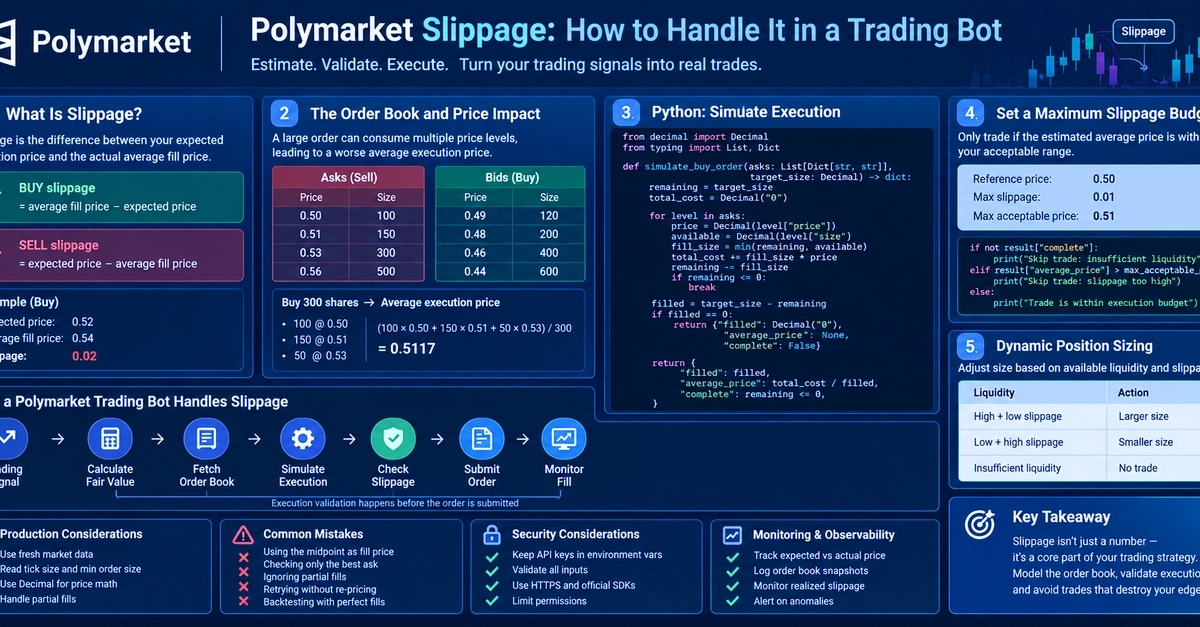
Understanding Polymarket Slippage
Slippage is a silent killer of profitable trading strategies on prediction markets like Polymarket. Even when your trading bot correctly identifies an undervalued asset, like a YES token, the ability to execute that trade at the price your model predicted is not guaranteed. This discrepancy, known as slippage, occurs when a large order consumes multiple levels of the order book, pushing the average execution price unfavorably higher. For any automated trading bot operating on Polymarket, slippage must be an integral part of the trading decision-making process, not merely an afterthought calculated after the trade is complete.
Polymarket, operating on a Continuous Limit Order Book (CLOB), presents unique challenges for high-frequency or large-volume traders. Unlike decentralized exchanges (DEXs) that might rely on automated market makers (AMMs) with predictable impermanent loss, Polymarket's CLOB behaves more like a traditional exchange. This means liquidity can be fragmented, and executing large orders can significantly impact the market price. The deeper your order has to traverse the order book, the worse your average entry or exit price becomes. This is the core of Polymarket slippage: the difference between the price you intended to trade at and the actual price at which your trade is filled.
Estimating Slippage from the CLOB
To effectively control slippage, you must first be able to estimate it. This involves analyzing the Continuous Limit Order Book (CLOB) to understand its depth and the price impact of your intended order. The CLOB is a list of all outstanding buy (bid) and sell (ask) orders for a specific market, organized by price level. Each price level has a corresponding quantity of tokens available.
When your bot wants to buy YES tokens, it needs to consume the available ASK orders. If your desired quantity is small relative to the available liquidity at the best ask price, your order might be filled entirely at that price. However, if your order is larger than the total quantity available at the best ask, it will consume that level and then move to the next best ask price, and so on. The CLOB allows you to see these subsequent price levels and the quantities available at each.
To calculate the expected average execution price, you can simulate this process. Start with the best ask price. If your order quantity is less than or equal to the quantity at that price, your average price is simply that best ask price. If your order quantity exceeds it, you take all tokens at that price and reduce your remaining order quantity. You then move to the next ask price, add its quantity to your filled amount, and update your average price calculation by considering the weighted average of all tokens filled so far. This iterative process, walking the order book, gives you a realistic estimate of your execution price.
Implementing an Execution Budget
Once you can estimate the potential slippage, the next crucial step is to set an execution budget. This budget defines the maximum acceptable slippage for any single trade. Your trading bot should treat this budget as a hard constraint. Before even attempting to place an order, the bot must perform the CLOB analysis described above. If the estimated average execution price, including the anticipated slippage, falls outside your predefined acceptable range (i.e., it exceeds your budget), the bot should reject the trade outright. This prevents the bot from entering into trades that are mathematically unprofitable from the outset due to poor execution.
The execution budget is not a static figure; it can and should be dynamic. Factors such as market volatility, overall liquidity, and the specific trading strategy can influence what constitutes an acceptable slippage amount. For instance, a strategy with a very high expected profit margin might tolerate slightly more slippage than one with razor-thin margins. Conversely, during periods of extreme volatility or low liquidity, the budget might need to be tightened considerably, leading to fewer, but safer, trades.
This proactive rejection of trades based on an execution budget is far more effective than trying to manage slippage after the fact. It stops unprofitable trades before they even occur, preserving capital and ensuring that only trades with a high probability of positive net profit are executed.
Order Splitting for Enhanced Execution
For larger trades that would incur unacceptable slippage if placed as a single order, splitting the order into multiple smaller orders is a common and effective technique. Instead of attempting to buy a large quantity all at once, the bot can break the total desired quantity into several smaller chunks. These smaller orders are then placed sequentially, with a brief pause or cooldown period between each. This strategy aims to minimize the price impact of each individual order, allowing the market to absorb the liquidity without drastic price movements.
The optimal size for these smaller orders and the interval between them are critical parameters that need careful tuning. Too large, and each chunk will still cause significant slippage. Too small, and the increased number of transactions could lead to higher gas fees (if applicable) and more chances for other market participants to front-run your orders. The cooldown period is also vital; it gives the order book a chance to settle and potentially replenish liquidity before the next order is placed. Monitoring the CLOB in real-time during the execution of a split order is paramount. If liquidity conditions change drastically between order placements, the bot may need to re-evaluate the remaining portions of the split order.
This method is akin to a large ship entering a harbor: instead of a single massive wake, it creates a series of smaller, more manageable ones. By breaking down a large order, you reduce the immediate pressure on any single price level in the order book, leading to a better overall average execution price compared to a single, large order.
Monitoring and Refinement
Continuous monitoring of trade execution is the final piece of the puzzle. Even with sophisticated estimation and splitting strategies, real-world market conditions can deviate from predictions. Your trading bot should meticulously log the expected execution price for every trade it attempts and compare it against the actual execution price. This data is invaluable for refining your slippage control mechanisms.
By analyzing the difference between expected and actual execution over a large number of trades, you can identify patterns. Are your CLOB depth estimates consistently off? Is the market reacting more strongly to your orders than anticipated? This feedback loop allows you to adjust parameters such as the execution budget, the optimal order split size, and the cooldown intervals. Over time, this iterative refinement process leads to a more robust and profitable trading bot that can navigate the complexities of Polymarket's CLOB with greater precision and efficiency.
What nobody has addressed yet is the potential for sophisticated bots to intentionally manipulate perceived liquidity by placing and then cancelling orders, thereby influencing the slippage calculations of other bots. This adversarial aspect of automated trading on CLOBs warrants further investigation.