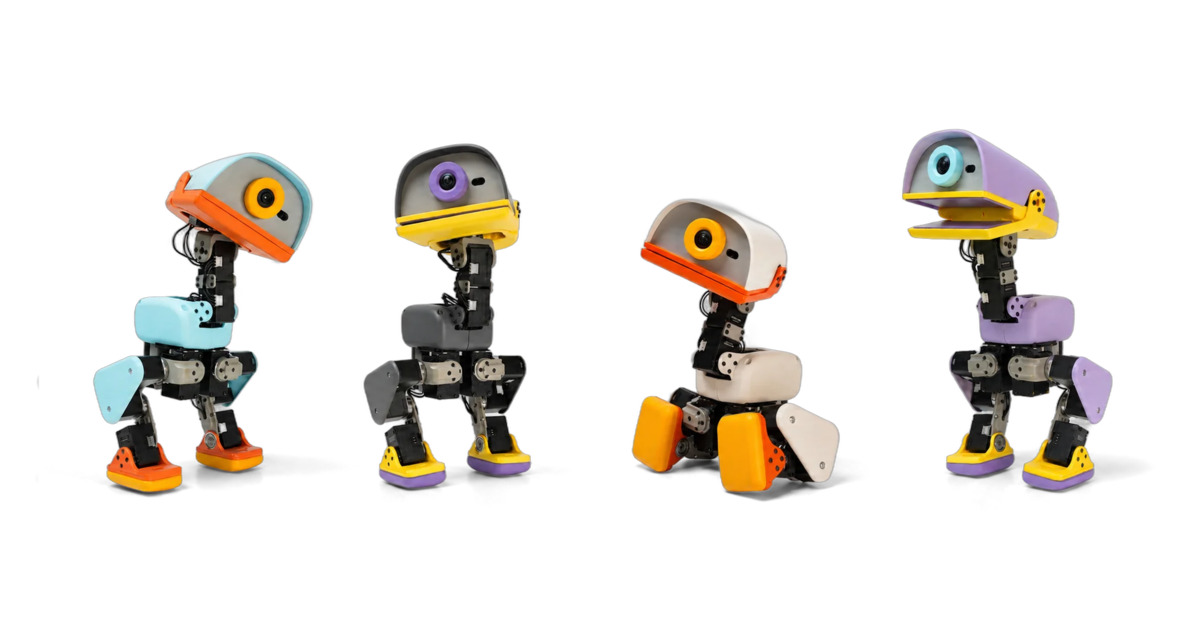
Introducing Microduck: A New Contender in Open-Source Robotics
Pollen Robotics has unveiled Microduck, a novel robotic arm aimed at the research, education, and hobbyist markets. This compact, six-degrees-of-freedom (6-DOF) manipulator is built with a focus on modularity and accessibility, making it a compelling option for those looking to integrate robotic capabilities into their projects without the prohibitive cost or complexity of industrial-grade systems. The company, known for its contributions to the open-source robotics community, positions Microduck as a platform for experimentation and learning.
Design and Modularity
Microduck distinguishes itself through its modular design. The arm is composed of several distinct segments, allowing for easier customization and repair. This approach means users can potentially swap out or upgrade individual joints or end-effectors without needing to replace the entire arm. The base unit provides a stable foundation, and each subsequent link is designed for straightforward attachment. This philosophy extends to its internal components, where standard connectors and accessible wiring are prioritized.
The choice of materials and construction methods emphasizes durability while keeping the weight down. This is crucial for applications where the arm might be mounted on a mobile platform or where space is a constraint. The aesthetic is clean and functional, typical of modern robotics development platforms, signaling its intended use in labs and maker spaces.
Technical Specifications and Performance
Microduck boasts six axes of motion, providing a high degree of dexterity. Each joint is driven by standard hobby servos or more precise stepper motors, depending on the configuration chosen by the user or researcher. This flexibility allows for a trade-off between cost, precision, and speed. The payload capacity is modest, suitable for handling small tools, sensors, or light assembly tasks, aligning with its target applications in education and research rather than heavy industrial automation.
A key aspect of Microduck's design is its integration with the Robot Operating System (ROS). This is a significant advantage for developers and researchers already familiar with the ROS ecosystem. The arm comes with pre-built ROS packages, simplifying the process of control, simulation, and data acquisition. This means users can leverage existing ROS tools and libraries to program complex behaviors, test algorithms in simulation, and integrate Microduck with other robotic components.
The controller board is designed to be user-friendly, with accessible ports for sensors and actuators. While specific details on the processing power and communication interfaces are still emerging, the emphasis on ROS suggests a Linux-based control system, likely running on a single-board computer like a Raspberry Pi or a more powerful industrial PC, depending on the complexity of the intended application. This open approach to the control system ensures that users are not locked into proprietary software and can adapt the arm to a wide range of computational backends.
Open-Source Philosophy and Community
Pollen Robotics is a strong proponent of open-source development, and Microduck embodies this commitment. The design files, software, and documentation are intended to be made available under permissive licenses. This allows the community to inspect, modify, and contribute to the project. Such a collaborative approach can accelerate innovation, as researchers and developers worldwide can build upon the existing work, share improvements, and adapt the arm for novel use cases.
The Hacker News discussion surrounding Microduck's announcement highlights the community's interest in accessible robotics platforms. Comments often revolve around potential applications, comparisons to existing open-source arms, and suggestions for future enhancements. This immediate engagement from the developer community underscores the potential for Microduck to become a widely adopted platform for robotics education and research.
Applications and Use Cases
The versatility of Microduck opens up numerous possibilities. In educational settings, it can serve as a hands-on tool for teaching robotics concepts, programming, and control theory. Students can learn about kinematics, inverse kinematics, path planning, and sensor integration in a tangible way.
For researchers, Microduck can act as a testbed for developing and validating new robotic algorithms. This could include areas such as machine learning for robot control, human-robot interaction, collaborative robotics, or advanced manipulation tasks. Its modularity makes it an ideal candidate for rapid prototyping of custom robotic systems.
Hobbyists and makers might find Microduck a capable platform for automating tasks in their workshops, creating custom robotic art installations, or integrating robotic arms into home automation projects. The accessibility of the hardware and software lowers the barrier to entry for complex robotic projects.
The Future of Microduck
Pollen Robotics' release of Microduck signifies a growing trend towards more open and accessible robotic hardware. By focusing on modularity, ROS integration, and an open-source ethos, the company aims to empower a new generation of roboticists. The success of Microduck will likely depend on continued community engagement, the release of comprehensive documentation, and the ongoing development of its software ecosystem. As the field of robotics continues to evolve, platforms like Microduck are essential for democratizing access to advanced technology and fostering innovation.