The "Flaky Test" Fallacy
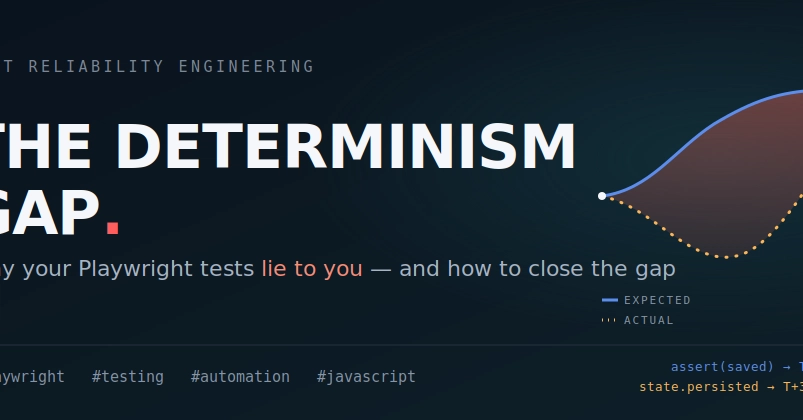
Every automation engineer has uttered the phrase, "It's flaky, just re-run it." This common refrain masks a deeper problem: a race condition between test assertions and the application's actual state. This isn't randomness; it's unmeasured latency. I call this phenomenon the Determinism Gap – the time window where a test asserts a state that is still in flux.
Think of it less like a database and more like a live news feed. You can't reliably assert the headline of an article the moment it starts to load; you need to wait for the full content to render. Similarly, UI automation tests often assert conditions before the underlying application state has stabilized. This gap is the breeding ground for flakiness, leading to unreliable test suites that erode confidence and waste valuable developer time.
The core issue is that modern web applications are highly asynchronous. Components update, data fetches, and network requests complete independently. A test that simply waits for a specific element to be visible might not account for related data that hasn't loaded yet, or a background process that hasn't finished. This can lead to tests passing when the application is in an inconsistent state, or failing because a crucial piece of data arrived milliseconds too late.
Measuring the Gap: Latency as a First-Class Metric
To combat the Determinism Gap, we must shift from treating latency as an afterthought to measuring it as a first-class metric. Instead of relying on arbitrary waits or simple retry mechanisms, we need to understand the actual time it takes for application states to stabilize. This requires a systems-engineering mindset applied to testing.
This involves instrumenting your application and test environment to capture timing data. Key metrics include:
- Time from user interaction to specific UI element becoming interactive.
- Time from initial page load to all critical data being fetched and rendered.
- Time for background processes or animations to complete.
By collecting this data, you can identify the true bottlenecks and dependencies within your application's rendering and state management. This allows for more intelligent waiting strategies, moving beyond fixed `sleep()` calls or generic `waitFor` functions.
A Systems-Engineering Fix: Explicit State Stabilization
The proposed solution is to build testability into the application's architecture. This means creating explicit signals or hooks that indicate when a particular state has been achieved. Instead of the test guessing when the application is ready, the application informs the test.
This can be achieved through several mechanisms:
- Custom Events: The application can dispatch custom DOM events when specific operations (like data fetching or component rendering) are complete. Tests can then reliably wait for these specific events.
- State Flags: Introduce application-level state flags that tests can query to confirm readiness. For example, a `dataLoaded` boolean that is set to `true` only after all necessary data has been fetched and processed.
- Network Request Interception: Playwright already offers network interception. This can be leveraged not just to mock responses, but to wait for specific, critical network requests to complete and return successfully before proceeding with assertions.
The key is to make the test's wait condition directly tied to the application's observable, stable state, rather than an arbitrary time duration. This transforms flaky tests into deterministic ones because the test now waits for a concrete, verifiable condition, not a temporal approximation.
Beyond Retries: A Path to Reliable Automation
The "just re-run it" mentality is a crutch that hides systemic issues. It's akin to ignoring a structural crack in a building and just repainting the wall. Eventually, the underlying problem causes a collapse. In software, this collapse is a test suite that can no longer be trusted.
Adopting a systems-engineering approach to test reliability means:
- Instrumenting for Latency: Treat timing data as critical.
- Architecting for Testability: Build explicit state stabilization mechanisms into your application.
- Eliminating Arbitrary Waits: Replace fixed delays with condition-based waits tied to application state.
By understanding and actively managing the Determinism Gap, development teams can move from a state of constant test flakiness to one of reliable, trustworthy automation. This shift is crucial for maintaining development velocity and confidence in the face of complex, asynchronous applications.
What remains unaddressed is the cost-benefit analysis for teams with massive, existing test suites. Retrofitting these architectural changes can be a significant undertaking. The question for many will be: how much technical debt are they willing to accrue to avoid the upfront investment in deterministic testing?