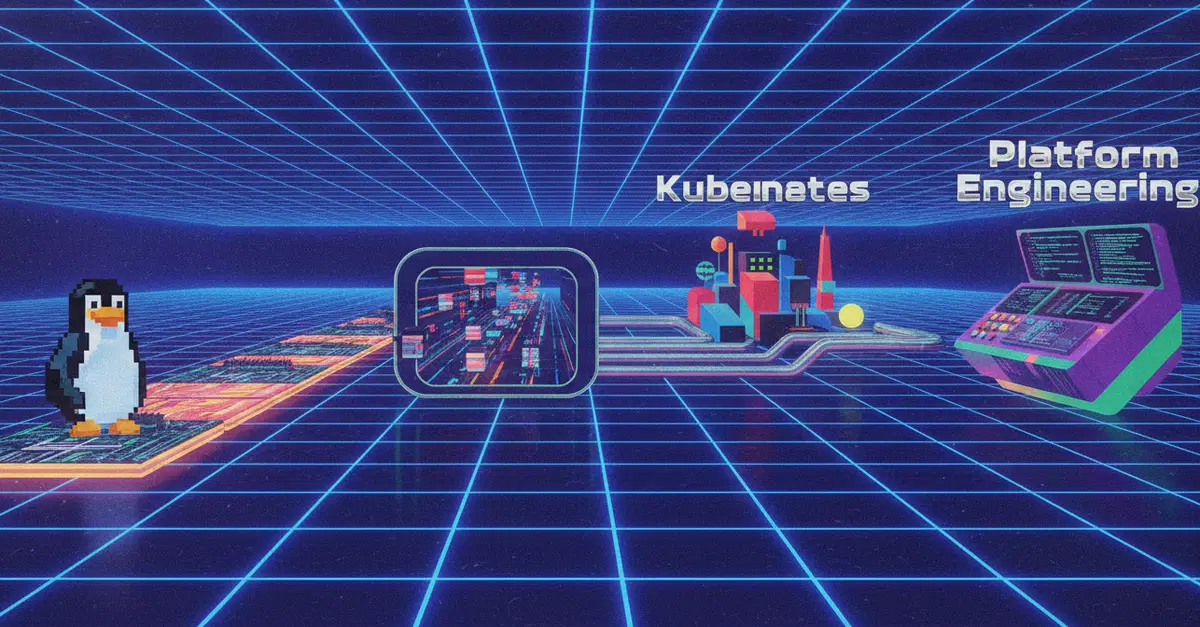
The Misconception: Kubernetes as the Starting Point
A common question I encounter is, "Where do I start to become a Platform Engineer?" The expected, and often given, answer is Kubernetes. This perspective, however, misses the fundamental essence of Platform Engineering. Kubernetes is a powerful tool, but it's a solution to a problem, not the problem itself. Platform Engineering is defined by the problems it aims to solve, not by the orchestrator used to solve them.
My experience running and evolving Kubernetes platforms in production, supporting hundreds of workloads and thousands of pods in a regulated corporate environment, has revealed a critical distinction. This difference isn't found in mastering kubectl commands. It lies in understanding and answering three core questions that most introductory tutorials overlook:
- Who is your platform's customer? The cluster itself is not the customer. The real customer is the development team that relies on the platform to deploy and manage their applications efficiently and reliably. Understanding their needs, workflows, and pain points is paramount.
- What problem are you actually solving for them? Are you reducing deployment time? Improving reliability? Simplifying infrastructure management? Enhancing security posture? Pinpointing the exact problem allows for the selection of appropriate tools and strategies.
- How do you measure success? Without clear metrics, it's impossible to know if the platform is delivering value. This could involve metrics like lead time for changes, deployment frequency, mean time to recovery (MTTR), or developer satisfaction scores.
These questions form the bedrock of effective Platform Engineering. They shift the focus from the technical implementation of a specific tool to the strategic goal of empowering development teams.
Beyond Kubernetes: The Broader Scope of Platform Engineering
Platform Engineering encompasses the design, build, and operation of self-service platforms that streamline the application lifecycle. This involves abstracting away the complexities of underlying infrastructure, enabling developers to focus on writing code and delivering business value. While Kubernetes is a frequent component, it's rarely the entire solution.
Consider the journey of knowledge within engineering teams. As highlighted in Source 2, valuable insights from architecture discussions, incident post-mortems, and project learnings often disappear. This knowledge loss is a significant problem that Platform Engineering can help address. A well-designed platform can incorporate mechanisms for capturing, sharing, and leveraging this institutional knowledge, turning ephemeral discussions into enduring, accessible resources.
This is where the true value of Platform Engineering emerges. It’s about creating an environment where developers can:
- Provision infrastructure with ease and speed.
- Deploy applications reliably and consistently.
- Monitor application health and performance effectively.
- Manage security and compliance requirements seamlessly.
- Access the knowledge and best practices needed to succeed.
The platform acts as a force multiplier, providing paved paths for common tasks and guardrails for critical operations. It’s less about the specific technology stack and more about the developer experience and the acceleration of value delivery.
The Developer Experience as the North Star
Ultimately, Platform Engineering is a discipline focused on improving the developer experience. Think of it like building a high-quality road system for a city. You don't start by choosing the type of asphalt. You first identify where people need to go, what traffic problems exist (congestion, accidents), and how to make the journey smooth and efficient for everyone. Only then do you select the best materials and construction methods for the roads, bridges, and tunnels.
Similarly, Platform Engineering begins with understanding the developer's journey. What are their biggest frustrations? Where do they encounter bottlenecks? What tools and information do they need to be productive? Answering these questions leads to the design of internal developer platforms (IDPs) that are intuitive, efficient, and tailored to the organization's specific needs.
Kubernetes, in this analogy, might be a sophisticated traffic management system or a high-speed rail line. It's a critical piece of infrastructure that enables efficient movement, but it's only one part of the overall transportation network. The platform engineer's role is to orchestrate all these components—from CI/CD pipelines and observability tools to security scanning and documentation portals—into a cohesive, self-service offering.
The Unanswered Question: Scalability of Knowledge Sharing
While Source 2 eloquently describes the problem of disappearing engineering knowledge, the platform engineering approach offers a potential solution. However, a significant unanswered question remains: How do we ensure that the knowledge embedded within a platform remains current, accessible, and truly useful as systems and teams evolve? Building a platform that captures knowledge is one challenge; maintaining its relevance and discoverability over time is another, equally critical, hurdle that requires continuous effort and strategic design.
Conclusion: Focus on the 'Why' Before the 'How'
The discipline of Platform Engineering is about solving real-world problems for development teams. It’s about creating efficiency, reliability, and a superior developer experience. While Kubernetes is an indispensable tool in many modern platform stacks, it should be adopted only after a thorough understanding of the problems it is intended to solve and the users it is meant to serve. By prioritizing the 'why'—the developer's needs and the business objectives—over the 'how'—the specific technology choices—organizations can build truly effective and impactful platforms.