The Problem: Redundant API Test Creation
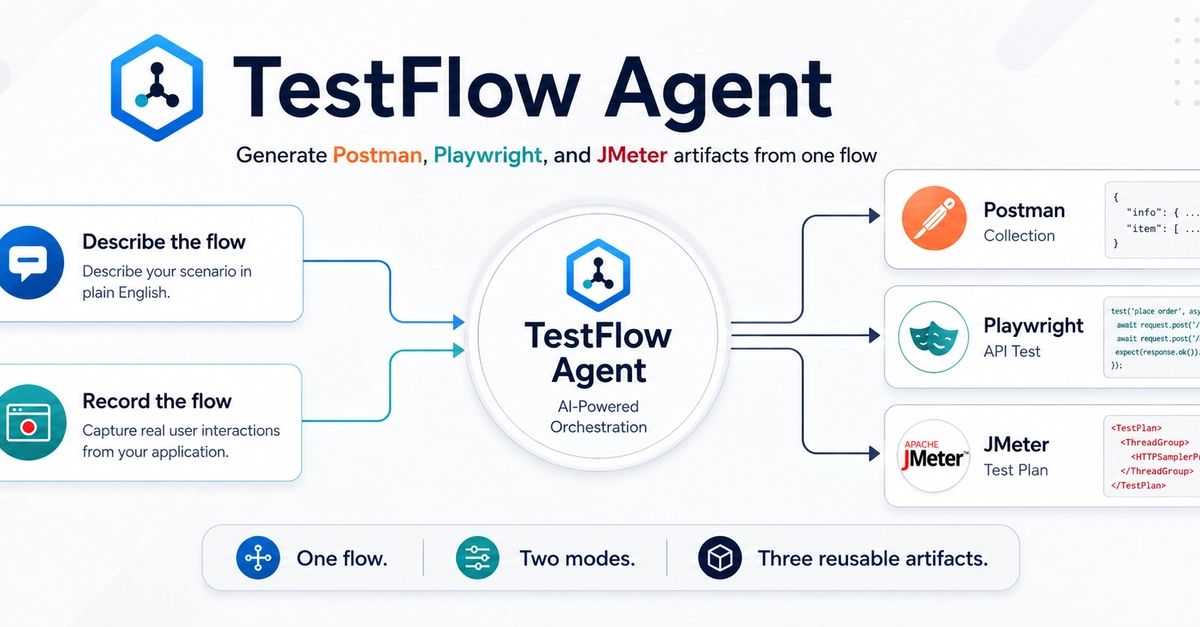
QA engineers often face the tedious task of recreating the same API tests across multiple tools. For a single business flow, this could mean building a Postman collection, a Playwright API test suite, and a JMeter performance test plan. This process is not only time-consuming but also prone to errors, as maintaining three separate, identical test suites becomes a significant burden. When any part of the API changes, all three must be updated, leading to drift and increased maintenance overhead.
To address this common pain point, QA engineer Shankar Subramanian developed TestFlow Agent, a side project designed to generate API tests from plain English descriptions and live websites. The agent aims to streamline the testing process by allowing users to define test flows once and generate them in various formats.
How TestFlow Agent Works: Two Modes
TestFlow Agent operates in two distinct modes, each catering to different testing scenarios:
Mode 1: Testing Your Own Service
This mode is ideal when you have control over the API you are testing, such as your team's internal services. In this scenario, you simply describe the business flow in plain English. The agent parses this description and generates the corresponding API tests. This method leverages the familiarity of the developer or QA engineer with the service's endpoints and expected behavior, translating that knowledge directly into executable tests. The goal is to define the flow once and have it automatically converted into different testing formats, eliminating the need for manual replication.
Mode 2: Testing External Websites/APIs
The second mode is designed for situations where you need to test external websites or APIs where you may not have direct control over the underlying code or documentation. Here, TestFlow Agent can leverage a live website as its source of truth. By analyzing the structure and behavior of a live web application, the agent can infer API interactions and generate tests. This is particularly useful for end-to-end testing or for verifying the functionality of third-party services through their exposed APIs. The agent acts as an intelligent observer, translating observed web interactions into structured API test cases.
Technical Underpinnings and Future Potential
While the article excerpt does not delve deeply into the specific technologies used, the concept suggests an integration of Natural Language Processing (NLP) for understanding plain English descriptions and potentially web scraping or browser automation techniques for analyzing live websites. The core value proposition lies in abstracting the complexity of test script writing across different tools into a single, intuitive input method.
The implications of such a tool are significant for QA teams looking to improve efficiency and reduce manual effort. By standardizing test creation from a single source of truth, teams can ensure consistency across their testing efforts and reduce the time spent on repetitive tasks. This also frees up valuable engineering time that can be redirected towards more complex testing strategies or exploratory testing.
The surprising detail here is not just the automation of test creation itself, but the dual approach: it works both for internal services where documentation might be implicit or evolving, and for external systems where direct access to specifications is limited. This versatility makes TestFlow Agent a potentially powerful tool for a wide range of testing needs.
What's Next for TestFlow Agent?
The project, available on GitHub, is a testament to the innovative solutions QA professionals can develop to solve their own workflow challenges. As the complexity of web applications and APIs continues to grow, tools that simplify test creation and maintenance will become increasingly crucial. TestFlow Agent offers a glimpse into a future where defining tests is as straightforward as describing them in everyday language.
If you're a QA engineer or a developer looking to speed up your API testing workflow, exploring TestFlow Agent on GitHub is a logical next step. Understanding its capabilities could fundamentally change how you approach test automation, moving from manual script writing to declarative test definition.