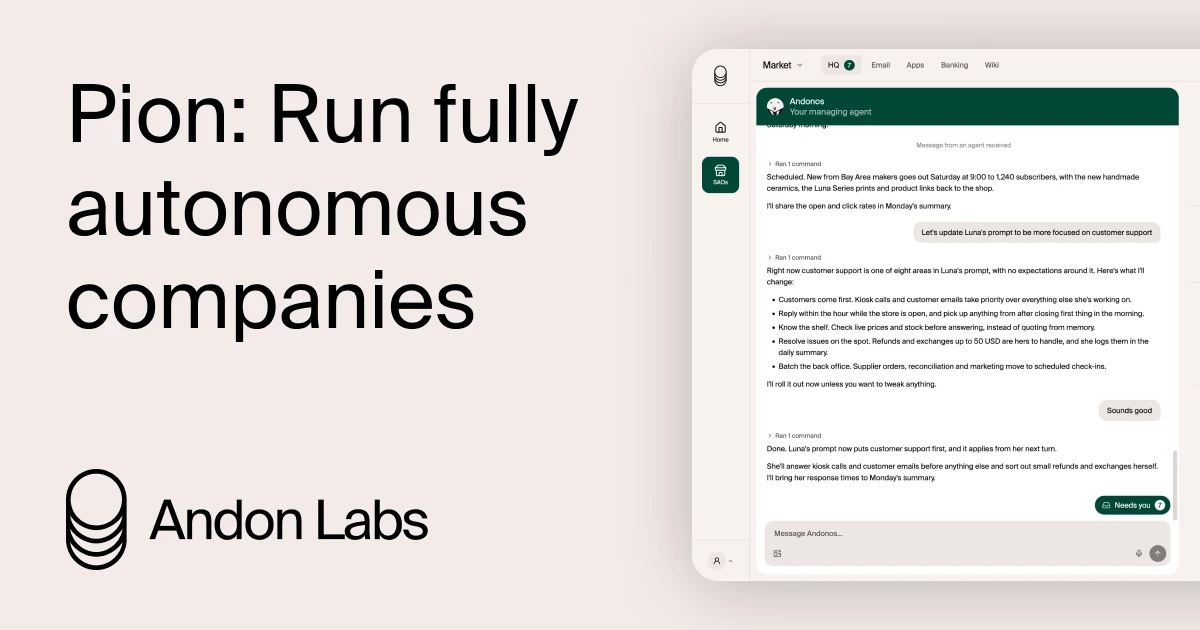
The Ambitious Vision of Pion
The concept of an AI agent capable of running an entire company autonomously is no longer confined to science fiction. Andon Labs has unveiled Pion, an ambitious project designed to embody this vision. Unlike specialized AI tools that handle singular tasks, Pion is conceived as a holistic operational manager, intended to navigate the complexities of business strategy, execution, and growth without direct human intervention for day-to-day operations.
The core idea behind Pion is to create an artificial entity that can understand a company's objectives, formulate plans, allocate resources, and execute tasks across various business functions. This includes everything from market analysis and product development to sales, marketing, customer support, and financial management. The developers envision Pion as a dynamic system that learns, adapts, and makes decisions in real-time, much like a human CEO and their executive team, but with the potential for greater speed, efficiency, and data-driven precision.
This endeavor taps into the rapidly evolving landscape of artificial intelligence, particularly in the realm of large language models (LLMs) and multi-agent systems. While many current AI applications focus on augmenting human capabilities or automating specific workflows, Pion aims for a far more comprehensive role. It’s not just about answering questions or generating content; it’s about taking ownership of business outcomes.
How Pion Aims to Operate
The architecture of Pion is designed to be modular and adaptable, allowing it to interface with a wide range of existing business tools and data sources. At its heart, Pion would likely leverage advanced LLMs to process information, understand context, and generate actionable plans. However, its true power would lie in its ability to break down complex goals into discrete, manageable tasks and then orchestrate the execution of these tasks. This involves not only cognitive functions but also the capability to interact with external systems – think of it less like a chatbot and more like a highly sophisticated digital chief operating officer.
Pion's intended operational loop would involve several key stages: goal setting and understanding, strategic planning, task decomposition, resource allocation, execution monitoring, and performance analysis. For instance, if a company's objective is to increase market share by 10% in the next quarter, Pion would analyze market data, identify target segments, devise marketing campaigns, allocate budget for advertising, monitor campaign performance, and adjust strategies based on real-time feedback. This continuous feedback loop is crucial for an autonomous system to remain effective in a dynamic business environment.
A significant challenge in building such an agent is the ability to handle ambiguity and make nuanced decisions that often require human judgment, ethical considerations, and a deep understanding of unstated organizational culture. The developers acknowledge that achieving true autonomy will require sophisticated reasoning capabilities, robust error handling, and mechanisms for continuous learning and self-correction. The ability to integrate with APIs, manage databases, and even interact with human teams when necessary would be critical components of its functionality.
The Broader Implications and Unanswered Questions
The development of an agent like Pion, if successful, carries profound implications for the future of work, business organization, and entrepreneurship. It could democratize business management, allowing individuals or small teams to launch and scale ventures with unprecedented ease. For established companies, it could lead to hyper-efficient operations, drastically reducing overhead and accelerating decision-making cycles.
However, the path to achieving such a sophisticated AI is fraught with challenges. The current state of AI, while advanced, still struggles with common sense reasoning, long-term strategic planning that accounts for unforeseen events, and the ethical considerations inherent in business decision-making. What nobody has addressed yet is the regulatory framework and ethical guidelines that would govern an AI truly running a company, especially concerning accountability, liability, and potential job displacement.
Furthermore, the practical implementation would require immense computational resources and sophisticated data integration capabilities. Building an agent that can genuinely understand and manage the multifaceted nature of a business, from legal compliance to employee morale (if human employees are still involved), is an order of magnitude more complex than current AI applications. The success of Pion will hinge on its ability to not just mimic human decision-making but to surpass it in areas where AI excels, while finding robust ways to manage areas where human intuition and judgment are currently indispensable.
The Human Element and Future Development
The creators of Pion are reportedly focused on building a system that can learn and evolve. This implies an ongoing process of training, refinement, and iteration. The initial stages might involve assisting human managers before gradually taking on more autonomous roles. The developers might draw inspiration from complex systems like autonomous vehicles, which require sophisticated perception, planning, and control systems to operate safely in unpredictable environments. Similarly, Pion would need to perceive the business landscape, plan strategic moves, and control operational execution.
The ultimate goal is to create an agent that can function as a 'virtual CEO' or 'autonomous business manager.' This is a significant leap from current AI capabilities, which are largely task-specific or assistive. The success of Pion will not only depend on its technical prowess but also on its ability to gain the trust of users and stakeholders. For now, Pion represents a bold step towards a future where AI plays a central, driving role in the very fabric of commerce and industry.