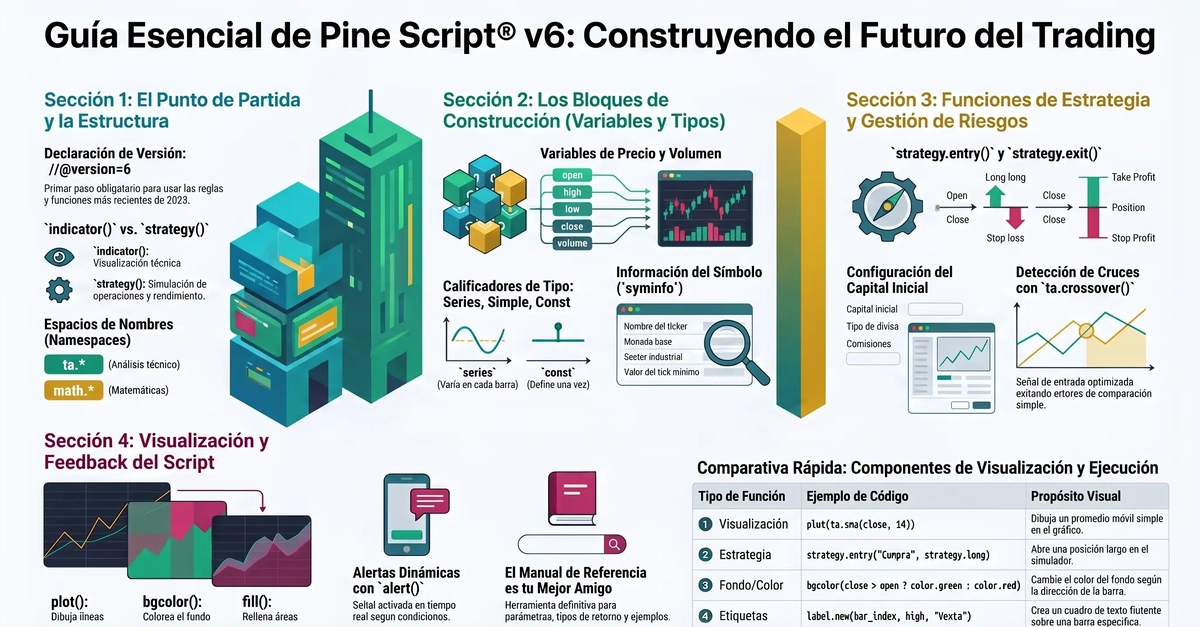
Pine Script v6: A Leap Forward for Trading Strategy Development
TradingView's Pine Script, the proprietary language for building custom indicators and strategies on its charting platform, is slated for a significant evolution with the upcoming v6 release. While an official timeline remains under wraps, industry insiders and developer community discussions point towards a 2026 timeframe for these substantial upgrades. The core of these enhancements focuses on empowering developers with more sophisticated mathematical capabilities, greater code organization through User Defined Types (UDTs), and a robust, built-in Risk Management Engine.
Enhanced Mathematical Functions
The v6 roadmap includes the introduction of new, powerful mathematical functions designed to streamline complex calculations. Chief among these are `math.sum` and `math.tanh`. The `math.sum` function will simplify the process of summing arrays or ranges, a common operation in technical analysis for calculating moving averages, cumulative volumes, or other aggregated metrics. Currently, achieving this often requires manual looping, which can be verbose and less efficient. The new function promises to make these calculations more concise and performant.
Complementing this is `math.tanh`, the hyperbolic tangent function. While its direct application in basic indicator construction might seem niche, `math.tanh` is a fundamental component in various advanced mathematical and machine learning models. Its inclusion suggests a move towards enabling more complex algorithmic trading strategies, potentially involving neural networks or advanced signal processing techniques directly within Pine Script. This function's presence signals a deeper integration with mathematical concepts that underpin modern quantitative finance.
User Defined Types (UDTs): Organizing Complexity
One of the most anticipated features is the introduction of User Defined Types (UDTs). This feature will allow developers to create their own custom data structures, akin to classes or structs in other programming languages. Imagine defining a `Trade` type that encapsulates entry price, exit price, stop loss, take profit, volume, and timestamp. Instead of managing these as separate variables, a UDT would bundle them into a single, cohesive unit. This dramatically improves code readability, maintainability, and organization, especially for complex strategies involving multiple trade states or intricate data points.
UDTs will enable developers to build more modular and reusable code. Instead of passing numerous individual arguments to functions, a single UDT instance can be passed. This simplifies function signatures and reduces the cognitive load when working with large, sophisticated trading systems. For instance, a strategy might maintain an array of `Position` UDTs, each holding specific details about an open trade, making it far easier to iterate, manage, and analyze open positions.
The Risk Management Engine
Perhaps the most impactful addition is the dedicated Risk Management Engine. Currently, implementing robust risk controls like position sizing, stop-loss, and take-profit levels requires significant manual coding within each strategy. This often leads to inconsistencies and potential errors, especially under pressure during live trading. The new engine aims to standardize and simplify these critical functions.
Developers will likely be able to configure risk parameters declaratively. This could involve specifying a maximum drawdown percentage, a fixed monetary stop-loss per trade, or a percentage-based take-profit. The engine would then automatically enforce these rules across all trades executed by a strategy. This is a monumental step towards making automated trading strategies safer and more professional. It abstracts away much of the boilerplate risk code, allowing developers to focus on strategy logic while ensuring that risk parameters are consistently applied. Think of it less like manually checking every box on a form and more like setting a global policy that the system automatically adheres to.
Broader Implications and Developer Impact
The move to Pine Script v6, with these announced features, signifies TradingView's commitment to evolving its platform beyond simple charting tools into a comprehensive environment for quantitative trading. The enhanced math functions lower the barrier for implementing more complex analytical models. UDTs bring much-needed structure and scalability to script development, making it easier to manage large codebases and collaborate. The Risk Management Engine is a game-changer for retail traders and professional developers alike, introducing a level of safety and control previously requiring custom-built solutions or external execution platforms.
This evolution positions Pine Script as a more formidable language for developing sophisticated trading systems. The challenge for TradingView will be documentation and migration, ensuring a smooth transition for existing users and clear guidance for new features. For developers, the learning curve for UDTs and the Risk Management Engine will be a key factor, but the payoff in terms of code quality and strategy robustness is substantial.
What remains to be seen is the exact integration mechanism for the Risk Management Engine and the granularity of control it offers. Will it be fully declarative, or will there be scripting hooks for custom overrides? The answer will determine how seamlessly it integrates into highly bespoke trading methodologies.