
The Phantom Drive: A Stealthy Approach to Portable Encryption
Security professionals and privacy-conscious individuals often face the challenge of securely transporting sensitive data. Traditional methods, like encrypted containers on standard drives or cloud storage, come with their own risks: software vulnerabilities, unauthorized access to cloud accounts, or simply the risk of a device being physically compromised and its contents exposed. Now, a new open-source hardware project called 'Phantom Drive' offers a novel solution, blending physical security with robust encryption in a way that’s designed to evade casual inspection.
Phantom Drive presents itself as a seemingly ordinary 8GB USB flash drive. This capacity is deliberately chosen to be unremarkable, fitting the profile of a common promotional or basic storage device. However, beneath this innocuous exterior lies a hidden, encrypted partition. The magic behind Phantom Drive isn't in a complex software suite, but in its custom firmware and a clever interaction with the USB controller and its microcontroller. The device appears as a standard mass storage device with its 8GB decoy partition, but a specific unlock mechanism reveals the true, larger encrypted storage.
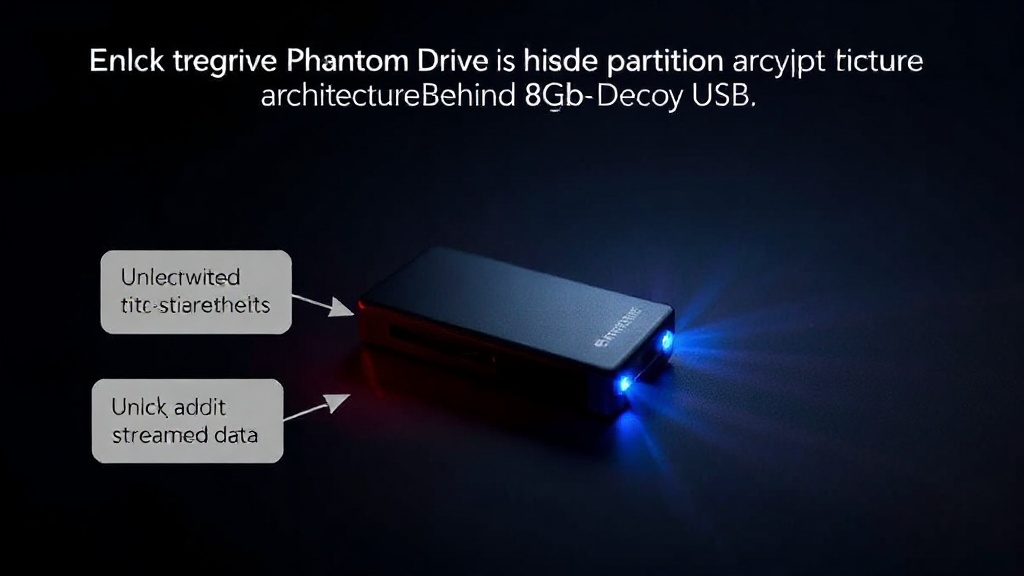
How Phantom Drive Works: Firmware and Interception
The core innovation of Phantom Drive lies in how it handles the password and encryption. When a user wants to access the hidden partition, they don't interact with a typical password prompt. Instead, the system relies on the creation of a specific text file. Within this text file, the user places their chosen password. This file isn't directly read by the operating system to decrypt data. Instead, the custom firmware running on the Phantom Drive’s microcontroller intercepts the process.
During the unlock sequence, the microcontroller reads the content of the designated password file. It then immediately hashes this password using a strong cryptographic algorithm. Crucially, the password itself is never written to any persistent storage on the drive. The hashed password is then used to unlock the encrypted partition. This approach is a significant security advantage. By never storing the plaintext password, the attack surface is dramatically reduced. Even if the decoy partition were to be compromised or forensically analyzed, the actual password would remain unknown.
This method of password handling is reminiscent of how some hardware security modules (HSMs) or secure enclaves operate, where sensitive credentials are processed in a protected environment without ever being exposed to the main system's memory or storage. The microcontroller's SRAM (Static Random-Access Memory) is used to temporarily hold the hashed password during the unlocking process, ensuring it's volatile and lost when the device is powered down or reset.
Implementation and Open-Source Philosophy
The Phantom Drive project is built on an open-source foundation. This means that the hardware design, the custom firmware, and the methodologies used for encryption and decryption are publicly available. This transparency is vital for security-critical projects, as it allows independent researchers and developers to audit the code and hardware for vulnerabilities. It also fosters trust, as users can verify that the device functions as advertised and that no backdoors or weaknesses have been intentionally introduced.
The underlying hardware typically involves a common USB microcontroller capable of running custom firmware, coupled with a flash memory chip. The firmware is the key component, managing the USB interface, presenting the decoy partition, handling the password file creation, performing the hashing, and controlling access to the hidden, encrypted partition. The choice of encryption algorithm for the hidden partition is also critical; strong, well-vetted algorithms like AES (Advanced Encryption Standard) with appropriate key lengths are essential for ensuring data confidentiality.
Building such a device requires a combination of hardware engineering knowledge, embedded systems programming, and a solid understanding of cryptography. The open-source nature lowers the barrier to entry for others who might want to replicate, modify, or build upon the Phantom Drive concept. It also means that the community can contribute to its improvement, potentially leading to more robust designs or enhanced features over time.
Potential Use Cases and Security Implications
The primary use case for Phantom Drive is the secure, discreet transport of sensitive information. Journalists needing to carry confidential source material, activists requiring secure communication tools, or even individuals wanting to protect personal financial or medical records can benefit from this approach. The device's ability to appear as a standard, low-capacity USB drive makes it less likely to attract suspicion compared to devices explicitly marketed as high-security storage.
However, the security of Phantom Drive is not absolute and depends heavily on several factors. The strength of the chosen encryption algorithm and the complexity of the user's password are paramount. A weak password, even when hashed, can be vulnerable to brute-force attacks. Furthermore, the physical security of the device itself remains a consideration. While it hides data well, it's still a physical object that could be lost or stolen. The microcontroller's firmware could also, in theory, be a target for sophisticated attackers seeking to exploit vulnerabilities.
The project also raises an interesting question: as more individuals and organizations seek to protect data in transit, will we see a rise in hardware-based, stealthy storage solutions that mimic everyday devices? The Phantom Drive concept suggests a future where the line between ordinary consumer electronics and secure data carriers becomes increasingly blurred, forcing security professionals to develop new methods for device identification and threat assessment.
Comparison to Other Security Measures
Compared to software-based encryption like VeraCrypt or BitLocker, Phantom Drive offers a layer of physical obfuscation. These software solutions encrypt data on a drive, but the drive itself is still recognizable as a storage device, and the software often needs to be installed or run on the host system, which could be monitored. Phantom Drive's approach bypasses the need for host software for decryption, relying solely on the physical drive and the password file interaction. This makes it more resilient against host-based attacks or unauthorized software installations.
Cloud storage, while convenient, introduces a significant trust model. Users must trust the provider's security, their own account security, and the integrity of the internet connection. Phantom Drive removes the cloud dependency, offering an offline, self-contained solution. However, it lacks the collaboration and accessibility features of cloud storage and is susceptible to physical loss or damage, unlike redundant cloud backups.
The open-source nature of Phantom Drive also distinguishes it from proprietary hardware encryption solutions, which often operate as black boxes. While proprietary solutions might offer polished user experiences and vendor support, their closed nature prevents independent verification of their security claims. Phantom Drive, by contrast, invites scrutiny and community contribution, which can be a powerful driver of security and reliability in the long run.
The Future of Stealthy Storage
The Phantom Drive project represents a fascinating intersection of hardware hacking, cryptography, and practical security needs. Its success hinges on the careful implementation of strong encryption and secure firmware, combined with user diligence in choosing robust passwords. As digital threats continue to evolve, solutions that offer layered security and obfuscation will likely become more prevalent. The challenge for the security community will be to develop effective methods for detecting and defending against such increasingly sophisticated methods of data concealment.