
The Desktop PCB Factory Arrives
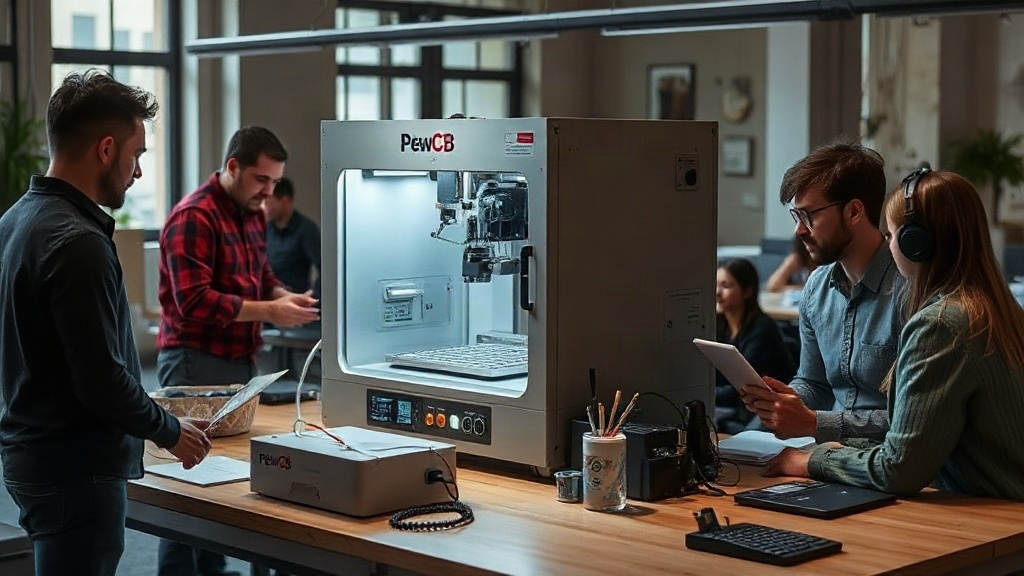
The landscape of hardware prototyping is shifting. Traditionally, creating printed circuit boards (PCBs) involved sending designs to specialized manufacturers, a process that could take days or weeks and incur significant costs, especially for iterative development. PewCB aims to disrupt this workflow with its new desktop PCB factory, a machine designed to bring the entire fabrication process in-house. The company's tagline, "Vibe-routing is coming. Desktop PCB Factory is here," signals an ambition to democratize PCB production for engineers, designers, and hobbyists.
PewCB positions itself as a solution for rapid prototyping, enabling users to go from design to a physical, functional PCB within hours rather than days. This acceleration is critical for fast-paced development cycles where quick iteration and testing are paramount. The machine is touted as a complete fabrication unit, capable of handling multiple steps of the PCB creation process, from milling traces to drilling holes and even finishing the boards.
Core Functionality and Target Audience
At its heart, PewCB is an automated milling and drilling machine. It utilizes a high-speed spindle to precisely carve out the conductive pathways (traces) and drill vias on a copper-clad substrate. This process replaces the chemical etching typically used in larger-scale PCB manufacturing. The machine’s design emphasizes ease of use, aiming to be accessible to individuals without extensive manufacturing experience. This suggests a plug-and-play approach, where users load their design files (likely in standard formats like Gerber or Excellon) and the machine handles the rest.
The target audience appears to be broad, encompassing:
- Electronics Engineers and Designers: Those who need to quickly test new circuit designs without the lead times and costs associated with external fabrication houses.
- Startups and Small Businesses: Companies with limited budgets or a need for extreme agility in their product development.
- Educational Institutions: Universities and schools looking to provide hands-on experience in electronics manufacturing.
- Hobbyists and Makers: Individuals passionate about building their own electronic projects who desire greater control over the PCB creation process.
The appeal lies in the immediate feedback loop. An engineer can discover a design flaw on a freshly milled board, make a correction, and have a new version ready for testing the same day. This dramatically reduces the time spent waiting for new prototypes and allows for more experimentation.
Technical Capabilities and Potential Advantages
While specific technical specifications were not detailed in the initial announcement, the concept of a desktop PCB factory implies several key capabilities. These likely include the ability to mill fine traces and small vias, accommodate standard PCB substrate materials (like FR-4), and offer a reasonable build area for common prototyping needs. The "vibe-routing" mentioned in their marketing suggests a focus on precision and potentially a novel approach to material handling or tool path generation that minimizes vibration for cleaner cuts.
The primary advantage of such a system is unparalleled speed. For a single-sided or double-sided prototype, the time from design to finished board could be reduced from days or weeks to a few hours. This immediacy is a significant factor in accelerating innovation. Furthermore, it offers greater design freedom. Users are not constrained by the minimum order quantities or setup fees of external manufacturers, making it economically viable to produce very small batches or even single, highly customized boards.
Another potential benefit is enhanced intellectual property security. Keeping the fabrication process in-house reduces the risk of sensitive designs being exposed to third-party manufacturers. For projects involving proprietary technology, this can be a crucial consideration.
Challenges and Considerations
Despite the exciting prospects, bringing PCB fabrication to the desktop comes with inherent challenges. The precision required for milling fine features on a PCB is substantial. Achieving consistent, high-quality results on a compact, affordable machine is technically demanding. Factors such as tool wear, spindle stability, material flatness, and the accuracy of the motion control system all play critical roles.
Unlike professional PCB manufacturing facilities that use specialized chemicals for etching and can achieve extremely high resolutions, milling is a subtractive process that can leave burrs and may not be suitable for the most intricate, high-density designs required for advanced applications like high-frequency RF circuits or dense multi-layer boards. The resolution and accuracy of a desktop machine will likely be a limiting factor for some applications.
Maintenance and consumables are also considerations. The milling bits will wear out and need replacement. The machine itself will require calibration and upkeep. Users will also need to source their own copper-clad boards and potentially other finishing materials. The learning curve, while potentially lower than industrial methods, will still exist, requiring users to understand CAM processes and machine operation.
The initial announcement on Product Hunt is a starting point, and detailed specifications, pricing, and availability are crucial for assessing the true impact of PewCB. However, the concept itself addresses a long-standing need in the hardware development community for faster, more accessible PCB prototyping.
The Future of In-House Prototyping
PewCB's entry into the market signals a broader trend towards desktop manufacturing solutions. As 3D printing has revolutionized plastic prototyping, machines like PewCB aim to do the same for electronics. If successful, it could empower a new generation of hardware innovators by lowering the barriers to entry for creating complex electronic devices. The ability to rapidly iterate on PCB designs directly on one's workbench could significantly speed up the time from idea to market for countless new products.
This development is particularly relevant in an era where supply chain disruptions and the desire for localized manufacturing are increasing. Having the capability to produce essential electronic components on-demand, even at the prototype stage, offers a degree of resilience and control that external manufacturing simply cannot match.
What remains to be seen is how PewCB’s technology scales and whether it can deliver the reliability and precision needed to genuinely replace external fabrication for many common prototyping tasks. The success of this product will likely depend on its ability to balance performance, cost, and ease of use, making it an indispensable tool for anyone serious about building hardware.