The Evolving Landscape of AI Hardware
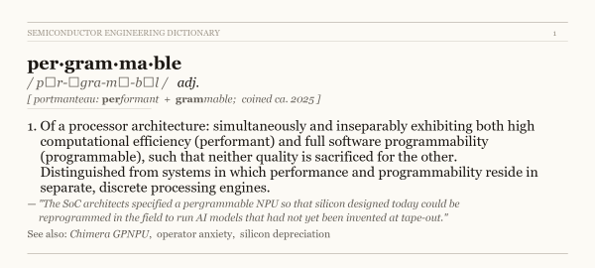
The relentless demand for more powerful and efficient artificial intelligence processing is pushing the boundaries of semiconductor design. Traditional fixed-function accelerators, while offering peak performance for specific tasks, fall short in an era characterized by rapidly evolving AI models and diverse computational workloads. This has ignited a search for a new paradigm in AI silicon: hardware that is both highly efficient and fundamentally programmable. The term 'pergrammable', though not yet a standard dictionary entry, captures this critical design objective.
At its core, the challenge lies in reconciling two often-conflicting goals. High efficiency in AI hardware typically stems from specialization. Architectures are meticulously crafted to optimize for matrix multiplications, convolutions, and other operations common in deep learning. This optimization, however, comes at the cost of flexibility. Once a chip is designed and manufactured with a specific set of functions in mind, altering its capabilities to accommodate new algorithms or unforeseen workloads becomes impossible without a complete redesign and re-fabrication – a prohibitively expensive and time-consuming process.
Conversely, programmability implies a degree of generality. A programmable processor, akin to a CPU or GPU, can execute a wide range of instructions and adapt to new software. While offering immense flexibility, achieving the same level of power efficiency as a specialized ASIC (Application-Specific Integrated Circuit) for a narrow task is often difficult. The overhead associated with instruction decoding, general-purpose data paths, and broader memory access can lead to higher power consumption and lower throughput for highly specific AI operations.
The concept of 'pergrammable' silicon seeks to bridge this divide. It envisions hardware that retains a significant portion of the efficiency benefits of specialized accelerators while incorporating a substantial degree of reconfigurability and adaptability. This isn't merely about adding a few more instructions to an existing fixed-function block; it's about designing architectures from the ground up with programmability as a first-class citizen, without sacrificing the performance and energy efficiency crucial for widespread AI deployment.

Why 'Pergrammable' Matters Now
The current trajectory of AI research and development underscores the urgency for such hardware. The AI landscape is not static. New neural network architectures emerge with surprising regularity. Models are becoming larger, more complex, and are being applied to an ever-expanding array of problems, from natural language processing and computer vision to reinforcement learning and generative AI. What is state-of-the-art today might be suboptimal or even obsolete in a year or two.
For SoC (System on Chip) architects, this presents a formidable challenge. Designing an AI accelerator today means making bets on which algorithms and workloads will dominate in the future. A chip optimized solely for today's convolutional neural networks, for instance, might struggle to efficiently handle the attention mechanisms prevalent in modern transformer models, or the complex graph operations used in graph neural networks.
The 'pergrammable' approach offers a solution by allowing hardware to be adapted through software or firmware updates, rather than requiring physical redesign. This means that a single piece of silicon can potentially support a diverse and evolving set of AI tasks throughout its lifecycle. This adaptability is not just a convenience; it has direct implications for cost, time-to-market, and the longevity of hardware investments.
Consider the economics. Developing and fabricating cutting-edge semiconductor chips is an astronomically expensive undertaking, often running into billions of dollars. A chip that can be reprogrammed to handle new AI tasks extends its useful life, amortizing the initial NRE (Non-Recurring Engineering) costs over a longer period and across a wider range of applications. This is particularly critical for companies that cannot afford to constantly refresh their hardware infrastructure with every algorithmic breakthrough.
Architectural Approaches to Pergrammability
Achieving 'pergrammability' is not a one-size-fits-all endeavor. Several architectural strategies are being explored and implemented by chip designers:
- Configurable Dataflow Engines: These architectures feature processing elements that can be dynamically interconnected to form different computational graphs. Instead of fixed pipelines, the data flow is defined by software, allowing for adaptation to various neural network structures.
- Heterogeneous Architectures: Combining multiple types of processing units on a single chip is another key strategy. This might include dedicated, highly efficient cores for common operations (like matrix multiplication) alongside more general-purpose programmable cores that can handle control flow, novel operations, or less common computational patterns. The 'pergrammable' aspect comes from the ability to orchestrate these diverse cores effectively via software.
- Reconfigurable Logic: Field-Programmable Gate Arrays (FPGAs) have long offered a high degree of reconfigurability. While traditionally not as power-efficient as ASICs for peak performance, advancements in FPGA technology and the integration of specialized AI acceleration blocks are blurring the lines. Modern FPGAs can be programmed at a very granular level, offering a potent form of pergrammability.
- Instruction Set Extensions: For architectures that are already somewhat programmable (like GPUs or specialized AI accelerators), adding new instructions or extending existing ones can provide a pathway to supporting new operations and models. This is a less radical form of pergrammability but can be effective for incremental adaptation.
The surprising detail here is not the complexity of these architectures, but the fact that many companies are converging on similar hybrid approaches. The industry seems to agree that a purely fixed-function or purely general-purpose approach is insufficient for the dynamic demands of AI.
The Broader Implications
The pursuit of 'pergrammable' AI silicon has far-reaching consequences. For developers, it means a more stable and versatile hardware platform. Instead of constantly needing to port code to entirely new hardware architectures with each generation, they can focus on developing and refining AI models, knowing that the underlying silicon can adapt. This accelerates the pace of innovation in AI applications.
For system architects, it simplifies the design process by reducing the need to anticipate every possible future workload. A pergrammable chip offers a degree of future-proofing, allowing for more robust and adaptable systems. This is akin to having a toolkit where many of the tools can be subtly reshaped for different jobs, rather than needing an entirely new set of specialized tools for every minor variation.
From a business perspective, pergrammable silicon can lead to reduced development cycles, lower manufacturing costs over the long term, and a broader market appeal for hardware products. It democratizes access to advanced AI capabilities by making powerful, adaptable hardware more economically viable.
The term 'pergrammable' itself may evolve or be replaced by more standardized industry terminology. However, the underlying concept – the critical need for AI hardware that is both efficient and adaptable – is undeniably shaping the future of semiconductor design. The industry is moving towards silicon that doesn't just compute, but that can be taught to compute in new ways, efficiently and effectively.