The AI Compute Bottleneck: Beyond the GPU
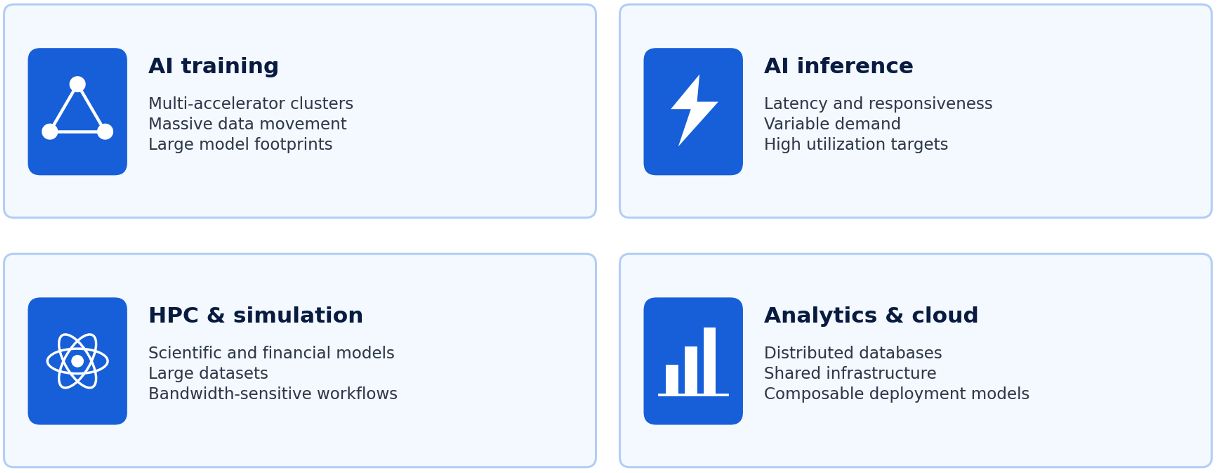
The insatiable demand for AI compute power, driven by ever-larger language models and complex neural networks, is pushing the boundaries of traditional infrastructure. While GPUs remain the workhorses of AI training, their effectiveness is increasingly hampered by the limitations of interconnectivity. Data must flow to and from these powerful processors efficiently, and the Peripheral Component Interconnect Express (PCIe) bus, the standard for connecting high-speed components within a server, is proving to be a significant bottleneck. As AI models grow, so does the need to aggregate more compute resources, often spread across multiple nodes, creating a demand for a more flexible and expansive PCIe fabric.
This is where advanced PCIe solutions, specifically PCIe switches and retimers, become critical. These components are not new, but their application and sophistication are evolving rapidly to meet the unique challenges of AI infrastructure scaling. They enable the creation of configurable PCIe subsystems that can span local expansion within a single server, shared resource domains across multiple servers, and even longer-reach topologies that connect geographically dispersed compute clusters. The goal is to move beyond the confines of a single server chassis and build adaptable, high-bandwidth, low-latency networks that can feed the AI beast.
PCIe Switches: Enabling Resource Sharing and Expansion
PCIe switches are fundamental to building scalable AI infrastructure. They act as intelligent traffic directors, allowing multiple PCIe devices – such as GPUs, TPUs, FPGAs, and high-speed network interface cards (NICs) – to communicate with each other and with the CPU, even when they are not directly connected. A single server might have a limited number of PCIe slots, often dictated by the motherboard and CPU capabilities. PCIe switches allow system designers to increase the number of available PCIe lanes and devices that can be connected. This is crucial for AI workloads that require numerous accelerators, high-bandwidth storage, and fast networking.
More importantly for large-scale AI, PCIe switches facilitate the creation of shared resource domains. Instead of each server being a self-contained unit with its own set of GPUs, switches can create pools of accelerators accessible by multiple compute nodes. This enables a more efficient utilization of expensive hardware. For instance, if a particular AI training job requires 16 GPUs but a single server only has 8, a system architect can design a solution where a PCIe switch connects these 8 GPUs to multiple servers, allowing them to be allocated dynamically as needed. This reduces idle hardware and optimizes resource allocation, which is a significant cost-saving measure in the capital-intensive world of AI supercomputing.
The latest generations of PCIe switches support the newest PCIe standards (e.g., PCIe 5.0 and beyond), offering significantly higher bandwidth per lane compared to older versions. This increased bandwidth is essential for feeding the latest generation of AI accelerators, which can process data at unprecedented rates. Without a corresponding increase in interconnect speed, these accelerators would be starved for data, negating their performance gains. Switches also offer advanced features like Quality of Service (QoS) to prioritize critical AI traffic, error reporting, and advanced diagnostics, all of which are vital for maintaining the stability and performance of large, complex AI systems.
Retimers: Extending Reach and Ensuring Signal Integrity
While switches expand the network's capacity and connectivity options, retimers are essential for maintaining signal integrity over longer distances and through complex routing. PCIe signals are high-frequency and susceptible to degradation from factors like trace length on a motherboard, connector losses, and routing complexity. Without intervention, the signal can become too corrupted for the receiving device to interpret correctly, leading to errors or complete connection failures.
Retimers are active components that receive a degraded PCIe signal, clean it up, re-time it, and retransmit it. Think of them less like a simple amplifier and more like a diligent postal worker who takes a smudged, bent letter, carefully transcribes its contents onto a fresh piece of paper, and delivers it with a crisp new envelope. This process ensures that the data arrives at its destination intact, even when traversing multiple switches, long cables, or complex backplanes. In the context of AI infrastructure, retimers are crucial for building rack-scale and even multi-rack deployments where PCIe devices might be located several meters away from their host CPUs or other devices.
The need for retimers becomes even more pronounced as PCIe speeds increase. Higher data rates mean less tolerance for signal degradation. PCIe 5.0, for example, operates at 32 GT/s per lane, a speed that demands meticulous signal management. Retimers are designed to handle these speeds, often incorporating features like equalization to compensate for signal attenuation and jitter reduction to maintain precise timing. They allow system architects to design more flexible physical layouts for their AI clusters, placing compute resources where they are most convenient or cost-effective, rather than being constrained by strict signal-loss limitations.
Building Configurable Topologies for AI
The combination of PCIe switches and retimers empowers engineers to design a wide array of configurable PCIe topologies tailored to specific AI workloads. For local expansion within a single server, switches can connect multiple GPUs and NVMe SSDs to a high-end CPU. For shared resource domains, a fabric of switches can link dozens or even hundreds of accelerators, allowing compute nodes to access them as needed. This is particularly effective for distributed training scenarios where model parallelism or data parallelism requires efficient communication across many processing units.
Longer-reach topologies are where the synergy between switches and retimers truly shines. Imagine a cluster of AI servers where GPUs in one rack need to communicate directly with FPGAs in another, or where a central pool of memory is shared across many compute nodes. Retimers can extend the reach of these PCIe links across multiple boards, through complex cabling infrastructure, and between different pieces of equipment, ensuring that the high-bandwidth, low-latency communication required for AI remains robust. This allows for the creation of AI supercomputing facilities that are not confined to the traditional server rack but can be architected with greater flexibility and scale.
The development of these advanced PCIe solutions is not just about incremental improvements; it's about fundamentally rethinking how AI compute resources are connected and utilized. By enabling flexible, scalable, and high-performance PCIe fabrics, these components are paving the way for the next generation of AI infrastructure, capable of supporting the most demanding models and workloads. The ability to build configurable PCIe subsystems that span local expansion, shared resource domains, and longer-reach topologies is essential for any organization looking to stay at the forefront of AI development and deployment.