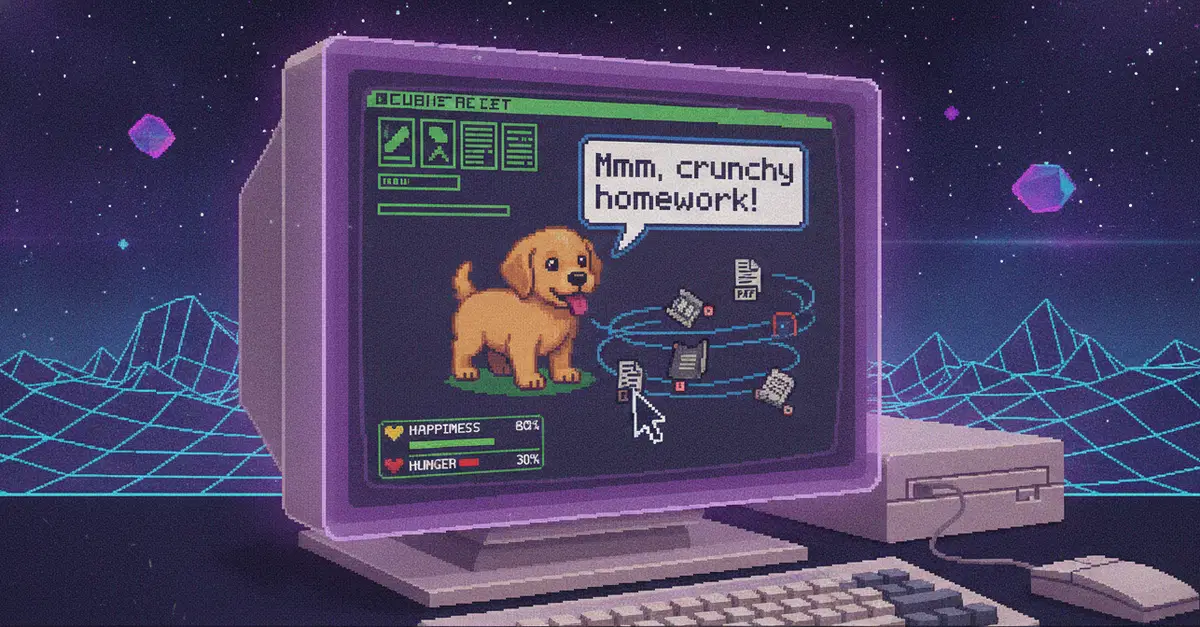
A Nostalgic Revival with an AI Twist
Remember the days of Neko the cat and Tamagotchi, those digital pets that lived on your desktop? That specific brand of pixelated companionship has made a comeback, reimagined for 2026. PawBot, a new Chrome extension, revives this cherished concept but injects it with the power of modern AI, specifically Google's Gemini LLM.
This project, born from the Weekend Challenge: Dog Days Edition, isn't just a static image. PawBot is a dynamic, interactive desktop pet that lives within your browser, offering a touch of whimsy and a novel way to interact with your digital environment. It’s a golden retriever puppy, rendered in charming pixel art, designed to capture attention and provide a unique user experience.
The core of PawBot’s functionality lies in its ability to mimic the playful, sometimes demanding, nature of a real puppy. It roams your screen, a constant but unobtrusive presence. When your cursor gets too close, it springs into action, chasing it with animated enthusiasm. This simple mechanic alone taps into a primal human instinct to interact with moving objects, a core appeal of early desktop pets.
Interactive Features and AI Integration
PawBot goes beyond basic animation. Its feature set is designed to be both engaging and reflective of a living creature. One of its most unique abilities is its file-eating capability. Users can drag and drop various file types – from PDFs and code snippets to simple text or even emoji – directly onto the puppy. PawBot then 'eats' these items, incorporating them into its digital diet. This mechanic, while playful, offers a novel, albeit unconventional, method of interacting with and clearing digital clutter.
The intelligence behind PawBot is powered by Google Gemini. This integration allows the puppy to 'bark back' with short, contextually aware responses. The AI analyzes the user's interaction and the general mood of the browser session to generate appropriate barks. This means PawBot doesn't just react; it communicates, albeit in a limited, pet-like fashion. If left unattended for too long, the puppy exhibits signs of neglect, eventually falling asleep. This is visualized with charming 'Zzz' particles emanating from the sleeping pet, adding another layer of behavioral realism.
Interaction is also key to PawBot’s design. Users can 'pet' the puppy by clicking on it, eliciting a positive reaction. A double-click can be interpreted as a wave or a more enthusiastic greeting. These simple, intuitive actions reinforce the bond between the user and their digital companion, bringing back the emotional connection that made Tamagotchis and Neko so popular.
The Appeal of Digital Companionship
The resurgence of desktop pets like PawBot speaks to a larger trend: the human need for connection and companionship, even in digital spaces. In an era where digital interactions often feel transactional, PawBot offers a moment of levity and a non-demanding form of engagement. It’s a digital equivalent of having a plant on your desk that you can briefly interact with, but with the added personality and responsiveness of AI.
The choice of a golden retriever puppy is also significant. This breed is widely associated with loyalty, playfulness, and friendliness, making it an ideal archetype for a digital companion. The pixel art aesthetic further enhances the nostalgic appeal, bridging the gap between retro charm and modern technology. It’s a deliberate design choice that appeals to a wide audience, from those who remember the original desktop pets to a new generation discovering them.
PawBot’s development as a Chrome extension means it’s readily accessible to a vast number of internet users. It doesn't require complex installation or significant system resources, making it an easy addition to anyone's browsing experience. The combination of a familiar concept, advanced AI, and accessible technology positions PawBot as more than just a novelty; it's a glimpse into how AI can be integrated into everyday digital life to add personality and interaction.
Future Possibilities and Broader Implications
While PawBot is currently presented as a fun, engaging project, its underlying technology opens doors to more sophisticated applications of AI-driven desktop companions. Imagine pets that could provide gentle reminders, offer personalized productivity tips based on user habits, or even serve as a visual interface for managing notifications. The 'file-eating' mechanic, while whimsical, could be abstracted into a visual representation of data processing or task completion.
The success of such projects also highlights the growing interest in AI that is not solely focused on utility but also on emotional engagement and entertainment. As AI models become more sophisticated, the line between functional tools and digital companions will continue to blur. PawBot, in its current form, is a delightful experiment in this evolving landscape, proving that AI can be both powerful and playful.
What remains to be seen is how developers will build upon this concept. Will future iterations offer deeper AI integration, allowing for more complex conversations or personalized behaviors? Could PawBot evolve into a platform for other AI-driven digital pets, creating a whole ecosystem of interactive screen inhabitants? The current implementation is a charming starting point, demonstrating the potential for AI to inject personality and fun into our otherwise utilitarian digital lives.