The Campus Navigation Conundrum
Large university campuses present a perennial challenge: finding your way. For new students, visiting faculty, or even returning students navigating expanded facilities, locating lecture halls, administrative offices, labs, or libraries can be a time-consuming ordeal. Standard mapping applications often fall short, lacking the granular detail needed to pinpoint specific campus locations like department offices, printing centers, or student service hubs. This disconnect leads to confusion and wasted time, particularly at the start of academic sessions.
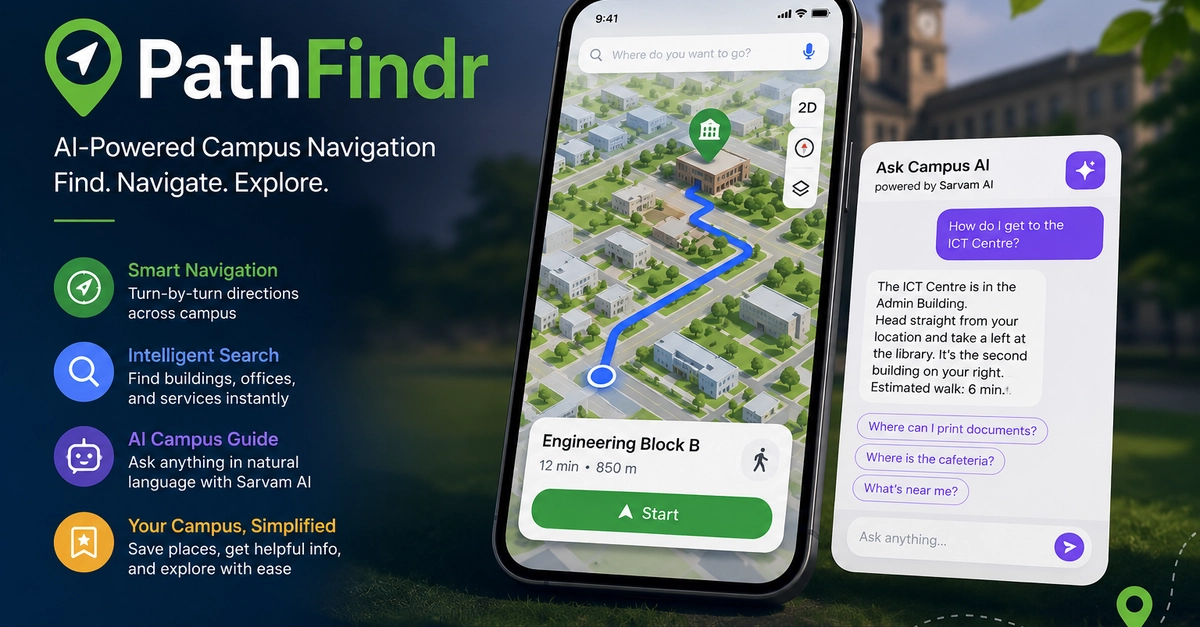
To tackle this problem head-on, a team developed PathFindr, an AI-powered mobile application specifically designed to streamline campus navigation. PathFindr aims to make the process simple, intuitive, and accessible for everyone on campus.
Leveraging Technology for a Smarter Campus
PathFindr's architecture is built on a foundation of modern, efficient technologies. The frontend is developed using Expo, a framework and platform for universal React applications. Expo significantly simplifies the development process for mobile apps by providing a managed workflow, a vast library of pre-built components, and the ability to deploy to both iOS and Android from a single codebase. This choice allows for rapid iteration and broad reach without the complexities of native development.
The core intelligence of PathFindr is powered by Sarvam AI. Sarvam AI, a significant player in the Indian AI landscape, provides the underlying large language models (LLMs) and natural language processing (NLP) capabilities. These models are crucial for understanding user queries, processing campus data, and generating accurate, context-aware navigation instructions. By integrating Sarvam AI, PathFindr can process natural language requests like "Where is the nearest computer lab?" or "How do I get to the Dean's office from here?" and translate them into actionable routes.
Core Functionality and User Experience
PathFindr's primary function is to provide precise, turn-by-turn directions within campus environments. Unlike generic mapping services, PathFindr's data is curated specifically for university campuses. This includes detailed information about buildings, floor plans, room numbers, and the specific functions of various facilities. The AI component ensures that the navigation is not just accurate but also contextually relevant. For example, if a user asks for the "student union," the AI can differentiate between various student union buildings or facilities and guide them to the most appropriate one based on their current location and typical campus usage patterns.
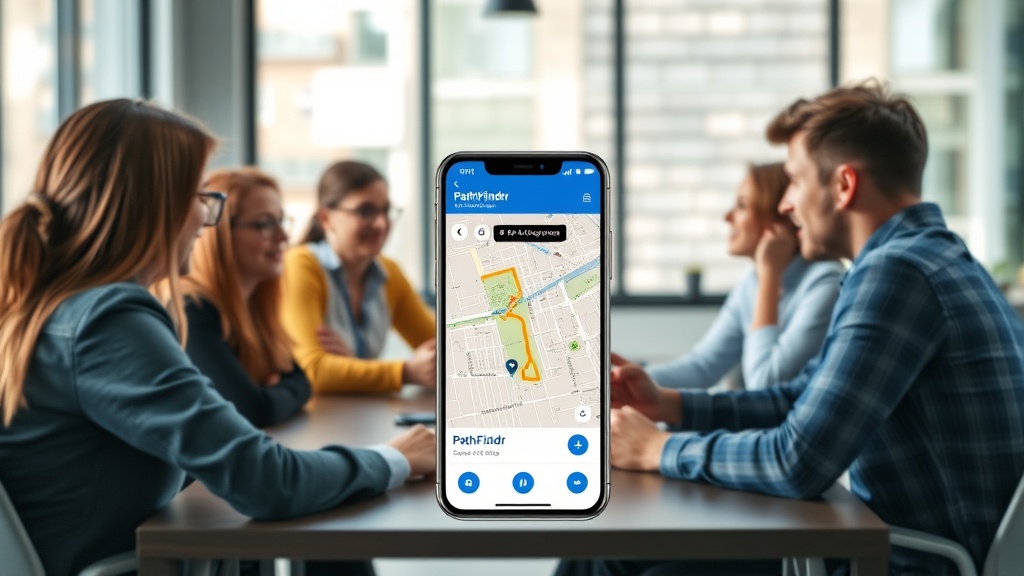
The development team focused on creating an intuitive user interface. Users can input their destination via text or potentially voice commands. The application then calculates the most efficient route, taking into account indoor navigation where applicable (e.g., guiding a user to a specific room within a large building). The routes are displayed clearly on a map, with visual cues and textual instructions. The use of Expo ensures a consistent and high-quality user experience across different mobile devices.
The AI Advantage: Beyond Simple Directions
The integration of Sarvam AI elevates PathFindr beyond a mere GPS tool. The AI's ability to understand natural language queries means users don't need to know the exact nomenclature of campus locations. The system can interpret variations in language and provide the correct guidance. Furthermore, the AI can learn and adapt, potentially improving its understanding of user needs and campus layouts over time. This could lead to features such as personalized route suggestions based on user history or real-time updates on campus events that might affect navigation, like road closures or building access changes.
What remains to be seen is how effectively PathFindr can scale its AI model to handle the diversity of information across numerous university campuses. Each campus has its unique layout, naming conventions, and facility types. Training a single AI model to be proficient across a wide range of such environments presents a significant data and engineering challenge. The success will hinge on the quality and breadth of the training data and the robustness of Sarvam AI's underlying architecture to generalize effectively.
Development Workflow and Tooling
The choice of Expo as the development framework streamlines the entire mobile app development lifecycle. Expo's unified API simplifies access to device features like camera, location, and storage, reducing the need for complex native module integration. Its over-the-air (OTA) update capabilities allow developers to push updates to the app instantly without requiring users to download a new version from the app store, which is invaluable for rapidly evolving applications like PathFindr.
The development team likely benefited from Expo's extensive documentation and active community support. This allows for faster problem-solving and quicker adoption of new features. For a project aiming to provide a seamless navigation experience, the ability to quickly test and deploy changes is paramount. The synergy between Expo's development efficiency and Sarvam AI's intelligent backend creates a powerful platform for a sophisticated navigation solution.
Future Potential and Broader Implications
PathFindr demonstrates a compelling use case for AI in improving the daily lives of students and staff within educational institutions. Beyond navigation, the underlying technology could be extended to provide information about campus services, event schedules, or even real-time crowd density in different areas. The successful implementation of PathFindr could serve as a blueprint for other smart campus initiatives, integrating AI and mobile technology to create more efficient and user-friendly university environments.
The partnership between a mobile development framework like Expo and an AI provider like Sarvam AI highlights a growing trend in application development: leveraging specialized platforms to accelerate innovation. Developers can focus on unique features and user experiences, relying on robust frameworks for cross-platform compatibility and powerful AI services for intelligent functionalities. This approach democratizes the creation of sophisticated applications, making advanced capabilities accessible to a wider range of development teams.