Overview
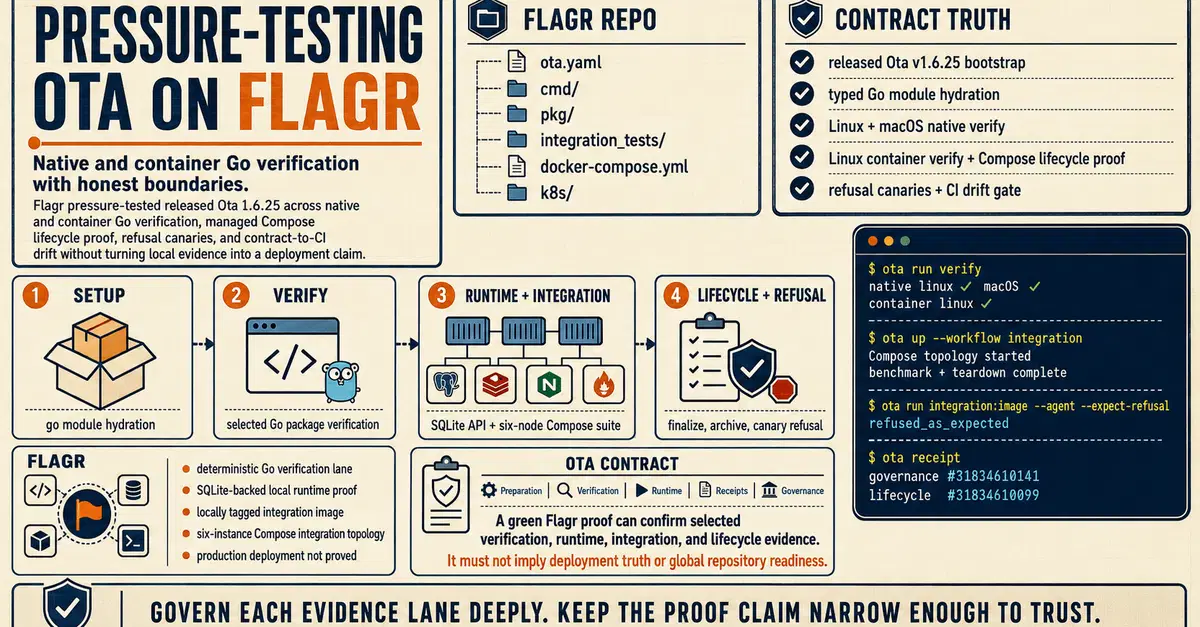
Flagr, a feature flagging service, serves as a critical benchmark for Ota's ability to maintain legibility across diverse execution environments. The new pressure-testing suite targets Ota's Go verification path, which encompasses a local SQLite-backed API, a six-instance Docker Compose integration topology, four distinct database services, and a locally tagged integration image. These represent fundamentally different 'execution truths.' The goal is to prevent a single green test command from masking underlying discrepancies in readiness or deployment claims across these varied setups.
The pressure contract, implemented for Ota version v1.6.25, rigorously separates deterministic verification logic from runtime and integration tasks. This ensures that the Docker Compose topology operates under a runner-owned lifecycle proof, offering a more accurate reflection of its operational state. Notably, this testing strategy explicitly removes Windows from the primary verification surface. Instead, any Windows-specific considerations are relegated to an audit-only lane, preventing them from being misconstrued as full execution support.
Why This Repo Mattered
Flagr's architecture is significant because it combines several patterns commonly found in mature, distributed systems. Its complexity, involving multiple databases, containerized services, and both native and containerized execution paths, makes it an ideal candidate for stress-testing verification tooling. The challenge lies in ensuring that Ota's verification process can accurately assess the health and correctness of Flagr regardless of the underlying infrastructure. This includes validating API responses, database integrity, and inter-service communication within the Docker Compose environment.
Separating Deterministic Verification from Runtime Concerns
A core tenet of this pressure test is the strict separation between what can be verified deterministically and what requires runtime or integration-level checks. Deterministic verification typically involves static analysis, unit tests, and checks that can be performed without actually running the service in a live environment. This might include syntax checks, type validation, and simple logic tests. Runtime verification, on the other hand, involves testing the application as it executes, assessing its behavior under load, its response to network conditions, and its interactions with external dependencies.
By isolating these two types of verification, the Ota test suite gains clarity. A failing deterministic test points to a code-level issue within Ota itself or its direct Go dependencies. A failing runtime or integration test, however, suggests a problem with the environment, the configuration, the network, or the interaction between Flagr and Ota. This distinction is crucial for efficient debugging and for building confidence in the overall stability of the Ota verification process across different deployment scenarios.
Handling Multiple Execution Truths
The concept of 'multiple execution truths' is central to understanding the value of this work. In a development workflow, especially one involving microservices and containerization, a single codebase can manifest in several distinct ways. There's the code running natively on a developer's machine, the code running within a Docker container locally, and the code running in various configurations on production or staging environments. Each of these can have subtle differences in dependencies, networking, or environmental variables that affect behavior.
Ota's verification must account for these differences. Simply running a test suite against a native binary doesn't guarantee that the same tests will pass when that binary is containerized and deployed. The pressure test on Flagr specifically targets these discrepancies. It uses Docker Compose to spin up a realistic, multi-service environment that mimics production, allowing Ota's verification to be evaluated under conditions that closely mirror real-world deployments. The explicit removal of Windows from the primary verification surface acknowledges the practical challenges of maintaining cross-platform compatibility for execution verification and focuses resources on the most critical deployment targets.
The Pressure Contract and Lifecycle Proof
The 'pressure contract' defines the specific conditions and expectations for Ota's verification within the Flagr repository. It sets clear boundaries on what constitutes a successful verification and what metrics are tracked. This contract ensures that the tests are not only comprehensive but also repeatable and reliable. By pinning a specific version of Ota (v1.6.25), the contract provides a stable baseline for evaluating the effectiveness of the testing strategy.
Furthermore, the integration topology is equipped with a 'runner-owned lifecycle proof.' This means that the entity running the tests (the runner) is responsible for managing the entire lifecycle of the integration environment, from setup and configuration to execution and teardown. This approach enhances the determinism of the integration tests, as it reduces reliance on external or pre-existing environmental states. It's akin to a chef preparing all ingredients and tools before starting to cook, ensuring a controlled and predictable cooking process.
Implications for Ota and Flagr Users
For developers using Ota, this rigorous pressure-testing signifies a commitment to robust verification across complex deployment scenarios. It means that Ota's capabilities are being validated not just in isolation but within realistic, multi-component systems like Flagr. This builds confidence that Ota will perform as expected when integrated into larger, containerized applications.
For Flagr users and contributors, this work helps ensure that the service's own verification processes are reliable and that its integration with tools like Ota is well-understood and stable. The clarity gained from separating execution truths and deterministic checks will likely lead to more maintainable and trustworthy testing infrastructure for Flagr itself. The shift away from broad Windows execution support in favor of focused audit lanes suggests a strategic prioritization of testing resources on the most impactful platforms.