Oracle Cuts Always Free ARM Compute Resources
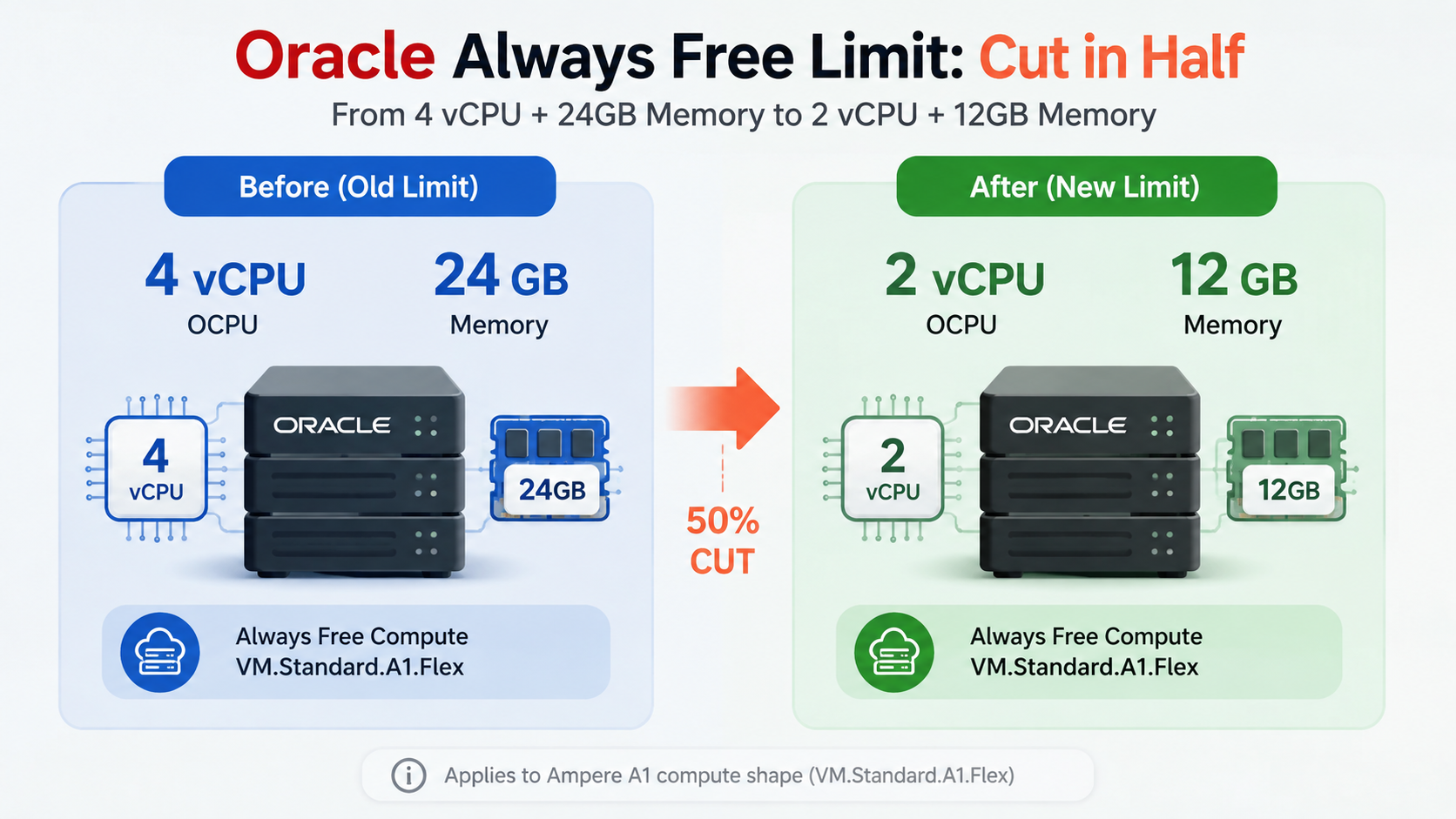
Oracle Cloud Infrastructure (OCI) has significantly altered its popular Always Free tier, notably halving the available compute cores for its ARM-based Ampere A1 instances. Previously, users could provision up to two ARM cores for free. This change, effective immediately, limits free tier ARM compute to a single core. While the total memory allocation remains unchanged at 6 GB, the reduction in CPU cores will affect the performance and feasibility of certain projects that relied on the dual-core free tier.
The Always Free tier has been a cornerstone for developers, students, and hobbyists looking to experiment with cloud-native technologies, host personal projects, or learn new skills without incurring costs. The ARM instances, powered by Ampere Altra processors, offered a compelling performance-per-watt proposition, making them attractive for a variety of workloads, from web servers and CI/CD pipelines to small databases and microservices. The previous offering of two Ampere A1 cores allowed for more robust setups, enabling users to run more demanding applications or host multiple services concurrently on a single free instance.
This reduction signals a potential shift in Oracle's strategy for its free tier, possibly aimed at managing the costs associated with its generous early offerings or encouraging more users to transition to paid tiers for more demanding applications. The move comes as the cloud computing market matures, and providers increasingly refine their free tier offerings to balance user acquisition with operational expenses. Competitors often have more restrictive free tiers, sometimes limited to single cores or specific instance types with stricter usage caps. Oracle's previous offering was notably generous, making this a significant change for its user base.
Impact on Users and Projects
For developers running personal websites, small blogs, or development/testing environments, the change might necessitate optimizations or a re-evaluation of their infrastructure. A single ARM core, while still capable, may not be sufficient for applications that require sustained multi-threaded performance or the ability to handle concurrent requests efficiently. This could mean that projects previously hosted comfortably on the free tier might now experience performance degradations, requiring users to either scale back their ambitions or consider upgrading to a paid OCI tier.
The reduction in compute cores directly impacts the ability to run multiple applications or services on a single free instance. For instance, a user might have been running a web server and a database on separate cores, or a CI/CD agent alongside a development environment. With only one core available, users will need to make choices about which workload is most critical, potentially leading to a less versatile or efficient setup. This change could also affect the learning experience for those using the free tier to understand multi-instance cloud architectures, as the ability to simulate distributed systems on a shoestring budget is diminished.
However, it is important to note that the memory allocation for the Always Free ARM instances remains at 6 GB. This means that memory-intensive applications might still be viable, provided their CPU demands are modest. The core count reduction is primarily a constraint on processing power and the ability to handle parallel tasks. Users who primarily relied on the generous memory for in-memory databases or caching mechanisms might find the impact less severe, assuming their CPU usage was not the bottleneck.
The broader implication is that the era of exceptionally generous free cloud compute resources, particularly for powerful ARM architectures, may be drawing to a close. As cloud providers continue to innovate and offer more specialized hardware like ARM processors, they also face pressure to monetize their services. This move by Oracle suggests a recalibration of what constitutes a sustainable free offering in a competitive market. Developers and hobbyists should remain vigilant about changes to free tier offerings across all major cloud providers, as these can significantly influence project planning and execution.
What remains to be seen is whether this change signals a broader trend of Oracle tightening its free tier across other services, or if it is a specific adjustment to manage the costs and demand for its Ampere A1 instances. The company has historically been aggressive in its cloud strategy, and such adjustments are not uncommon as services mature and gain wider adoption. For now, users of the Always Free ARM tier must adapt to the new, single-core limit.