
Opus 5 Takes Pole Position on AI Leaderboard
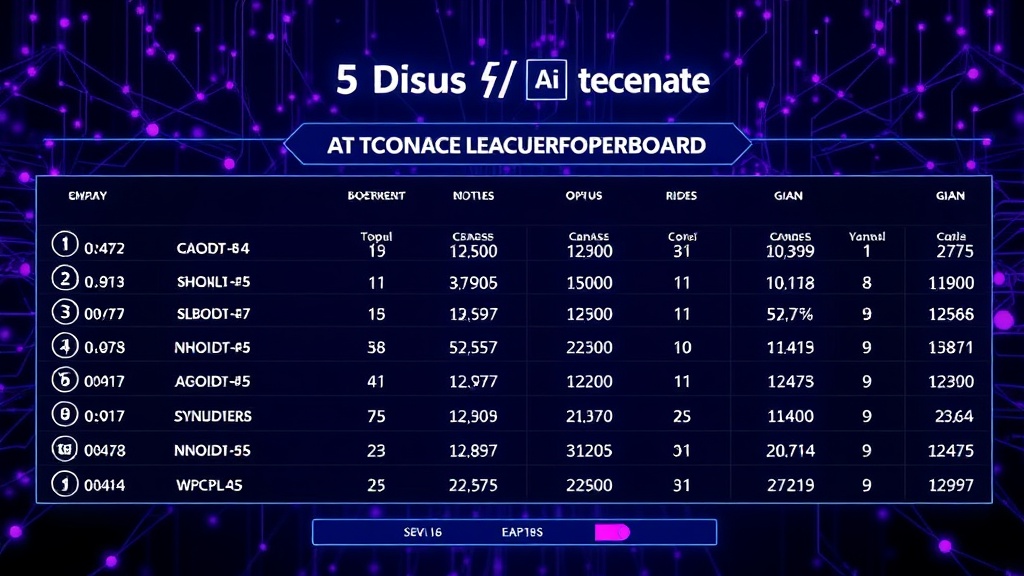
Anthropic's latest large language model, Opus 5, has ascended to the number one position on the Artificial Analysis Intelligence Leaderboard, a significant achievement that places it ahead of models from industry titans like Google and OpenAI. This ranking signifies a new benchmark in AI performance, particularly in areas requiring complex reasoning and nuanced understanding.
The Artificial Analysis Intelligence Leaderboard tracks the performance of various AI models across a range of benchmarks designed to test their capabilities in areas such as reasoning, coding, mathematics, and general knowledge. Opus 5's ascent to the top spot indicates a substantial leap in its ability to handle sophisticated tasks, a development that will undoubtedly shape the competitive landscape of AI development.
While the exact methodologies and specific benchmarks contributing to the top ranking are detailed on the Artificial Analysis website, the implication is clear: Opus 5 demonstrates superior performance in critical AI evaluation metrics. This positioning is not merely a symbolic victory; it suggests that Opus 5 possesses advanced capabilities that could translate into more powerful and reliable AI applications for a variety of industries.
Understanding the Leaderboard and Opus 5's Performance
The Artificial Analysis Intelligence Leaderboard is curated by a team focused on objective AI evaluation. It employs a multifaceted approach to assess models, moving beyond single-task performance to capture a more holistic view of an AI's intelligence. This includes evaluating performance on tasks that require:
- Complex Reasoning: The ability to break down intricate problems, identify logical connections, and derive sound conclusions.
- Mathematical Proficiency: Solving advanced mathematical problems, demonstrating a deep understanding of concepts rather than rote memorization.
- Coding Prowess: Generating efficient, correct, and idiomatic code across various programming languages, and debugging existing code.
- General Knowledge and Comprehension: Accessing and synthesizing information from a vast knowledge base to answer questions and explain concepts accurately.
Opus 5's success on this leaderboard suggests it excels across these diverse domains. This is a departure from previous AI models that might have shown strength in one area but lagged in others. The consistent high performance across multiple benchmarks indicates a more generalized and robust form of artificial intelligence.
The surprising detail here is not just that Opus 5 has reached the top, but the margin by which it may have surpassed its competitors in certain key areas. While specific scores are available on the leaderboard, the consensus among AI observers is that Opus 5 has introduced a new level of sophistication, particularly in its ability to handle multi-turn, complex reasoning tasks that have historically been challenging for even the most advanced models.
Implications for the AI Ecosystem
Anthropic's Opus 5 leading the Artificial Analysis Intelligence Leaderboard has several significant implications for the broader AI ecosystem. For developers and researchers, it means a new, more capable tool is available, potentially unlocking new possibilities for application development. Companies that have been hesitant to integrate advanced AI into their workflows due to performance limitations may now find Opus 5 to be a compelling solution.
For competitors like OpenAI and Google, this ranking serves as a clear signal. It underscores the relentless pace of innovation in the LLM space and highlights the need for continuous improvement and research. The race to develop more capable and efficient AI models is intensifying, and Opus 5's performance sets a new target for others to aim for. This competitive pressure is ultimately beneficial for end-users, as it drives the development of increasingly sophisticated and useful AI technologies.
Founders and product managers should consider how Opus 5's advanced capabilities can be leveraged to create differentiated products or enhance existing ones. The ability to handle more complex queries and generate more nuanced outputs could lead to improved customer experiences, more efficient internal processes, and the creation of entirely new product categories. The question remains: how quickly can these advanced capabilities be integrated into widely accessible platforms and services?
What This Means for the Future of AI
The ascendancy of Opus 5 is more than just a competitive win; it signifies a maturing of large language model technology. It suggests that models are moving beyond impressive parlor tricks to become genuine problem-solving tools. This advancement is crucial for the adoption of AI in critical sectors such as healthcare, finance, and scientific research, where accuracy, reliability, and complex reasoning are paramount.
The continuous improvement in AI model performance, as demonstrated by Opus 5, also prompts a re-evaluation of current benchmarks and evaluation methodologies. As models become more sophisticated, the metrics used to assess them must evolve to keep pace. The Artificial Analysis Intelligence Leaderboard's comprehensive approach is a step in the right direction, but the industry will need to remain agile in defining and measuring true AI intelligence.
If you are a developer building AI-powered applications, it is imperative to evaluate Opus 5's capabilities against your current stack. Understanding its strengths and weaknesses relative to other leading models will be key to making informed decisions about which AI to integrate for optimal performance and user experience. The era of highly capable, general-purpose AI models is rapidly approaching, and Opus 5 is a clear indicator of this trend.