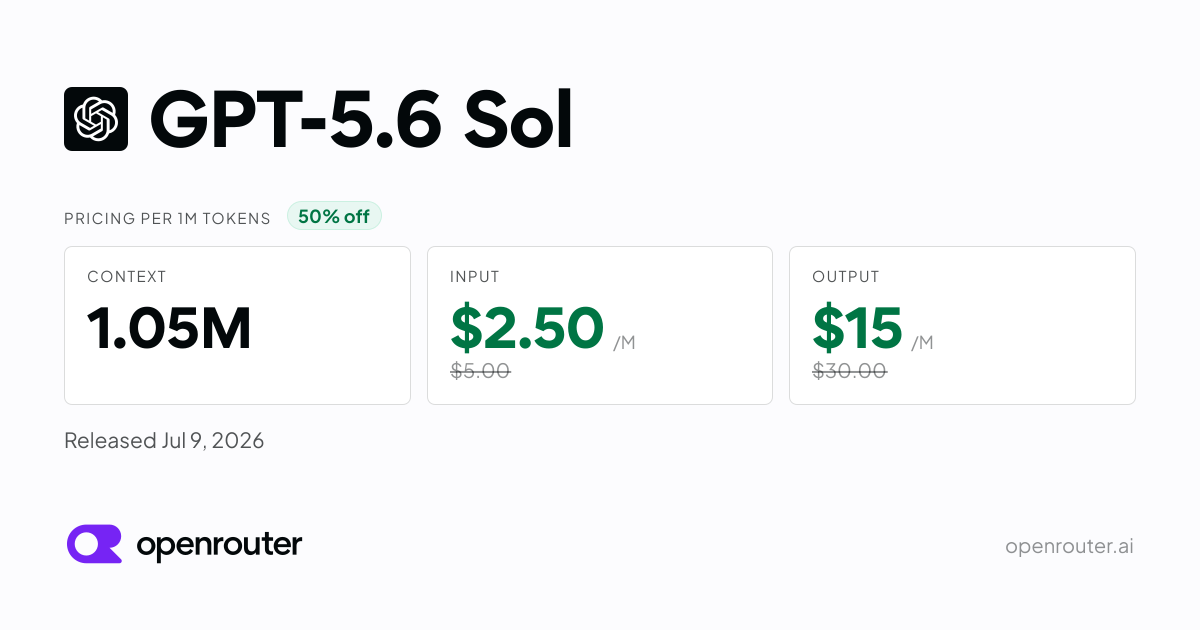
OpenRouter Announces Major Price Cut for GPT-5.6 Sol
OpenRouter, a platform that aggregates and provides access to various large language models, has announced a dramatic 50% reduction in the pricing for its GPT-5.6 Sol model. This move is set to significantly lower the operational costs for developers and businesses that rely on this particular model for their AI-powered applications. The price cut, effective immediately, positions GPT-5.6 Sol as a more accessible and cost-effective option in an increasingly competitive AI landscape.
Understanding the GPT-5.6 Sol Model and its Significance
GPT-5.6 Sol is a specialized large language model known for its advanced reasoning capabilities, particularly in complex problem-solving and code generation tasks. While OpenAI has not officially released a model named 'GPT-5.6 Sol,' the naming convention suggests it is a variant or a high-performance tier within a broader GPT-5.x family, possibly optimized for specific use cases or offering enhanced features over standard versions. Platforms like OpenRouter often provide access to these models, sometimes with their own optimizations or pricing structures, acting as a crucial intermediary for developers who need flexible and scalable AI solutions without the direct infrastructure overhead of managing their own model deployments.
The significance of a 50% price reduction cannot be overstated. For startups and smaller businesses, API costs can represent a substantial portion of their operational budget. A reduction of this magnitude can free up capital for further development, marketing, or expansion. For larger enterprises, it can enable the scaling of AI features to a much wider user base or the deployment of more sophisticated AI functionalities that were previously cost-prohibitive. This price cut makes GPT-5.6 Sol competitive with, or even cheaper than, other high-tier models available on various platforms, potentially shifting the cost-benefit analysis for many AI application developers.
Implications of the Price Reduction
The most immediate implication of this price cut is the direct financial benefit to users. Developers can now run more inference requests, train models with larger datasets, or deploy more complex AI workflows for the same budget. This could lead to an acceleration in the adoption of GPT-5.6 Sol for new projects and an increase in usage for existing ones. For instance, a company using GPT-5.6 Sol for customer support chatbots might find they can handle double the volume of inquiries within their existing budget, leading to improved customer satisfaction and reduced human agent load. Similarly, developers building AI-powered coding assistants could afford to offer more advanced features or handle more complex code analysis tasks.
This pricing strategy also signals a broader trend in the AI model market: the commoditization of powerful AI capabilities. As more advanced models become available and competition intensifies, providers are increasingly looking for ways to differentiate themselves, and price is a significant factor. OpenRouter's aggressive pricing for GPT-5.6 Sol could pressure other platforms and model providers to re-evaluate their own pricing structures. It suggests a market where access to cutting-edge AI is becoming more democratized, lowering the barrier to entry for innovation.
What This Means for Developers and Businesses
For developers, this presents an opportunity to experiment with and integrate GPT-5.6 Sol into their applications with reduced financial risk. They can afford to push the boundaries of what's possible, knowing that the cost of inference is significantly lower. This might encourage the development of more niche AI applications that were previously not economically viable. Developers should re-evaluate their current LLM choices and consider if GPT-5.6 Sol, at its new price point, offers a superior cost-performance ratio for their specific needs.
Businesses can leverage this price cut to enhance existing AI-driven services or explore new AI initiatives. The reduced cost of API calls might make it feasible to implement AI features that were previously considered too expensive, such as personalized content generation at scale, advanced data analysis, or sophisticated natural language understanding for internal tools. This could be a catalyst for companies to accelerate their AI adoption strategies and gain a competitive edge.
The Competitive Landscape and Future Outlook
The AI model market is dynamic, with new models and pricing adjustments occurring frequently. OpenRouter's bold move places GPT-5.6 Sol in a highly competitive position. It directly challenges models from other major providers by offering a potentially more powerful solution at a significantly reduced cost. This could lead to a price war or, at the very least, a recalibration of market expectations regarding the cost of high-performance LLMs. The long-term impact will depend on how other providers respond and whether OpenRouter can maintain this pricing while ensuring model performance and availability.
This development underscores the rapid evolution of AI accessibility. What was once the domain of large research institutions and well-funded corporations is increasingly becoming available to a broader spectrum of users. The 50% price cut on GPT-5.6 Sol is a clear indicator that the AI industry is maturing, with a growing emphasis on making advanced AI tools more practical and affordable for everyday use and development. Developers and businesses should stay attuned to these market shifts, as they can significantly impact technology roadmaps and strategic planning.