The Problem with Single-Agent AI
The current landscape of AI tools, while impressive, often suffers from a fundamental limitation: the reliance on single prompts and single agents. This approach, while simple, proves unproductive for complex tasks. Even the most advanced models, such as Kimi K3, Claude Fable 5, GPT Sol, and DeepSeek V4 Pro, exhibit significant flaws. These include inconsistent output quality, difficulty in maintaining coherent responses, and even what users colloquially refer to as "dumb hours" when model performance degrades. These issues stem from the inherent limitations of treating AI as a monolithic, single-input/single-output system.
For developers and power users, the desire for reliable workflows and pipelines to harness AI effectively is paramount. The frustration arises when a single AI agent fails to deliver a complete solution, requiring constant human intervention to guide it through a multi-step process. This is akin to having a brilliant but forgetful assistant who needs to be reminded of every previous instruction. The core issue is that complex problems rarely have simple, one-shot answers. They require a sequence of operations, decision points, and potentially, the collaboration of multiple specialized intelligences.
The author's experience using these tools highlighted this bottleneck. The desire for a more robust and automated way to chain AI capabilities led to the development of a new project. This project seeks to address the productivity gap inherent in single-agent interactions by introducing a more sophisticated architectural pattern.
Introducing Node-Based Workflows for AI
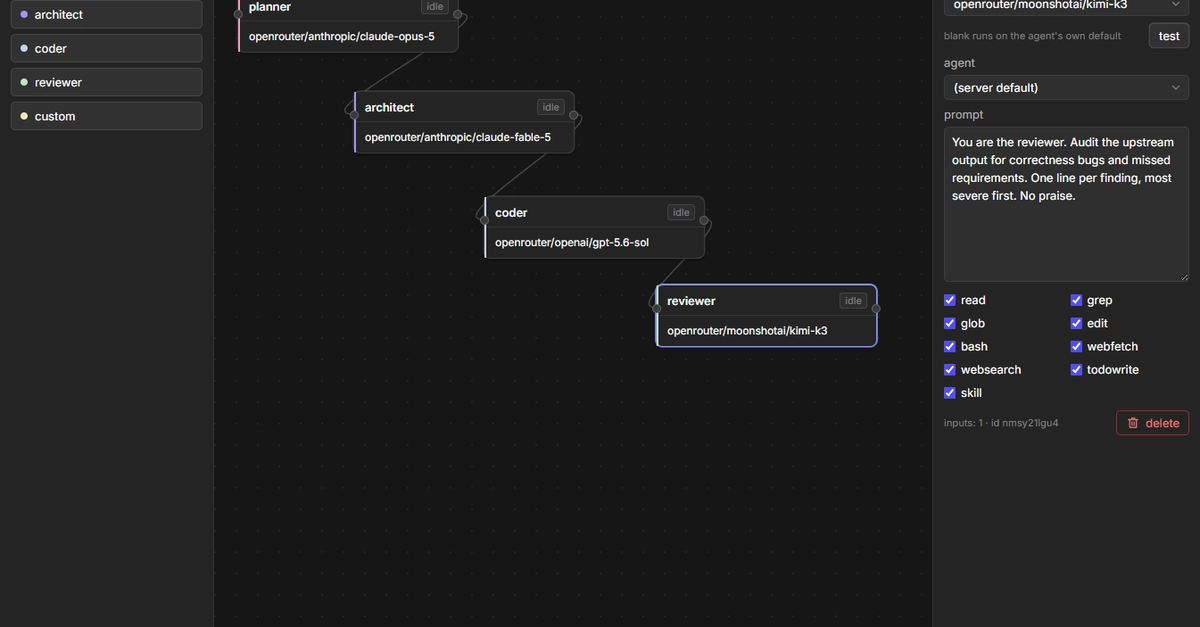
The solution lies in adopting a node-based workflow paradigm. This approach, familiar from visual programming environments and data processing pipelines, allows for the creation of complex, interconnected systems of AI agents. Instead of a linear sequence of prompts, a node-based system treats each AI agent or function as a distinct node. These nodes can be connected, allowing data and control flow between them. This creates a graph where each node performs a specific task, and the overall workflow is a directed acyclic graph (DAG) of operations.
Think of this less like dictating a single command to a general assistant, and more like assembling a highly specialized team for a project. Each team member (AI agent) has a specific role, receives input from others, performs their task, and passes their output to the next person in line. This modularity allows for greater flexibility, error handling, and the ability to leverage multiple AI models for their unique strengths. For example, one node might be responsible for summarizing a long document, another for extracting specific entities, and a third for generating a creative response based on the extracted information.
Building the OpenCode Project
The newly open-sourced project, also named OpenCode, aims to implement this node-based architecture. It moves beyond the limitations of single-prompt interactions by enabling users to construct multi-agent, multi-prompt workflows. This means that a complex task can be broken down into smaller, manageable steps, with each step handled by a dedicated AI agent or function. The output of one agent seamlessly becomes the input for the next, creating a robust and automated pipeline.
Key benefits of this approach include:
- Enhanced Reliability: By breaking down tasks and using specialized agents, the overall reliability of the AI process increases. If one agent falters, it may not derail the entire workflow, or the system can be designed to retry or reroute.
- Improved Efficiency: Automating multi-step processes significantly reduces the manual effort required from the user. Complex tasks that would normally take many individual prompts can be executed with a single trigger.
- Flexibility and Modularity: Users can easily swap out agents, add new steps, or modify existing ones without rebuilding the entire system. This allows for experimentation and optimization of AI workflows.
- Leveraging Diverse Models: The architecture can support integrating various AI models, each chosen for its specific strengths. A powerful language model could be paired with a specialized image generation AI, for instance.
The project's open-source nature is crucial. It allows the community to contribute, identify new use cases, and collectively improve the system. This collaborative development model is essential for pushing the boundaries of what's possible with AI orchestration.
The Future of AI Workflows
The shift towards node-based, multi-agent workflows represents a significant evolution in how we interact with and leverage artificial intelligence. It moves AI from being a simple tool for isolated tasks to a powerful engine for complex, automated processes. This paradigm shift is not just about building better AI applications; it's about fundamentally changing how we think about problem-solving with intelligent systems.
For developers, this means new opportunities to build more sophisticated applications that can handle intricate, multi-stage operations. Founders can explore business models that rely on automated, AI-driven workflows for core operations. Security professionals might find new ways to chain AI for threat analysis or incident response. Data scientists can design more elaborate data processing and model training pipelines.
The limitations of single-agent AI are becoming increasingly apparent as we push these technologies to solve more challenging real-world problems. The OpenCode project, by embracing node-based workflows, offers a compelling vision for the future, one where AI operates not as isolated "agents of one," but as coordinated, powerful teams capable of tackling complexity with unprecedented efficiency and reliability.