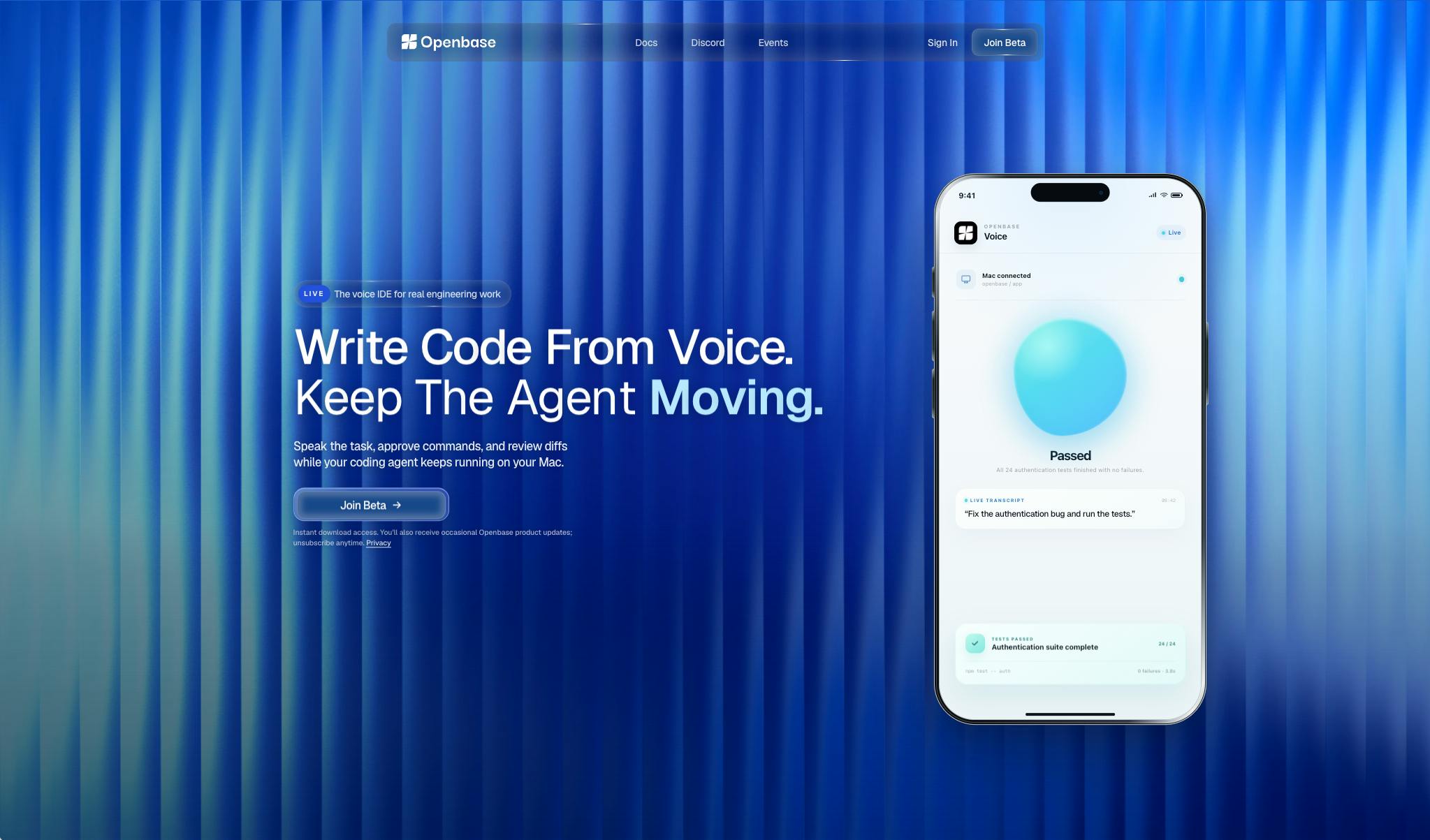
Orchestrating AI Agents with Voice
Managing multiple AI agents, each with its own purpose and capabilities, can quickly become a complex task. For developers and teams building with AI, coordinating these agents for specific workflows often involves intricate prompt engineering, API calls, and state management. Openbase emerges with a novel approach: a voice-first interface designed to streamline this orchestration.
The core promise of Openbase is to abstract away the underlying complexity of agent management. Instead of crafting detailed commands or scripting interactions, users can purportedly interact with their AI agents using natural language voice commands. This aims to make AI agent deployment and control more accessible, akin to how one might manage smart home devices or virtual assistants.
Consider the current landscape of AI agent development. Frameworks like LangChain and LlamaIndex provide powerful tools for building agentic systems, but they require a significant level of technical expertise. Developers spend considerable time defining agent roles, memory mechanisms, tool usage, and the logic that dictates how agents collaborate or hand off tasks. Openbase suggests a departure from this, offering a layer of abstraction that prioritizes ease of use through voice.
The platform’s emphasis on voice control is a deliberate choice. In scenarios where hands-on keyboard interaction might be inconvenient or impossible, such as during field work, travel, or even multitasking at a desk, voice commands offer a more fluid interaction model. This could be particularly beneficial for founders or project managers who need to quickly query the status of AI-driven tasks, initiate new processes, or adjust parameters without interrupting their primary activities.
How Openbase Aims to Work
While the specifics of Openbase's internal architecture are not detailed in the provided source, the product's description suggests a system capable of interpreting natural language commands and translating them into actionable instructions for AI agents. This likely involves sophisticated speech-to-text processing, natural language understanding (NLU) to parse intent, and a robust backend that can map these intents to specific agent actions or agent group orchestrations.
The concept of managing AI agents by voice is not entirely without precedent, but Openbase appears to be focusing on a more comprehensive orchestration layer rather than simple command execution. This implies the ability to:
- Initiate complex, multi-step workflows involving multiple agents.
- Query the status and output of ongoing agent tasks.
- Modify agent parameters or reassign tasks on the fly.
- Potentially, manage the creation and configuration of new agents through voice prompts.
The challenge for Openbase will be to achieve a level of accuracy and flexibility in voice interpretation that rivals or surpasses traditional command-line interfaces or GUI-based tools. Misinterpretations could lead to costly errors when managing AI agents, especially in production environments. The platform’s success will hinge on its ability to reliably understand nuanced instructions and context.
The Broader Implications for AI Agent Management
If Openbase delivers on its promise, it could significantly lower the barrier to entry for managing sophisticated AI agent systems. This democratizing effect could empower a wider range of users, including those with less technical backgrounds, to leverage the power of agent-based AI for their businesses or projects. Imagine a marketing team using voice commands to have AI agents draft social media posts, analyze campaign performance, and suggest optimizations, all without deep technical intervention.
The current paradigm for AI agent interaction is largely text-based, relying on developers to write code or meticulously craft prompts. Openbase’s voice-first approach, while seemingly simple, represents a significant shift in human-AI interaction. It positions AI agents not just as tools to be programmed, but as collaborators that can be directed and managed through natural conversation.
However, a critical question remains: how does Openbase handle the inherent complexity and variability of AI agent outputs and behaviors? AI agents can sometimes produce unexpected or erroneous results. A voice interface needs to be robust enough not only to issue commands but also to receive and interpret feedback, error messages, or status updates in a way that is immediately understandable and actionable for the user. The surprising detail here is not just the ambition of voice control, but the implicit requirement for Openbase to build sophisticated feedback loops that can operate effectively through spoken word.
For founders and product managers, Openbase could represent a new way to integrate AI into their operations. It shifts the focus from the technical implementation of AI agents to their strategic deployment and management. This could accelerate the adoption of AI-driven workflows across various business functions, making AI a more dynamic and responsive part of day-to-day operations.
The platform’s launch on Product Hunt suggests an initial target audience of early adopters and tech enthusiasts, likely developers and product builders themselves. Their feedback will be crucial in shaping the future of Openbase, particularly in refining the voice recognition and command interpretation capabilities to meet the demanding needs of AI development and deployment.