Automating API Test Generation from OpenAPI Specs
Manually translating OpenAPI (or Swagger) specifications into Playwright API tests is a tedious, repetitive task. For every endpoint, developers often follow a pattern: write the happy path test, add a 401 Unauthorized test, then a missing-field test, and repeat this process across dozens or even hundreds of endpoints. This boilerplate effort consumes valuable development time that could be better spent on core product features.
The core insight is that an OpenAPI specification is far more than just documentation. It inherently contains a detailed test plan. Each endpoint definition specifies the request structure (path, method, parameters, body schema), expected responses (including status codes like 200, 401, 404, 422), required fields, and necessary security schemes. This rich information is precisely what is needed to construct comprehensive API tests.
Recognizing this inefficiency, a new tool, accessible at swagger-to-playwright.vercel.app, aims to automate this translation process. It accepts OpenAPI 3.x specifications in either YAML or JSON format and automatically generates a Playwright .spec.ts file. This output is designed to be immediately runnable, significantly reducing the manual effort involved in API testing.
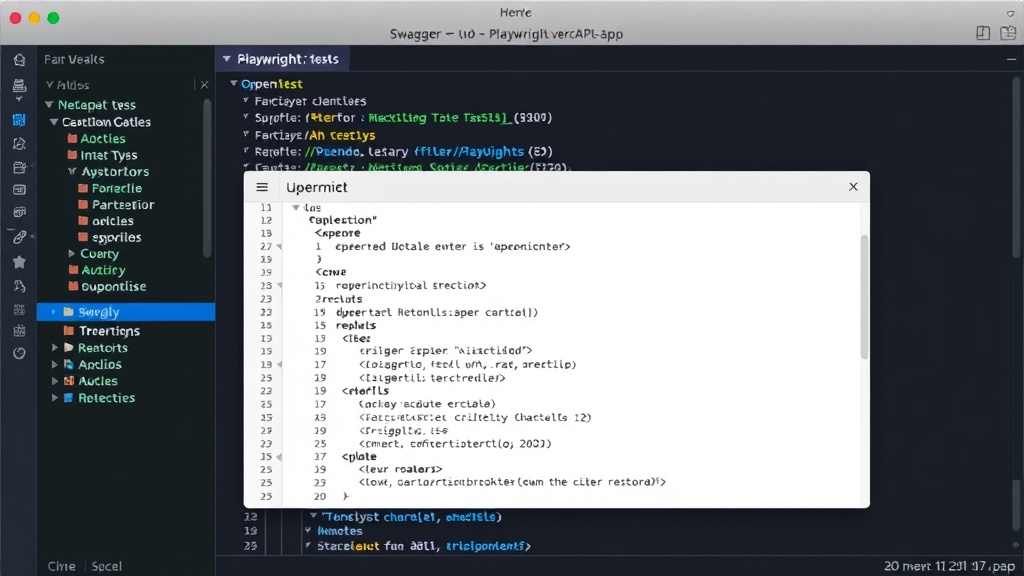
Generated Test Suite Structure
For each endpoint defined in the OpenAPI specification, the tool generates a suite of four distinct tests. This approach ensures a baseline level of test coverage for every API operation:
- Happy Path Test: Validates that the endpoint functions correctly with valid input, expecting a successful response (typically a 200 OK status code). This is the most fundamental test, ensuring core functionality is operational.
- Unauthorized Test: Checks the endpoint's behavior when a request is made without the necessary authentication or authorization credentials. It verifies that the API correctly returns a 401 Unauthorized status code, protecting sensitive endpoints.
- Not Found Test: Assesses the endpoint's response when a non-existent resource or identifier is requested. This test confirms that the API returns a 404 Not Found status code for invalid resource paths or IDs.
- Missing Field Test: Examines the API's reaction to requests that omit required fields in the request body or parameters. The expectation is a 422 Unprocessable Entity status code, indicating that the request payload is malformed or incomplete according to the schema.
This structured generation covers common failure scenarios and the most critical success case for every API endpoint. By providing these four tests out-of-the-box, the tool drastically cuts down the initial setup time for API test suites.
Beyond the Basics: Customization and Integration
While the automatically generated tests provide a solid foundation, real-world API testing often requires more nuanced scenarios. The generated Playwright files serve as a starting point, offering developers a clear structure to build upon. They can easily modify the generated tests, add more specific assertions, or introduce complex test data variations.
The tool's reliance on Playwright means that existing Playwright infrastructure and best practices can be leveraged. Teams already using Playwright for end-to-end testing can seamlessly integrate these generated API tests into their existing CI/CD pipelines. This consistency simplifies tooling and reduces the learning curve for team members.
The process itself is straightforward: developers paste their OpenAPI spec URL or upload the spec file directly into the tool. The generated TypeScript file can then be downloaded and integrated into a Playwright project. This low barrier to entry makes it accessible for teams of all sizes looking to improve their API testing efficiency.
The Value Proposition: Speed and Reliability
The primary benefit of this approach is a significant acceleration in test suite development. What once took hours or days of manual coding can now be accomplished in minutes. This speed allows development teams to achieve better test coverage faster, leading to earlier detection of bugs and more reliable API releases.
Furthermore, by deriving tests directly from the OpenAPI specification, the tests remain in sync with the API's contract. As the API evolves, regenerating the tests becomes a trivial task, ensuring that the test suite remains relevant and accurate. This reduces the maintenance burden associated with test suites that often fall out of sync with evolving APIs.
The tool addresses a common pain point in modern software development where APIs are the backbone of distributed systems. Ensuring the quality and reliability of these APIs is paramount. By treating the OpenAPI spec as a living test plan, teams can unlock a more efficient and effective testing strategy.
Future Considerations and Broader Impact
While this tool handles the common cases effectively, the question remains about how to best handle more complex scenarios. For instance, testing multi-step workflows that involve sequences of API calls, or dealing with sophisticated data validation rules beyond simple schema checks, might still require manual intervention or more advanced tooling. However, even in these cases, the automatically generated tests provide a robust starting point.
The broader impact for development teams is a shift towards a more contract-driven testing approach. It encourages API providers to maintain accurate and detailed OpenAPI specifications, as these documents directly fuel the automated testing process. This can lead to better API design and documentation overall.
For founders and product managers, this translates to faster release cycles and reduced QA costs. For security professionals, it means more consistent validation of security requirements defined in the spec. For data scientists and creators building on top of APIs, it ensures the underlying services they depend on are more stable and predictable.