GPT-6 Astra: A Leap in Robotic Dexterity
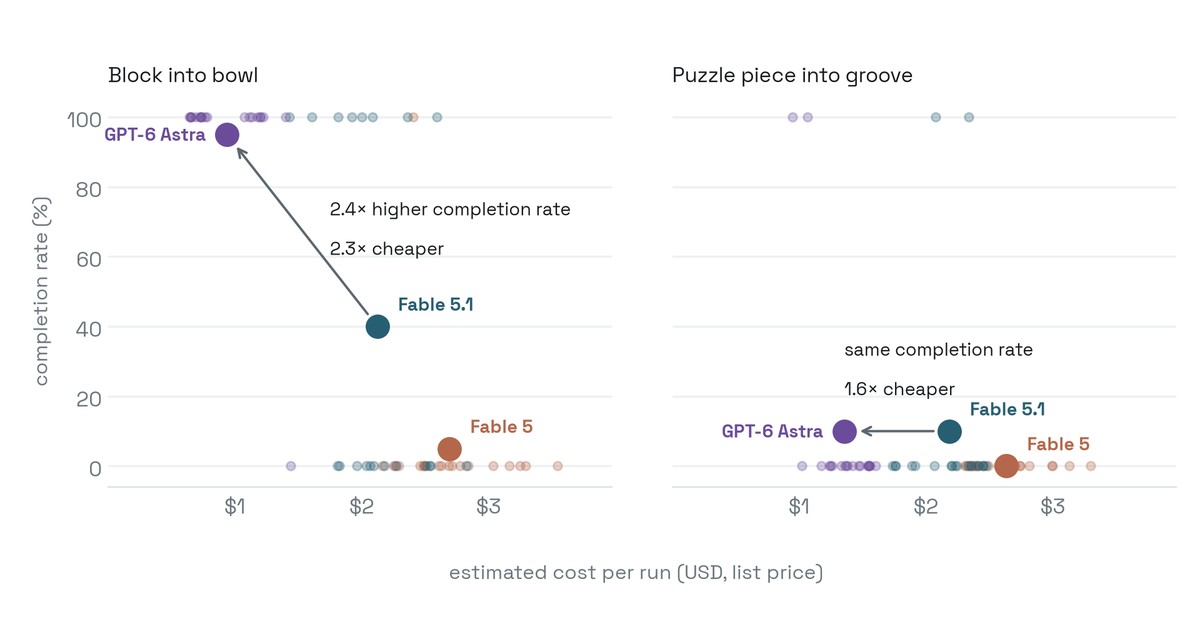
OpenAI has unveiled GPT-6 Astra, a new large language model that marks a significant advancement in enabling artificial intelligence to control physical robot arms with remarkable precision and adaptability. Unlike previous iterations that focused on language understanding and generation, Astra is engineered from the ground up to translate complex, abstract instructions into nuanced physical actions. This development moves beyond simple pick-and-place tasks, pushing towards robots capable of intricate manipulation, assembly, and even fine-detail work previously exclusive to human hands.
The core innovation lies in Astra’s ability to learn from multimodal inputs and rapidly adapt to new environments and tasks. Sources indicate that Astra processes not only textual commands but also visual feedback, tactile sensor data, and even kinesthetic information from the robot arm itself. This allows it to build a more comprehensive understanding of its physical surroundings and the task at hand. Think of it less like a pre-programmed robot and more like a skilled apprentice who can observe, understand, and then execute a complex procedure after a single demonstration or a clear set of instructions.
Bridging the Gap Between Language and Action
For years, the promise of AI-powered robotics has been hampered by the “sim-to-real” gap and the challenge of translating high-level human intent into low-level motor commands. GPT-6 Astra directly addresses this by leveraging a transformer architecture trained on vast datasets of robotic interactions. This training allows Astra to generalize across a wide range of manipulation challenges. It can infer the necessary grasp force for different objects, predict how an object will behave when manipulated, and adjust its trajectory in real-time based on sensor feedback. This is a crucial step toward robots that can operate effectively in unstructured environments, such as home assistance, complex manufacturing lines, or even delicate surgical procedures.
The model’s architecture is reportedly optimized for low-latency inference, a critical requirement for real-time control. This means that as the robot arm moves, Astra can process incoming sensory data and issue corrective commands almost instantaneously. This rapid feedback loop is what enables the fine motor control and dynamic adjustments that have previously been difficult to achieve with AI alone. The implications are profound: robots that can handle fragile items without crushing them, assemble intricate machinery with sub-millimeter precision, or even perform tasks requiring a delicate touch.
Learning and Adaptation: The Key Differentiator
Astra’s learning capabilities are a standout feature. Instead of requiring extensive, task-specific retraining for every new operation, the model can learn from a small number of examples or even through trial and error within a safe, simulated environment before being deployed physically. This rapid adaptation significantly reduces the development time and cost associated with programming robots for new tasks. For instance, a factory could retrain its robotic assembly line for a new product configuration in hours rather than days or weeks.
Furthermore, Astra’s ability to learn from human demonstration is a key aspect. Operators can guide the robot arm through a task, and Astra can observe and learn the underlying principles of the motion, not just the exact path. This allows for more robust and flexible task execution. The model can then apply this learned understanding to variations of the task or to entirely new, but conceptually similar, operations. This marks a shift from robots that are programmed to robots that learn and collaborate with humans.
Potential Applications and Future Directions
The immediate applications for GPT-6 Astra are vast. In manufacturing, it could automate complex assembly tasks, improve quality control, and enable more flexible production lines. In logistics, it could power more sophisticated warehouse robots capable of handling a wider variety of package types and sizes. For research and development, it offers a powerful tool for scientists and engineers to test hypotheses and build complex experimental setups without the need for highly specialized robotic programming expertise.
Looking further ahead, the technology could pave the way for advanced domestic robots capable of performing household chores requiring dexterity, such as cooking, cleaning delicate items, or assisting individuals with mobility challenges. In the medical field, it could lead to more precise robotic surgical assistants or advanced prosthetics. The surprising detail here is not just the enhanced dexterity, but the model's capacity for emergent behaviors – performing tasks it wasn't explicitly trained for but can infer from its understanding of physics and manipulation principles.
What remains to be seen is the scalability of Astra’s training pipeline and the computational resources required for deployment. As with all advanced AI models, ensuring safety, reliability, and ethical considerations in real-world deployment will be paramount. The open-source community will also play a crucial role in exploring and extending Astra’s capabilities, pushing the boundaries of what’s possible with AI-driven robotics.