OpenAI's GPT-5.6-Cyber Enters the Security Arena
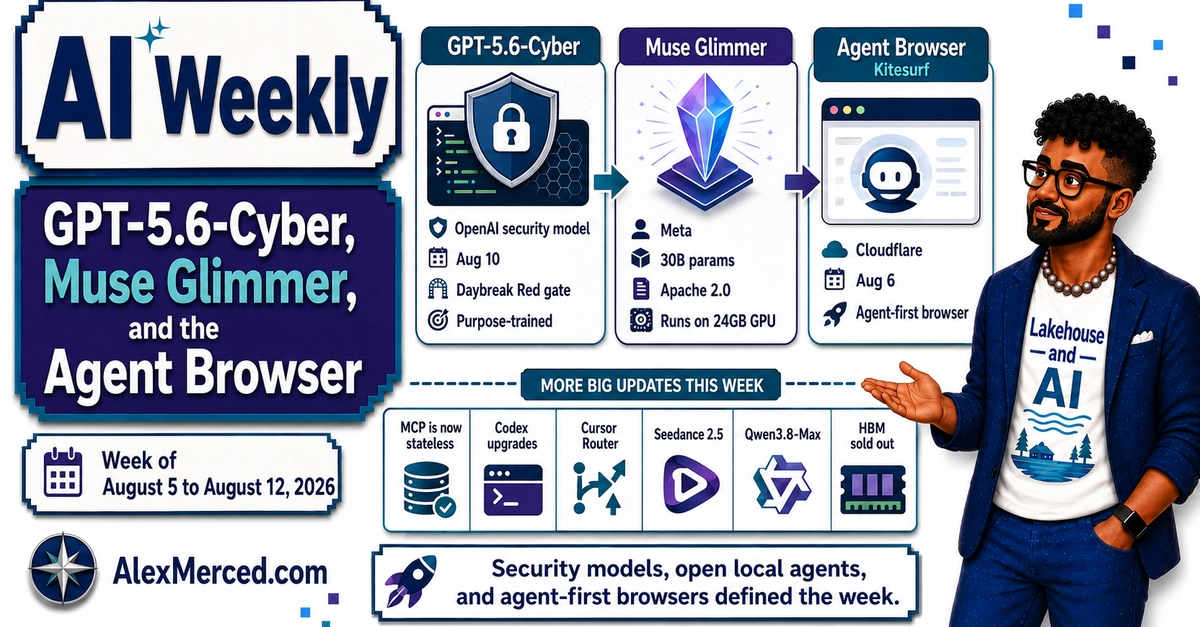
OpenAI made a significant move on August 10th, releasing GPT-5.6-Cyber, a specialized model engineered for cybersecurity applications. This model is integrated behind OpenAI's Daybreak Red approval gate, suggesting stringent vetting and deployment protocols. The pricing structure is set at $12.50 per million input tokens and $75 per million output tokens, positioning it as a premium offering for enterprise-level security operations. This release signals OpenAI's intent to capture a dedicated segment of the AI market focused on threat detection, vulnerability analysis, and incident response.
The purpose-trained nature of GPT-5.6-Cyber implies it has been fine-tuned on vast datasets of security-related information, including code vulnerabilities, attack patterns, and threat intelligence reports. Its integration with the Daybreak Red gate suggests a commitment to responsible AI deployment in a high-stakes domain where errors can have severe consequences. The tiered pricing indicates that organizations requiring advanced security AI capabilities will need to invest significantly, reflecting the specialized nature and potential ROI of such a tool.
This development puts pressure on existing cybersecurity AI vendors and opens new possibilities for security teams. By offering a model specifically designed for security tasks, OpenAI aims to streamline workflows and enhance the efficacy of AI in defending against increasingly sophisticated cyber threats. The higher cost of output tokens might also reflect the complexity and computational resources required for generating detailed security analyses or actionable defense strategies.
Meta's Muse Glimmer: Local Agents Go Open Source
In a contrasting move, Meta returned to the open-weight model philosophy with the release of Muse Glimmer on August 10th. This 30-billion-parameter model, licensed under Apache 2.0, is designed to run on a single 24GB consumer GPU. Its primary target is local agent workflows, empowering developers to build and deploy autonomous AI agents directly on their own hardware without relying on cloud infrastructure.
The significance of Muse Glimmer lies in its accessibility and focus. By making a capable model available with open weights and minimal hardware requirements, Meta is democratizing the development of AI agents. This allows for greater privacy, customization, and potentially lower operational costs for users. Local agent workflows can handle tasks ranging from personal assistants and automated research to code generation and task automation, all while keeping data processing on the user's machine.
The 30-billion-parameter size is a sweet spot, offering a balance between performance and resource efficiency. A 24GB GPU is within reach for many developers and enthusiasts, lowering the barrier to entry for experimenting with and deploying sophisticated AI agents. This move directly challenges proprietary models that require expensive cloud compute and may foster a new wave of innovation in decentralized AI applications.
A Busy Release Calendar Continues
Beyond these headline announcements, the AI landscape remains dynamic. ByteDance released Seedance 2.5 on August 8th, and Alibaba followed with Qwen3.8-Max on August 3rd. These releases, while perhaps less prominent than OpenAI's and Meta's, contribute to the rapid iteration and diversification of AI models available to the market. Each release brings incremental improvements in performance, efficiency, or specialized capabilities, catering to a wide array of use cases and developer needs.
The continuous stream of model releases underscores the intense competition and rapid pace of development in the AI industry. Companies are not only pushing the boundaries of model size and capability but also focusing on specific niches, such as security (OpenAI) or local agent deployment (Meta), and general-purpose improvements (ByteDance, Alibaba). This ensures a rich ecosystem where users can find models tailored to their specific requirements and constraints.
Evolving Agentic Coding and Development Tools
The race for agentic coding and development environments also saw significant advancements. OpenAI's Codex has introduced forkable thread history, allowing developers to branch and experiment with AI-generated code suggestions more effectively. The platform has also integrated Amazon Bedrock login, expanded to include audio inputs, and added import functionalities for code settings from Cursor and Claude. These updates enhance the collaborative and iterative nature of AI-assisted coding, making it easier for developers to manage complex projects and leverage AI tools more seamlessly.
Cursor, a prominent AI-native code editor, has responded with its own innovations. The rollout of Cursor Router with Auto Intelligence and Auto Balance aims to optimize AI model usage and performance. Cursor claims these features deliver satisfaction levels described as "above-Fable"—a benchmark likely referring to a proprietary internal metric—at a substantially reduced cost, specifically 68 percent lower. This suggests a focus on efficiency and cost-effectiveness in AI-powered development tools, a critical factor for widespread adoption.
The MCP 2026-07-28 stateless specification, though mentioned briefly, points to ongoing efforts in defining standards for AI system interactions, particularly those that are stateless. This is crucial for building scalable and reliable AI applications, especially in agentic workflows where maintaining state can be computationally expensive and complex. As AI systems become more integrated into development pipelines, standardization and efficient state management will be key to unlocking their full potential.
Broader Market Implications
The week's developments highlight a bifurcating trend in the AI market. On one hand, specialized, high-performance models like GPT-5.6-Cyber cater to enterprise needs with premium pricing and strict controls. On the other, open-weight models like Muse Glimmer democratize access, enabling local deployment and fostering community-driven innovation. This dual approach ensures that AI capabilities are expanding across different market segments, from large corporations seeking cutting-edge security solutions to individual developers building the next generation of AI agents.
The advancements in agentic coding tools and infrastructure further solidify AI's role as an indispensable partner in software development. The focus on efficiency, cost reduction, and improved user experience in these tools indicates a maturing market where practical implementation and developer productivity are paramount. As AI models become more capable and accessible, their integration into every facet of the tech industry will only accelerate.