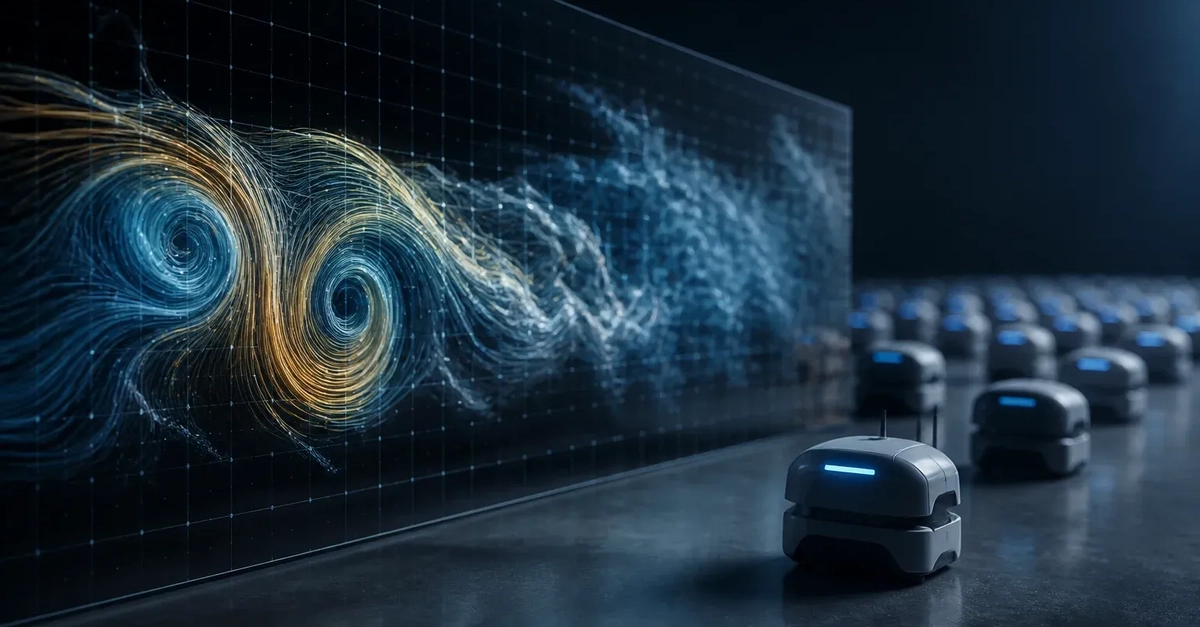
OpenAI's Computational Gambit: Tackling Navier-Stokes
OpenAI has reportedly undertaken a monumental computational task, aiming to solve the notoriously complex three-dimensional Navier-Stokes equations. This problem, a cornerstone of fluid dynamics and one of the Clay Mathematics Institute's Millennium Prize Problems, has eluded definitive analytical solutions for decades. The reported method involved a massive, coordinated deployment of approximately 10,000 concurrent AI agents working over an 88-hour period, commencing on September 1st. This endeavor signals a significant exploration into the capabilities of large-scale, multi-agent AI systems for tackling profound scientific challenges.
The Navier-Stokes equations describe the motion of viscous fluid substances, from the flow of water in pipes to the dynamics of weather patterns and the turbulence of airflow over an aircraft wing. Their complexity arises from the inherent nonlinearity and the difficulty in finding general, analytical solutions that hold true for all possible conditions. Historically, progress has been made through numerical simulations and approximations, but a complete, rigorous mathematical proof of existence and smoothness for solutions in three dimensions remains elusive, with significant implications for physics and engineering.
The Multi-Agent Approach
What sets this reported OpenAI effort apart is not just the problem's difficulty, but the proposed method of solution. Instead of a single, monolithic AI model, the claim points to a large, coordinated group of AI agents. This suggests a distributed problem-solving architecture, where individual agents might specialize in different aspects of the problem, communicate findings, and collectively converge on a solution. This approach mirrors how human research teams collaborate, with different members bringing distinct expertise to bear on a common goal.
The coordination of 10,000 concurrent agents over 88 hours represents a significant feat of computational orchestration. It implies a robust infrastructure capable of managing, directing, and aggregating the work of such a vast number of independent or semi-independent AI entities. This scale of operation is far beyond typical AI research experiments and hints at OpenAI's investment in developing and testing advanced multi-agent systems. The sheer computational power and coordination required suggest that the problem was broken down into smaller, manageable tasks that could be distributed and processed in parallel across this agent network.
Verification and the Scientific Process
Despite the ambitious nature of the claim, a crucial element is missing: public verification. As of the latest reports, OpenAI has not released a peer-reviewed paper, a preprint on a platform like arXiv, or any official first-party announcement detailing their methodology or results. This lack of formal disclosure means the claim should be treated with caution. While OpenAI's internal models are known for their advanced capabilities, scientific breakthroughs, especially those addressing Millennium Prize Problems, require rigorous scrutiny and validation by the wider scientific community.
The situation is analogous to a chef announcing they've perfected a notoriously difficult dish but refusing to share the recipe or let anyone taste it. The credibility of the claim rests on the reputation of the source, but the scientific method demands reproducibility and independent verification. Without a published paper detailing the specific algorithms, the data used, the exact formulation of the problem presented to the agents, and the mathematical proof itself, it remains an intriguing signal rather than a settled discovery. This gap highlights a broader challenge in AI-assisted research: how to integrate emergent AI capabilities into established scientific validation pipelines.
Broader Implications for AI and Research
If OpenAI's claim proves to be substantiated, it signals a paradigm shift in how complex scientific problems can be approached. The success of a large-scale multi-agent system in tackling a problem of this magnitude could unlock new avenues for AI-driven scientific discovery across numerous fields, from physics and chemistry to biology and materials science. It suggests that AI is moving beyond pattern recognition and data analysis to become a powerful tool for theoretical problem-solving and hypothesis generation.
Furthermore, the reported effort raises questions about the future of research and the role of AI. Will future scientific breakthroughs be announced by AI systems themselves, or by the human researchers who deploy and interpret them? The ability to mobilize thousands of AI agents for a specific, complex task could redefine the pace of innovation. However, the current opacity surrounding OpenAI's work underscores the need for transparency and collaboration. The scientific community thrives on shared knowledge and peer review. For AI to truly accelerate human understanding, its contributions must be demonstrable, verifiable, and accessible, allowing for collective advancement rather than isolated, unconfirmed achievements.
The challenge now is for OpenAI to provide the necessary evidence. The scientific world, and indeed the tech community, awaits the details that will allow for the independent assessment of this potentially historic claim. Until then, it remains a compelling, yet unresolved, signal of AI's burgeoning capacity.