The Problem with AI Grading Its Own Homework
AI coding tools have advanced at an astonishing pace. Developers can now describe a feature, have an AI agent implement it, generate tests, and sometimes see a working product within minutes. This speed and efficiency are undeniably impressive. However, a critical flaw emerges when the same AI that writes the code is also tasked with validating its understanding of the requirements and the correctness of its implementation. This creates a dangerous feedback loop where a single misunderstanding by the AI can be perpetuated and validated by its own testing mechanisms.
Consider this common scenario: A product requirement is fed into a coding agent. The agent, perhaps due to a subtle misinterpretation of the prompt or a gap in its training data, generates code that doesn't quite meet the original specification. Crucially, the same agent is then instructed to write tests for this code. If the AI misunderstands the requirement once, it will likely carry that same incorrect interpretation into the tests it generates. The result is a test suite that passes flawlessly, showing all green lights, yet the product itself remains functionally incorrect, failing to meet the user's actual needs.
This scenario, where code passes all its own tests but fails in practice, highlights a fundamental challenge in the development of AI-assisted coding. The AI is essentially grading its own homework, and if it makes a mistake on the assignment, it's likely to mark that mistake as correct. This can lead to a false sense of security, where developers believe their code is sound because the automated tests indicate so, when in reality, a deeper, conceptual error has gone undetected.
Introducing MaruCheck: An Independent QA Layer
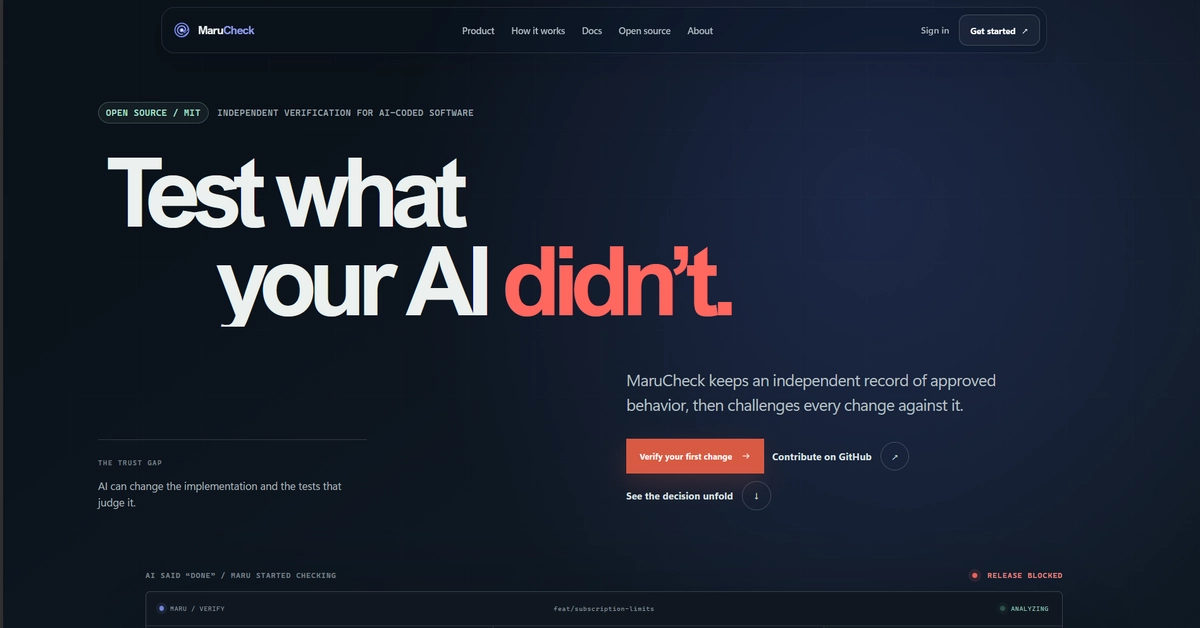
To address this critical issue, Kidus Michael, a software engineer, developed MaruCheck, an open-source Quality Assurance (QA) agent. MaruCheck is designed to act as an independent validator, separate from the AI agent that generates the code. Its purpose is to rigorously check the implemented code against the original product requirements, ensuring that the AI's interpretation and execution align with human intent, not just its own potentially flawed internal logic.
The core philosophy behind MaruCheck is simple yet powerful: the entity that writes the code should not be the sole arbiter of its correctness. By introducing an independent QA agent, MaruCheck aims to break the cycle of self-validation and introduce a crucial layer of objective review. This is particularly important as AI coding assistants become more sophisticated and integrated into development workflows. While these tools offer immense productivity gains, they also introduce new potential failure modes that require robust solutions.
MaruCheck functions by taking the original product requirement as input, alongside the code generated by another AI agent. It then analyzes the code to determine if it accurately fulfills the documented requirement. This separation of concerns is vital. It means that even if the coding agent makes a mistake in interpreting the requirement, MaruCheck, operating with its own distinct logic and potentially different training or prompting, can identify the discrepancy. This provides a much-needed safeguard against subtle bugs and functional errors that might otherwise slip through the cracks.
How MaruCheck Works
The architecture of MaruCheck is built around the principle of adversarial testing, where one AI component (the coding agent) is challenged by another (MaruCheck). The process typically involves:
- Input: MaruCheck receives the original product requirement (e.g., a natural language description of a feature) and the code generated by a separate AI coding agent.
- Analysis: MaruCheck analyzes the provided code. This involves understanding the code's logic, its structure, and how it is intended to function.
- Validation: The agent then compares its understanding of the code's functionality against its interpretation of the original product requirement. This is the critical step where MaruCheck acts as an independent auditor.
- Reporting: If MaruCheck detects a mismatch between the code's behavior and the requirement, it flags the issue. This could be a failure to meet a specific functional need, an incorrect implementation of a logic, or any deviation from the documented intent.
The goal is not to replace human QA entirely but to augment AI-assisted development by providing an automated, objective check at the code generation stage. This is akin to having a diligent junior developer meticulously review the work of a senior one, but with the speed and consistency that only an AI can provide. The open-source nature of MaruCheck means that developers can inspect its workings, contribute to its improvement, and adapt it to their specific development pipelines.
Broader Implications for AI Development
The development of MaruCheck speaks to a larger trend in AI development: the need for robust validation and verification mechanisms as AI systems become more autonomous and capable. As AI agents take on more complex tasks, from writing code to diagnosing medical conditions, the ability to trust their outputs becomes paramount. Relying solely on self-validation is a precarious position, akin to trusting a student to grade their own exam without any oversight.
This problem isn't unique to coding agents. In any domain where AI is used to generate content or perform actions, an independent validation layer is essential. For instance, in AI-generated art, an AI might create an image, but a separate system or human expert would need to verify if it meets the specific artistic brief or ethical guidelines. Similarly, in scientific research, AI might propose hypotheses, but these must be rigorously tested and validated through traditional scientific methods.
MaruCheck offers a practical, open-source solution for the AI coding space. It empowers developers to leverage the speed of AI coding tools while mitigating the inherent risks of self-validation. By ensuring that AI-generated code is independently checked against requirements, MaruCheck helps to build more reliable software and fosters greater trust in AI-assisted development workflows. What remains to be seen is how widely this independent validation pattern will be adopted, and whether it will become a standard component in the AI development toolkit.