
The Shifting Economics of Code Contribution
The landscape of software development is undergoing a seismic shift, driven by the emergence of AI agents capable of generating code. Traditionally, open source thrived on a delicate balance: the effort of writing and maintaining code was offset by the community's collective benefit and the eventual adoption of stable, well-vetted libraries. Now, AI agents are fundamentally altering this equation. They drastically reduce the cost and effort of producing code, making it easier than ever for developers to obtain functional snippets or even entire utilities for their projects. This surge in readily available, AI-generated code bypasses many of the established pathways of open source engagement. Instead of searching for existing libraries, reading their documentation, and assessing their community health, developers can now simply prompt an agent and receive a solution in seconds. This bypass means that the traditional discovery and adoption mechanisms for open source projects are becoming obsolete.
The critical issue lies in the review process. While AI agents can churn out code at an unprecedented rate, the responsibility for ensuring its quality, security, and maintainability still falls on human maintainers. Tim Hoffmann, a maintainer for the matplotlib project, highlighted this disparity on GitHub in February 2026: "Agents change the cost balance between generating and reviewing code. Code generation via AI agents can be automated and becomes cheap so that code input volume increases, but review is still a manual human activity, burdened on the shoulders of few core developers." This creates a bottleneck. The volume of code generated by AI will inevitably increase, overwhelming the limited human capacity for thorough code review, testing, and maintenance that has always been the bedrock of robust open source projects.
The 'Invisible' Dependency Problem
Consider the typical workflow for a developer needing a small utility for a side project. A few years ago, this involved searching for existing solutions, navigating project repositories, checking the README for usage instructions, and crucially, scanning the issues tab for any red flags or known problems with the dependency. This process, while sometimes tedious, provided a level of assurance. Developers understood the provenance of the code they were integrating and could assess the health and activity of the project they were relying on. They were, in essence, engaging with a community and its collective knowledge.
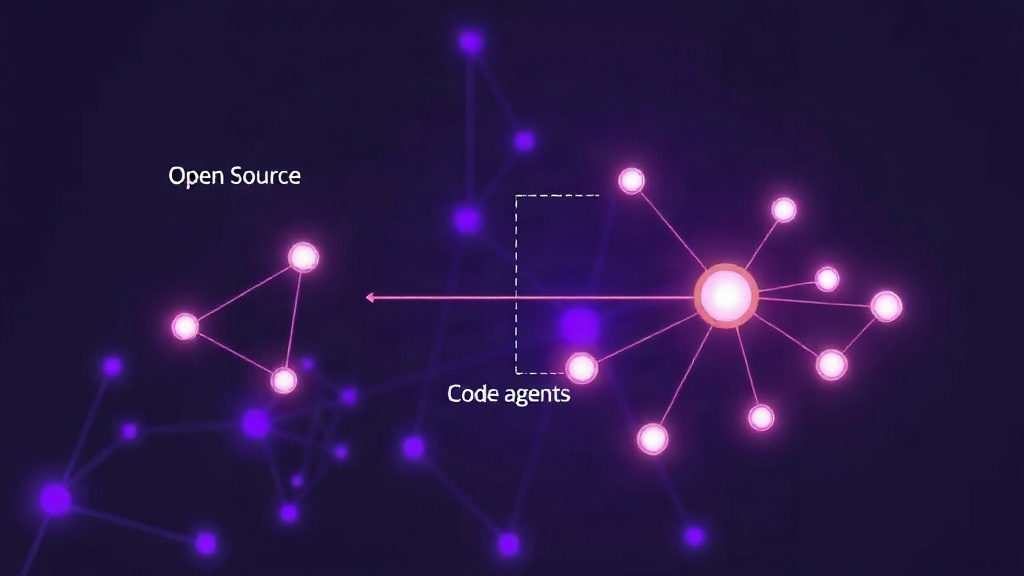
Today, that same developer can simply ask an AI agent for the utility. Within thirty seconds, they have code that accomplishes the task. The crucial difference is that they often never install anything, never read a README, and critically, never discover who wrote the pattern they are now running in production. This creates a new class of 'invisible' dependencies. Projects are increasingly built upon code whose origin and quality have not been vetted by human eyes in the traditional sense. This is particularly concerning when these AI-generated snippets are used in production environments, where reliability and security are paramount. The lack of direct engagement with the open source community means that the social contract of open source—where contributions are acknowledged and maintained—is eroded. The maintainers of the underlying libraries, whose work is now being indirectly consumed by AI agents, receive no feedback, no attribution, and no support, yet their projects bear the burden of any bugs or security flaws introduced by this automated generation process.
Implications for the Open Source Ecosystem
The rise of AI code agents poses a fundamental challenge to the sustainability of the open source model. The economic incentive for individual developers to contribute code has always been complex, often driven by passion, reputation building, or a desire to solve a specific problem for a community. However, the ease with which AI agents can generate code diminishes the perceived need for manual contribution. Why spend hours crafting a library when an AI can produce a functional equivalent in minutes? This could lead to a stagnation of new open source development and a decline in the maintenance of existing projects.
Furthermore, the lack of clear attribution and the bypass of traditional review processes create significant risks. When code is generated by an AI, who is responsible for its security vulnerabilities? Who is liable if it causes a data breach or system failure? The current open source licensing frameworks, which rely on traceable authorship and community governance, are ill-equipped to handle code generated autonomously by machines. The very notion of a 'community' around a project becomes diluted when the primary interface is an AI agent rather than fellow developers.
The burden on the few remaining human maintainers will become unsustainable. They will face an ever-increasing deluge of AI-generated code, much of which may be superficially correct but lack the depth of understanding, security considerations, or long-term maintainability that human developers bring. This situation is less about open source 'dying' and more about its fundamental operating principles being tested to their breaking point. The model, built on human collaboration and shared responsibility, struggles to accommodate an economy where code can be generated anonymously and at scale by non-human actors. The question becomes: how do we adapt our contribution models, our licensing, and our review processes to ensure that the benefits of open source—its transparency, its collaborative spirit, and its collective innovation—can survive in an AI-driven world?