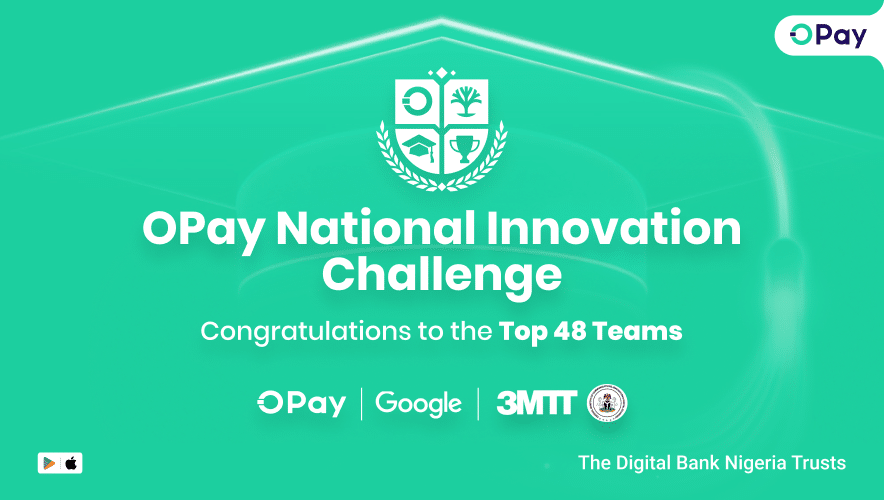
OPay's Inaugural National Innovation Challenge Reaches Crucial Stage
OPay, a prominent fintech company operating in Nigeria, has announced the top 48 teams that will advance in its inaugural National Innovation Challenge. This significant milestone marks the culmination of a rigorous selection process that began with thousands of applications from across the country. The challenge, designed to foster and support innovation within Nigeria's burgeoning tech ecosystem, focuses on identifying and empowering startups with solutions that can drive economic growth and technological advancement.
The selection of these 48 teams represents a critical juncture for OPay's initiative. These finalists will now enter a more intensive phase of the competition, which is expected to include mentorship, networking opportunities, and further evaluation. The ultimate goal is to identify a select few who will receive substantial support to scale their ventures. This challenge underscores OPay's commitment to not just providing financial services but also to actively contributing to the development of Nigeria's technological landscape.
Details regarding the specific sectors or problem statements addressed by the 48 teams were not immediately available, but the sheer volume of initial applications suggests a broad spectrum of innovative ideas. OPay has indicated that the challenge aims to identify solutions that align with national development goals, potentially spanning areas like financial inclusion, digital transformation, agriculture, and e-commerce. The company's investment in such a program signals a strategic intent to tap into the nation's creative potential and nurture the next generation of Nigerian tech entrepreneurs.
The Road to the Top 48: A Rigorous Selection Process
The journey to the top 48 was characterized by a comprehensive evaluation framework. OPay's internal review committees, likely comprising experts in technology, finance, and business development, sifted through a vast pool of submissions. This initial screening phase would have focused on criteria such as the novelty of the solution, the potential market impact, the scalability of the business model, and the strength of the founding team. The sheer number of applicants—reportedly in the thousands—highlights the vibrant and competitive nature of Nigeria's startup scene.
While the specific metrics used for elimination are proprietary, it is reasonable to infer that teams were assessed on their ability to articulate a clear problem, present a viable solution, and demonstrate a path to sustainability and growth. The competitive nature of the selection process means that the 48 teams advancing are not merely participants but have already proven their mettle against a significant field of contenders. This achievement alone is a testament to their innovation and entrepreneurial drive.
The next stages of the OPay National Innovation Challenge will likely involve deeper dives into the business plans, product demonstrations, and pitches from these 48 teams. OPay's role extends beyond mere sponsorship; it aims to act as a catalyst, providing resources, expertise, and a platform for these startups to thrive. The company's extensive user base and operational infrastructure in Nigeria could offer unique advantages to the winning teams, enabling them to rapidly test and deploy their solutions to a large market.
What This Means for Nigeria's Tech Ecosystem
The OPay National Innovation Challenge is more than just a competition; it's a significant investment in the future of Nigerian technology. By spotlighting and supporting promising startups, OPay is contributing to a more robust and dynamic innovation ecosystem. Such initiatives are crucial for economic diversification, job creation, and the development of homegrown technological solutions that address local challenges.
The success of this challenge could inspire other major corporations and investors to launch similar programs, creating a virtuous cycle of support for early-stage ventures. For the 48 finalist teams, this represents an invaluable opportunity to gain visibility, secure potential funding, and access mentorship that can accelerate their growth trajectories. The exposure alone can open doors to further investment, strategic partnerships, and market access.
What remains to be seen is the specific nature of the support OPay will offer beyond the competition itself. Will it involve direct equity investment, incubation programs, access to OPay's payment infrastructure, or a combination of these? The nature of this post-competition support will be a key determinant of the long-term impact of the challenge on the selected startups and the broader Nigerian tech scene. OPay's commitment to nurturing talent is clear, but the depth and breadth of its continued engagement will be closely watched by founders and investors alike.
The emergence of these 48 teams from a field of thousands is a powerful signal of the immense talent pool within Nigeria. It reinforces the narrative of Africa, and Nigeria in particular, as a burgeoning hub for technological innovation. OPay’s initiative, by providing a structured platform for these ideas to be nurtured and potentially scaled, plays a vital role in realizing this potential.