The RxJS Challenge: Complexity and Bad Docs
RxJS, the reactive programming library essential for Angular and other JavaScript projects, has a well-earned reputation for being difficult to master. Developers often struggle with its asynchronous nature, leading to common issues like forgotten unsubscribes and deeply nested subscriptions that become unmanageable. The official documentation, while comprehensive, often fails to provide an intuitive grasp of the library's core concepts for newcomers. This complexity creates a significant onboarding hurdle for new team members and contributes to a perception of RxJS as brittle or error-prone.
The challenge isn't that RxJS is inherently a bad library. Its power lies in managing complex asynchronous event streams, a crucial capability in modern web development. However, the path to understanding and effectively utilizing these powerful features is often obscured by a steep learning curve and documentation that can feel overwhelming. This disconnect between the library's potential and its accessibility has led many developers to seek alternative learning methods.
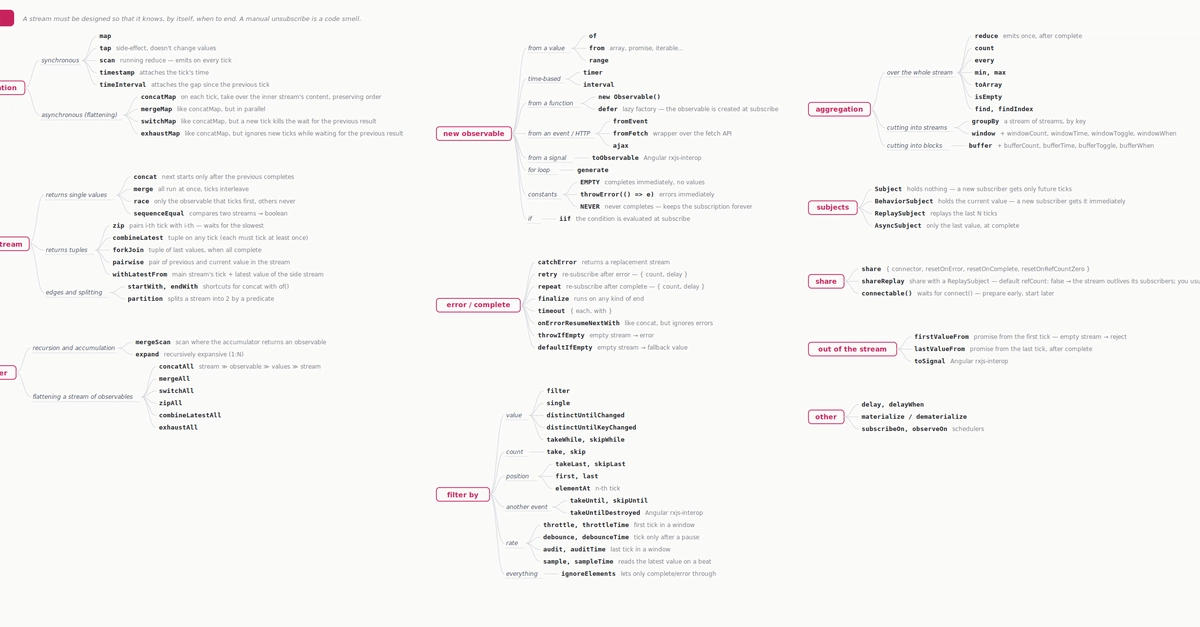
One such alternative has emerged in the form of a single-page map, designed to distill the essence of RxJS into a digestible format. This visual aid aims to provide a quicker, more intuitive learning experience than the traditional, text-heavy official documentation. The creator, a developer who built this resource for his own teams, shared it with the broader community, hoping to alleviate the common frustrations associated with learning RxJS.

The One-Page Map Approach
The core idea behind this one-page map is to simplify RxJS by presenting its key operators and concepts in a structured, visual manner. Instead of wading through lengthy API descriptions and theoretical explanations, learners are presented with a map that connects different operators and their relationships. This approach treats RxJS less like a set of disparate functions and more like a cohesive system, where each part plays a specific role in managing data streams.
The map categorizes operators based on their function, such as creation, transformation, filtering, and combination. This organization helps learners understand not just what each operator does in isolation, but how it fits into the broader RxJS ecosystem. For instance, understanding how a `map` operator transforms data is immediately contextualized by how it might be used in conjunction with a `filter` operator to select specific events from a stream, or a `merge` operator to combine multiple streams.
This visual, relational approach is fundamentally different from the linear, documentation-driven method. It encourages a more holistic understanding, much like how a geographical map helps you understand the relationships between cities, roads, and terrain, rather than just providing a list of addresses. The goal is to enable developers to grasp the fundamental patterns of reactive programming with RxJS in a matter of hours, rather than weeks or months of trial and error.
Beyond the Map: Onboarding and Design Principles
The developer who created the map also shared supplementary materials and principles that contribute to a more effective learning and development process with RxJS. These include an onboarding practice and a specific design rule, both aimed at reinforcing the concepts presented in the map and promoting best practices.
The onboarding practice likely involves hands-on exercises that leverage the visual map as a reference. This active learning approach is critical for solidifying understanding. Instead of just reading about operators, developers are encouraged to use them in practical scenarios, guided by the map's structure. This could involve building small applications or solving specific problems that require stream manipulation, directly applying the knowledge gained from the visual guide.
The design rule, though not detailed in the excerpt, presumably focuses on a principle that simplifies RxJS usage or promotes maintainability. This could be anything from a rule about when to use certain operators, how to structure complex observable chains, or a strict guideline on managing subscriptions. Such rules act as guardrails, helping developers avoid common pitfalls and write more robust, understandable reactive code. This is akin to having a set of architectural principles for building a house; they ensure the structure is sound and the living space is functional.
The Unanswered Question: Scalability of the Visual Approach
While this one-page map offers a promising solution for individual learning and small team onboarding, a critical question remains: how scalable is this visual, simplified approach for larger, more complex projects and enterprise-level development? The map excels at conveying core concepts and relationships, but the true challenges of RxJS often arise when dealing with intricate, multi-layered asynchronous operations, performance optimizations, and integration with diverse systems. Will this concise visual guide provide sufficient depth for developers to navigate these advanced scenarios confidently, or will it become a stepping stone that requires further, more traditional learning for complex real-world applications?
Implications for Developers and Teams
The existence of such a resource signals a shift in how complex libraries might be taught and adopted. For developers, it offers a much-needed shortcut to understanding a powerful but often intimidating technology. It democratizes access to RxJS, potentially lowering the barrier to entry for those who have been put off by its reputation or documentation. Teams, especially those struggling with onboarding new members or dealing with RxJS-related bugs, now have a tangible tool to improve their developers' proficiency.
The success of this one-page map could inspire similar efforts for other complex libraries and frameworks. It highlights the value of visual learning and conceptual mapping in software development education. If a single page can effectively teach a library like RxJS in a fraction of the time traditionally required, it suggests that more intuitive and efficient learning pathways are possible across the tech landscape. This could lead to faster development cycles, more confident teams, and a broader adoption of powerful but complex tools.