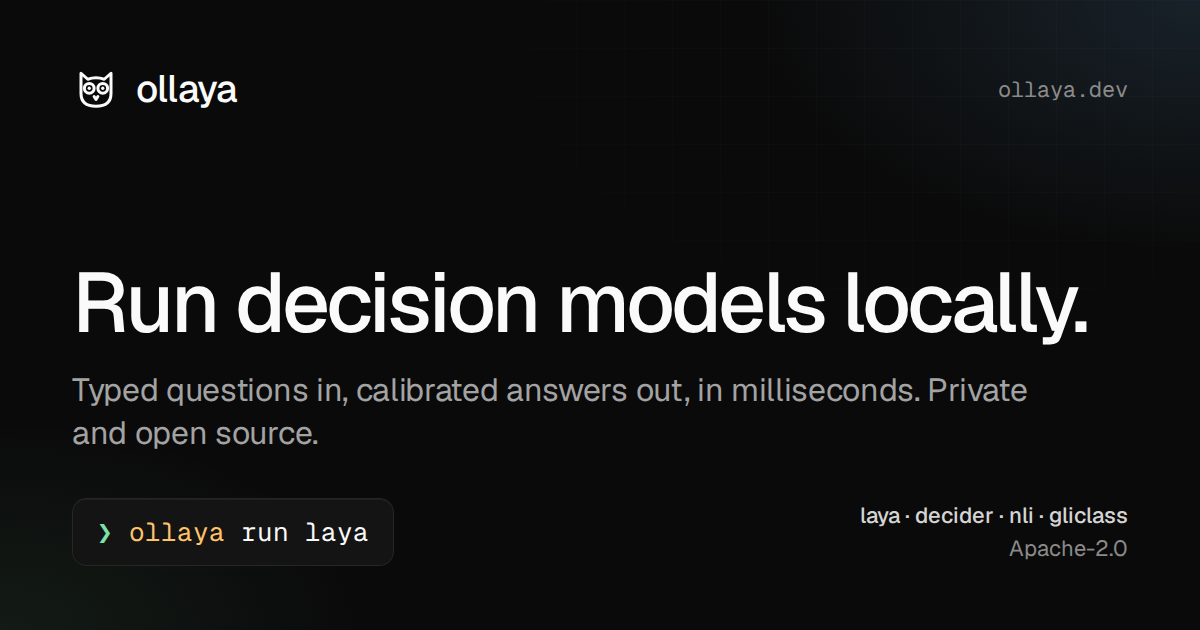
Introducing Ollaya: A New Paradigm for Decision Models
The landscape of decision modeling is often dominated by proprietary tools, limiting accessibility and customization for many organizations. Today marks the emergence of Ollaya, an ambitious open-source project aiming to democratize Jev-style decision models. Jev, known for its expressive power in capturing complex business logic and rules, has historically been confined to specific platforms. Ollaya seeks to break down these barriers, offering a robust, community-driven alternative.
At its core, Ollaya is designed to provide developers and business analysts with a flexible framework for defining, managing, and executing decision models. This approach moves away from opaque, black-box systems towards a more transparent and auditable method of codifying business rules. The project's philosophy centers on making sophisticated decision-making logic accessible, adaptable, and verifiable, fostering a more collaborative environment for rule development and maintenance.

Key Features and Design Philosophy
Ollaya's architecture is built around several key principles. Firstly, it champions an open-source ethos, meaning the entire codebase is available for inspection, modification, and contribution. This transparency is crucial for organizations dealing with regulated industries or those requiring a deep understanding of their decision logic. Unlike many commercial offerings, Ollaya allows users to understand precisely how decisions are being made, fostering trust and enabling easier debugging and auditing.
Secondly, the project embraces the Jev-style modeling approach. Jev, a domain-specific language, is renowned for its ability to represent complex decision tables, decision trees, and other rule structures in a human-readable yet machine-executable format. Ollaya provides an implementation that aims for high fidelity with Jev's core concepts while also introducing modern tooling and extensibility. This includes support for various input and output formats, integration with existing data sources, and the ability to define custom functions or logic extensions.
The project's design also prioritizes developer experience. This means providing clear documentation, comprehensive examples, and a well-defined API for programmatic interaction. The goal is to enable developers to embed Ollaya-powered decision engines directly into their applications, orchestrate complex decision workflows, and leverage the power of Jev-style modeling without the overhead of proprietary vendor lock-in. The maintainers have expressed a commitment to building a vibrant community, encouraging contributions and feedback to shape the project's future direction.
Why Jev-Style Models Matter
Decision models are fundamental to many business processes, from loan application approvals and insurance underwriting to fraud detection and personalized recommendations. The way these decisions are encoded directly impacts an organization's agility, fairness, and compliance. Jev-style models offer significant advantages in this domain:
- Expressiveness: They can capture intricate relationships and conditions that are difficult to represent in traditional code.
- Readability: The structured, often tabular, format makes rules understandable to business stakeholders, bridging the gap between IT and business units.
- Maintainability: Changes to business rules can often be made by updating the model rather than requiring code redeployment, leading to faster iteration cycles.
- Auditability: The explicit nature of decision models provides a clear trail for compliance and regulatory requirements.
Ollaya's arrival as an open-source Jev implementation directly addresses the need for these benefits without the associated costs or restrictions of commercial tools. It empowers smaller teams and organizations that might not have the budget for enterprise-grade decision management systems to adopt best practices in business rule management.
Community and Future Development
The success of any open-source project hinges on its community. The Ollaya team has laid the groundwork with a public repository, initial documentation, and a clear roadmap. Early discussions on platforms like Hacker News indicate a strong interest from developers familiar with decision modeling and those seeking more transparent alternatives. The project is actively seeking contributions in the form of code, documentation, bug reports, and feature requests.
Looking ahead, the roadmap includes enhancements to performance, expanded integration capabilities with popular programming languages and data platforms, and potentially the development of graphical modeling tools to further lower the barrier to entry. The long-term vision is to establish Ollaya as a de facto standard for open-source Jev-style decision modeling, fostering innovation and enabling organizations to build more intelligent, adaptable, and trustworthy systems.
What remains to be seen is how quickly the community will coalesce around Ollaya and what novel applications will emerge from its open and flexible nature. The potential for custom extensions and integrations means that organizations can tailor the decision modeling experience precisely to their unique needs, a level of freedom rarely found in the current market.