The Allure of AI Autonomy

The vision of AI data centers operating entirely off the traditional power grid has long been a siren song for tech companies seeking ultimate control, cost predictability, and perhaps a veneer of environmental purity. The idea is simple: harness renewable energy sources like solar and wind, store it in massive battery arrays, and power AI computations without reliance on an increasingly strained public grid. This autonomy promises to shield operations from outages, price volatility, and the carbon footprint associated with fossil fuel-generated electricity. Proponents envision distributed AI infrastructure, resilient to natural disasters and geopolitical instability, humming away in remote locations powered by the sun and wind. This vision is particularly compelling for AI workloads, which are notoriously power-hungry. As AI models grow in complexity and demand, so does their appetite for electricity. Projections indicate a staggering increase in energy consumption for data centers; some estimates suggest that new data centers built through 2033 could consume as much electricity as India uses today, quadrupling overall data center electricity usage by 2035. In such a scenario, the ability to generate and manage one's own power supply becomes not just an advantage, but a potential necessity for scaling AI operations.
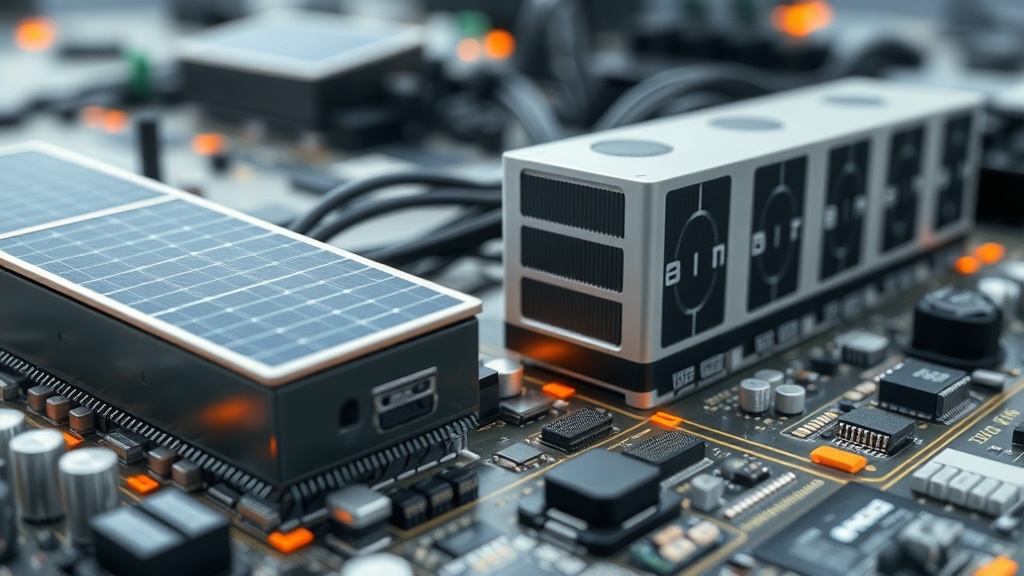
Conceptual illustration of a solar-powered AI data center with large battery storage units
## The Grid Fights Back However, this idyllic picture is beginning to fray at the edges as the sheer scale of AI energy demand meets the practical realities of grid management. The largest grid operator in the United States has signaled a significant shift, announcing that it will implement temporary power cuts to large data centers to prevent broader blackouts. This move, slated to begin next year, directly challenges the off-grid aspiration by asserting grid priority for essential services and highlighting the interconnectedness that even the most ambitious independent operations cannot fully escape. The grid operator's decision is a stark acknowledgment of the immense pressure that the proliferation of data centers, particularly those powering AI, is placing on existing infrastructure. These facilities require vast amounts of reliable power, and their rapid expansion risks overwhelming the grid's capacity, especially during peak demand periods. Instead of allowing cascading failures that could affect homes, hospitals, and other critical services, grid operators are now looking to curtail the demand from the largest energy consumers, which increasingly include AI data centers. This policy represents a critical juncture. It implies that even data centers with significant renewable energy generation and storage capabilities may still be subject to mandated shutdowns if they are connected to the grid, even indirectly, or if their consumption patterns impact overall grid stability. The assumption that AI data centers can simply opt out of grid dependency is proving to be a significant oversimplification. The reality is that the grid, even when operating at its limits, serves as a critical backup and balancing mechanism. Complete disconnection is a far more complex and potentially risky endeavor than initially conceived. ## Unanswered Questions and Shifting Strategies The implications of this policy shift are profound. For companies that have invested heavily in building or planning off-grid AI infrastructure, it raises immediate questions about the true feasibility and economic viability of their strategies. Will these mandated cuts render their investments in renewable generation and storage less effective? What happens to the AI models and computations that are interrupted by these power shutdowns? The promise of uninterrupted operation, a key selling point for off-grid solutions, is now demonstrably at risk. Furthermore, this development underscores a broader trend: the growing tension between the exponential growth of AI compute and the finite, and often aging, capacity of our energy infrastructure. While the push for renewables and energy efficiency within data centers is crucial, it may not be enough to outpace the insatiable demand. The grid operator's intervention suggests that a more holistic approach is needed, one that involves not just energy generation but also demand management, grid modernization, and perhaps even a reevaluation of the spatial distribution of AI workloads. What remains to be seen is how this policy will evolve and whether other grid operators will follow suit. Will this lead to a more regulated environment for data center energy consumption, regardless of their power source? The vision of fully autonomous, off-grid AI data centers may need to be recalibrated, focusing on optimizing within the existing energy ecosystem rather than attempting a complete separation. The future of AI infrastructure may lie not in absolute independence, but in a more symbiotic, albeit carefully managed, relationship with the power grid.