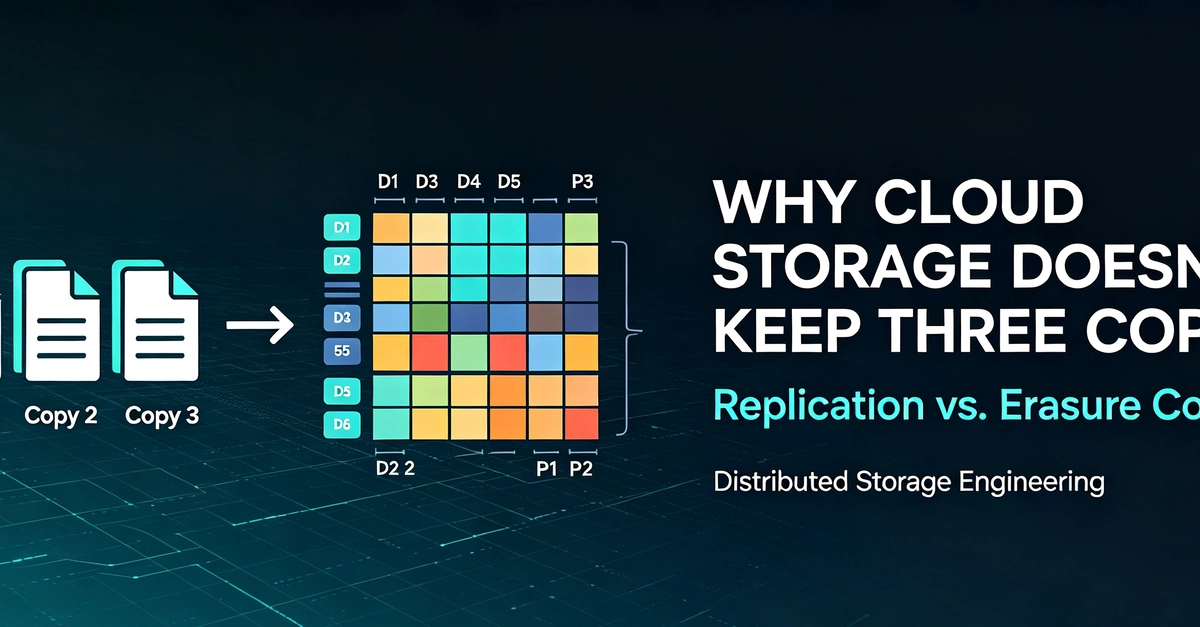
The Cost of Three Copies at Scale
The intuitive approach to ensuring data durability and availability in storage systems has long been replication. For many years, if you needed a system to withstand failures and keep your data safe, the answer was simple: keep multiple copies. The common wisdom suggested three copies for good durability and availability. This method is straightforward to implement and understand. However, as data volumes exploded, particularly in the realm of object storage handling petabytes of information, the financial implications of this simple strategy became untenable. Storing 10 petabytes (PB) of data using a three-way replication model means provisioning 30 PB of raw storage capacity. This isn't just a technical challenge; it's a significant financial burden. The cost of disks, racks, power, cooling, and networking for that much redundant data quickly escalates into millions of dollars at cloud scale. Storage engineers were forced to seek more economical solutions.
This economic pressure prompted a fundamental shift in thinking. Instead of asking 'how many copies do we need?', the question became 'how can we achieve the same or better durability with less overhead?'. The answer lies in a more advanced technique: erasure coding.
Erasure Coding: Smarter Redundancy
Erasure coding is a method of data protection that offers a more efficient way to achieve durability compared to simple replication. Instead of storing identical copies of data, erasure coding breaks data into fragments and encodes them with redundant parity fragments. These fragments are then distributed across different storage devices or nodes. The key advantage is that the original data can be reconstructed from a subset of these fragments, even if some are lost.
Think of it like a highly resilient recipe. You don't just make three identical batches of the cake. Instead, you might separate the ingredients (data) and add some 'binding agents' (parity). You can then bake several small cakes (fragments), and if one or two small cakes go missing, you still have enough information from the remaining pieces to bake a perfect replica of the original. The number of fragments and parity pieces can be precisely tuned to meet specific durability and availability targets while minimizing storage overhead.
For example, a common erasure coding scheme is Reed-Solomon coding. A configuration like 10+4 means that 10 data fragments are encoded with 4 parity fragments. This creates a total of 14 fragments. The system can tolerate the loss of any 4 fragments (data or parity) and still reconstruct the original data. In this scenario, the storage overhead is only 40% (14 fragments total / 10 data fragments), compared to the 200% overhead of three-way replication (3 copies total / 1 data copy). This dramatic reduction in storage footprint translates directly into significant cost savings for large-scale deployments.
Trade-offs and Complexity
While erasure coding offers superior storage efficiency, it introduces its own set of complexities and trade-offs. The encoding and decoding processes are computationally more intensive than simple replication. This means that CPU resources are required to generate the parity fragments when data is written and to reconstruct data when fragments are lost or read. For systems with extremely high ingest rates or very low latency requirements, this computational overhead can be a factor.
Furthermore, the recovery process when a drive or node fails can be more complex. Instead of simply copying data from one replica to another, the system must read fragments from multiple surviving locations, reconstruct the missing data, and then re-encode it to create new fragments. This 'rebuild' process can place a significant load on the network and remaining storage nodes during a failure event.
Despite these challenges, the economic imperative at scale is undeniable. Modern object storage systems, like those offered by major cloud providers and specialized storage vendors, overwhelmingly rely on erasure coding variants. They carefully balance the computational cost against the massive savings in raw storage capacity. The specific erasure coding schemes (e.g., k+m, where k is data chunks and m is parity chunks) are often proprietary and tuned to the specific hardware and workload characteristics of the platform.
The Future of Object Storage Durability
The evolution from simple replication to sophisticated erasure coding represents a critical maturation of object storage technology. It highlights a trend where extreme scale forces innovation to optimize for economic efficiency as much as technical performance. While simple replication might persist for smaller deployments or specific use cases requiring extreme simplicity, erasure coding has become the de facto standard for large-scale, cost-sensitive object storage. This shift allows organizations to manage vast datasets more sustainably and affordably, enabling the continued growth of data-intensive applications and services.
What remains to be seen is how further advancements in hardware, such as persistent memory or novel networking technologies, might influence the optimal balance between replication and erasure coding in the future. For now, erasure coding is the engine driving durable, cost-effective object storage at scale.