Intelligent Routing for AI Workloads
The escalating cost and latency associated with deploying large language models (LLMs) and other AI systems present a significant challenge for businesses. As demand for AI services grows, organizations often find themselves sending every query, regardless of complexity, to their most powerful and expensive models. This approach is inefficient and unsustainable. NVIDIA has introduced Switchyard, an open-source routing library designed to address this problem by enabling intelligent routing of AI requests.
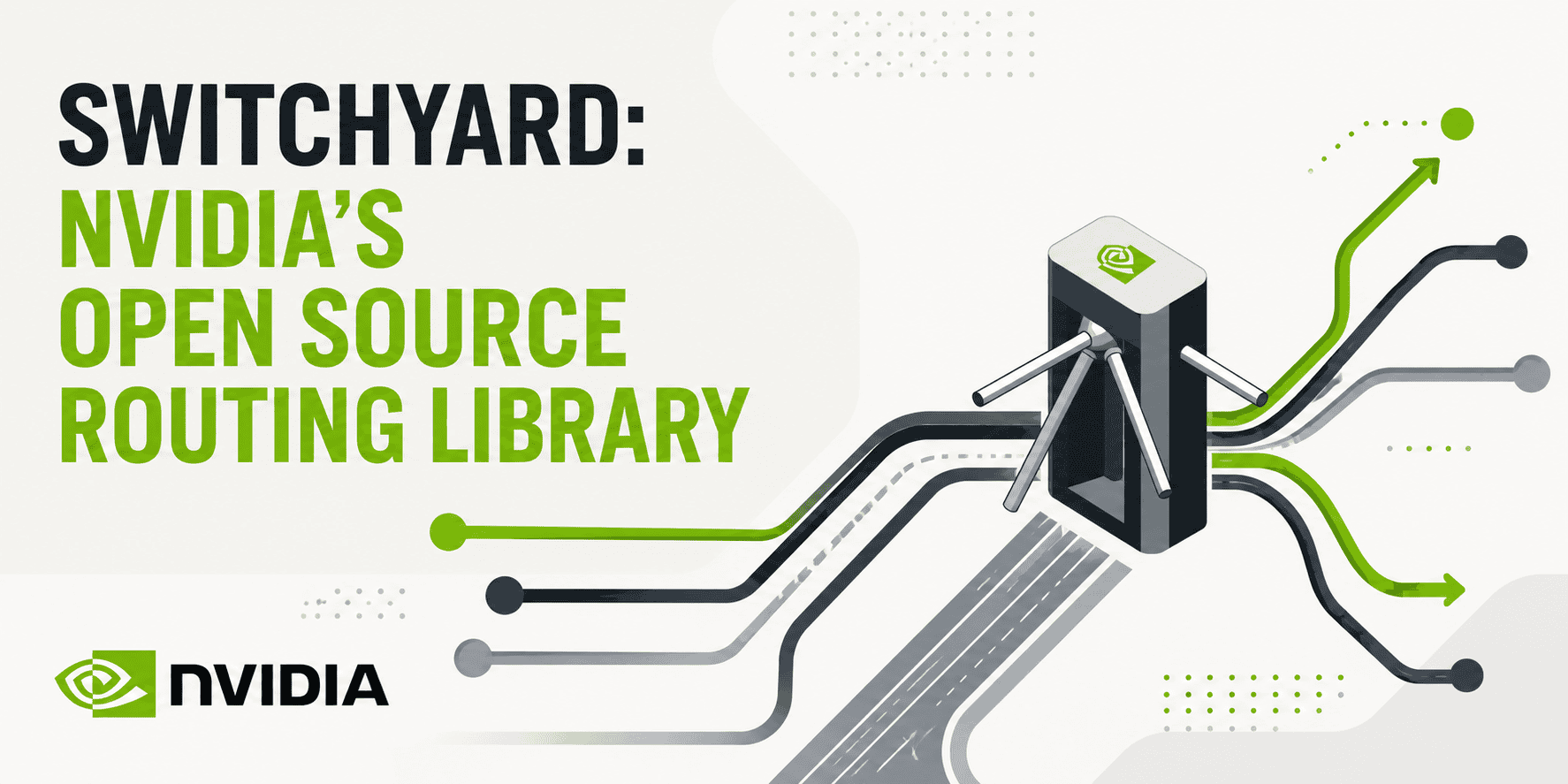
Switchyard acts as a sophisticated traffic manager for AI models. Instead of a one-size-fits-all approach, it analyzes incoming requests and directs them to the most appropriate model based on factors like cost, latency requirements, and desired quality. This means simpler queries might be handled by smaller, faster, and cheaper models, while complex requests are escalated to larger, more capable, but also more expensive ones. The goal is to achieve a balance, reducing operational expenses and improving response times without a significant degradation in output quality.
The library is built with a focus on flexibility and ease of integration. Developers can define custom routing logic, allowing them to tailor the system to their specific AI deployment architecture and business needs. This programmability is key to unlocking the full potential of multi-model AI systems. It moves beyond simple load balancing to true intelligent dispatching, where the system understands the capabilities and costs associated with each available model.
How Switchyard Optimizes AI Deployments
At its core, Switchyard enables a tiered approach to AI model serving. Imagine a system where a user asks a question. Switchyard first assesses the query. Is it a straightforward factual lookup, or does it require nuanced reasoning and creative generation? Based on this assessment, it decides which model is best suited. For instance, a request like "What is the capital of France?" could be easily handled by a small, highly optimized model. In contrast, a request like "Write a sonnet about the future of AI" would necessitate a larger, more sophisticated generative model.
This intelligent dispatching offers several tangible benefits:
- Cost Reduction: Smaller models are cheaper to run, requiring less computational power and memory. By offloading a significant portion of traffic to these models, overall operational costs can be drastically reduced.
- Latency Improvement: Smaller models generally respond much faster than their larger counterparts. Directing simpler queries to them immediately lowers the average response time for users, improving the overall user experience.
- Resource Optimization: Expensive, high-performance GPUs can be reserved for the tasks that truly require them. This leads to better utilization of valuable hardware resources.
- Scalability: By distributing the workload across different model sizes, the system can scale more efficiently to handle fluctuating demand.
The library integrates with existing AI inference frameworks and serving solutions, making it a practical addition to current infrastructure. It is designed to be a middleware component, sitting between the application interface and the deployed AI models. This strategic placement allows it to intercept and manage all incoming requests before they reach any specific model endpoint.
Technical Implementation and Flexibility
Switchyard's architecture is designed for performance and extensibility. It leverages NVIDIA's expertise in high-performance computing to ensure that the routing decisions themselves do not become a bottleneck. The library supports various routing strategies, which developers can implement through Python code. This allows for fine-grained control over how requests are evaluated and dispatched.
For example, a developer might implement a strategy that uses a small, fast classifier model to categorize incoming requests. The output of this classifier then informs which downstream LLM receives the request. Alternatively, routing could be based on predefined rules, user-defined metadata, or even real-time performance metrics of the models themselves. The library is open-source, meaning the community can contribute to its development, suggest new features, and adapt it to emerging use cases.
The integration with NVIDIA's broader AI ecosystem is also a key aspect. While Switchyard is a standalone library, it is designed to work seamlessly with NVIDIA's Triton Inference Server and other AI development tools. This synergy allows for a more cohesive and optimized AI deployment pipeline. The ability to define complex routing graphs, potentially involving multiple hops or conditional logic, further enhances its utility for sophisticated AI applications.
The Future of AI Model Serving
The introduction of Switchyard signals a maturing phase in AI model deployment. As the field moves beyond simply training massive models to efficiently serving them in production, tools that optimize cost, latency, and resource utilization become critical. This is particularly true for generative AI applications, which are often computationally intensive and expensive to run at scale.
By abstracting the complexity of managing multiple models, Switchyard empowers developers and operations teams to build more economical and responsive AI-powered products. The open-source nature of the project encourages widespread adoption and community-driven innovation, which is essential for keeping pace with the rapid advancements in AI technology. If you run a team that deploys AI models, understanding how intelligent routing can benefit your operations is no longer optional—it's a necessity for staying competitive and cost-effective.